
France wants manufacturers to hand over the 3D printing files of spare parts they no longer sell. A draft decree, notified to the European Commission as 2026/0274/FR, would give manufacturers and importers 15 working days to send a repairer the print file for an unavailable part, including the material used, from 1 January 2027. The EU review period ended on 3 September 2026, and the debate about what it means for design rights is now under way, with a guest post on the IP blog IPKat on 10 October 2026.
As far as we could find on 26 October 2026, the decree has not been published in the Journal officiel, and its wording may still change. The rule comes from France's 2020 anti-waste law (AGEC), which already says that when a spare part is no longer on the market and can be 3D printed, the manufacturer must supply the plan to make it. The missing piece was a decree listing which products are covered and how fast files must be sent. The draft now does both.
For SOLIDWORKS teams, this is not an abstract repair debate. The "plan" a repairer will ask for is a file that someone in your engineering department made, probably in SOLIDWORKS, and probably never prepared for outsiders. The covered products include furniture, lighting, DIY and garden tools, sports goods, e-bikes and cars, many of them designed by small manufacturers. Here is what the draft says, where your IP stands and what to prepare now.
TL;DR: your part files may become repair documents
Under France's draft decree 2026/0274/FR, manufacturers and importers of 15 product categories would have to give professional sellers, refurbishers and repairers the 3D printing plan of an unavailable spare part in a standard file format within 15 working days, including the original material, or technical specifications within 20 working days. It would apply from 1 January 2027 to models placed on the market from that date, even if the model was launched earlier. The obligation is subject to IP rights and does not apply where a printed part would not be safe. For SOLIDWORKS teams: know which parts are in scope, decide your IP position per part, prepare clean export files and keep dated proof of what you designed.
What does France's draft spare parts decree require?
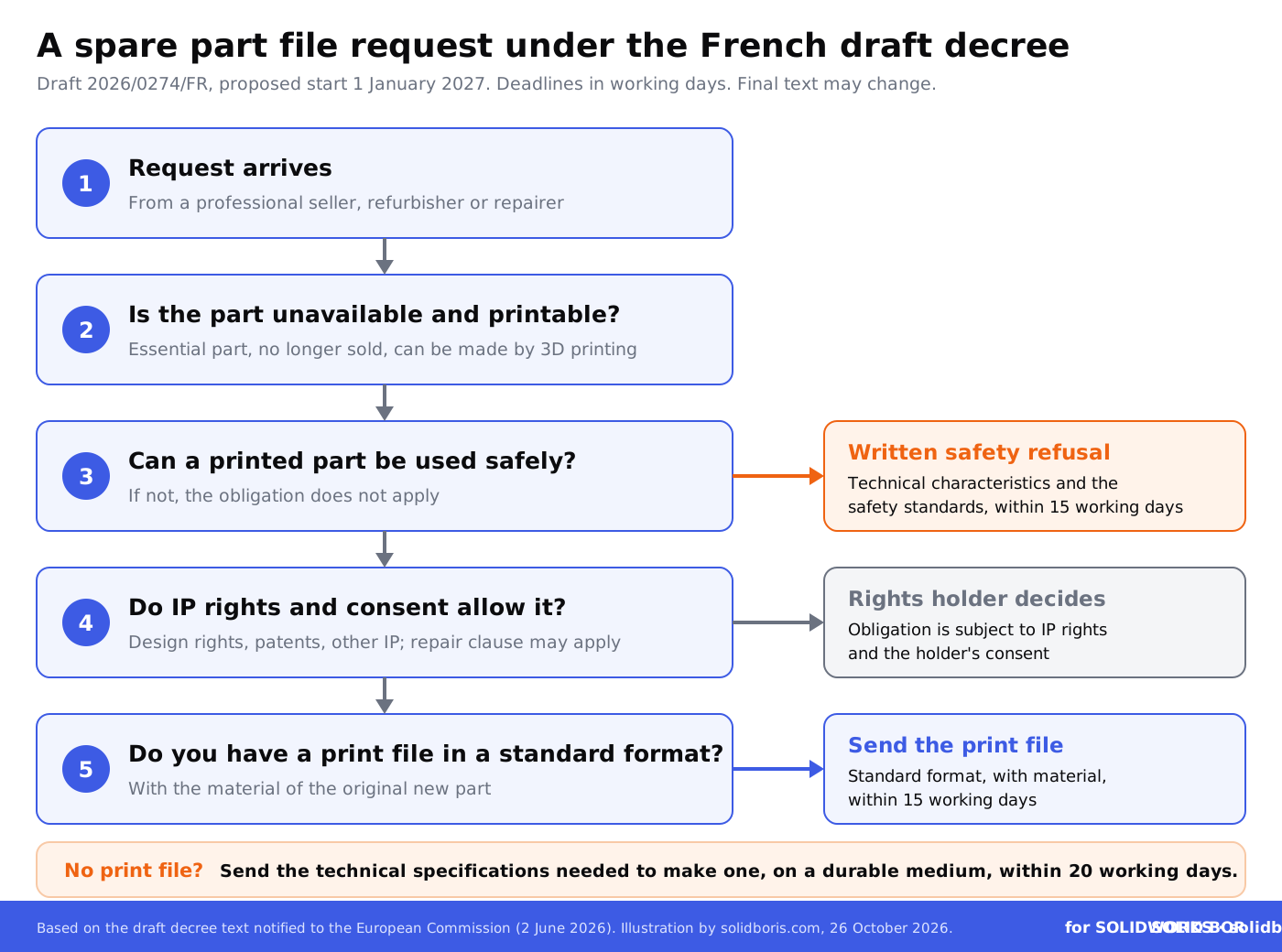
The French government notified the draft to the European Commission on 2 June 2026 under the EU's technical rules procedure. The notification, published in the TRIS database, includes the four-page draft text. It adds two articles to the French Consumer Code. The first lists the product categories. The second sets the conditions:
- When it applies: a spare part that is essential to use the product is no longer available on the market, and it can be made by 3D printing.
- Who can ask: professional sellers, refurbishers and repairers. The text does not give consumers a direct right to request files.
- What they get: if the manufacturer or importer has one, the 3D printing manufacturing plan of the part "in a standard computer format", within 15 working days.
- If no such file exists: the technical specifications needed to create the plan, on a durable medium, within 20 working days.
- What the file must contain: enough technical specifications to print the complete part, and in particular the type or types of material the manufacturer used for the original new part.
- IP reservation: the obligation is subject to intellectual property rights, and in particular to the consent of the rights holder, with a reference to the design rights chapter of the French Intellectual Property Code.
- Safety exception: the obligation does not apply when a 3D-printed part cannot be used safely. The manufacturer must then explain in writing, within 15 working days, the technical characteristics of the part and the safety standards that justify the refusal.
- Timing: entry into force on 1 January 2027, for product models placed on the market from that date, including models whose first unit was sold before.
Two details are still open. The draft does not define "standard computer format": STEP, STL and 3MF are obvious candidates, but none is named. And it says nothing about price: it neither requires the files to be free nor sets a fee.
Which products are covered?
The draft lists 15 categories. Several are typical SOLIDWORKS territory: products with moulded, machined or sheet metal parts that wear out or break.
If you design these products for a brand that sells in France, the request will go to the manufacturer or importer, not to you. But the brand will turn to whoever holds the SOLIDWORKS model. That makes your supplier contracts as important as the decree itself. Our guides to contract clauses for CAD IP protection and licensing agreements for CAD designs explain how to settle who owns and who may hand over which files.
Can manufacturers refuse because of IP?
This is the question that IPKat's guest post on 3D-printed spare parts looks at, and the answer is: sometimes, but not as simply as many manufacturers hope. The draft makes the obligation subject to IP rights and to the rights holder's consent, and it points to the French rules on registered designs. Several separate rights can be involved:
- Registered designs. Since 1 May 2025, the reformed EU design regulation lets a design holder stop others from creating, downloading, copying and sharing a file that records the design in order to make the product. But EU design law also has a repair clause: protection does not cover a component used only to repair a complex product and restore its original appearance. The new EU design directive, due to be applied by 9 December 2027, extends this clause to national designs.
- Copyright. A CAD file can sometimes be protected by copyright, but only after a case-by-case assessment, as the IPKat author notes.
- Trade secrets. Part data can be a trade secret. But the EU Trade Secrets Directive allows disclosure where EU or national law requires it, and a decree is such a law.
- Patents. A patent can protect the technical solution in a part. The decree does not override it.
The IPKat author also makes a useful distinction: getting access to a file and having the right to use it are two separate questions. A repairer who receives your print file does not automatically get the right to sell copies of the part. Our overviews of IP rights for CAD designs, copyright, patents and trademarks for 3D models and industrial design protection for CAD explain each route in more detail.
There is also an EU layer above the French rule. The EU Right to Repair Directive, which member states had to transpose by 31 July 2026, says manufacturers must not stop independent repairers from using original, second-hand, compatible or 3D-printed spare parts, as long as those parts comply with EU or national law, such as product safety and IP rules. France goes a step further by requiring the file itself.
Keep dated proof of every SOLIDWORKS part you release.
BORIS for SOLIDWORKS registers your parts, assemblies and drawings with a blockchain timestamp and a certificate of ownership, right from SOLIDWORKS, so you can show what you designed and when, even after files leave your company.
👉 See how BORIS for SOLIDWORKS works
Who opposes the decree, and why?
The TRIS file shows a divided reaction. Industry groups asked the Commission to reject or change the draft: the French digital industry alliance AFNUM (9 July), the home appliance association APPLiA (22 July), DIGITALEUROPE (2 September), LightingEurope and a group of Japanese electronics associations (3 September). FICIME and Video Games Europe with SELL also sent contributions. The French anti-obsolescence group HOP supports the decree.
According to the French news site Next, AFNUM argues that no 3D printing repairer has the certifications needed for digital products. APPLiA argues that CAD data cannot control the material of a part printed by someone else, a problem for parts that touch food, and that justifying safety refusals would be a heavy burden.
The standstill period ended on 3 September 2026 with no detailed opinion listed in the TRIS file, so France may now adopt the decree. Until it is published, treat the deadlines and product list as a draft.
What should SOLIDWORKS teams prepare now?
Even if the final text changes, this work pays off for any right to repair rule. Start with the products you or your customers sell in France.
- Map the parts in scope. List the models you plan to place on the French market from 1 January 2027, and flag the spare parts that wear, break or get lost. Note which could realistically be printed.
- Decide your IP position per part. Which parts have registered designs, patents or real trade secrets, and which are plain functional parts? The repair clause and the trade secret exception mean that a blanket "no" is unlikely to hold.
- Mark safety-critical parts now. For guards, load-bearing parts, battery housings and food-contact parts, write down the safety standard or reason a printed copy would not be safe. The draft gives you only 15 working days to explain a refusal in writing.
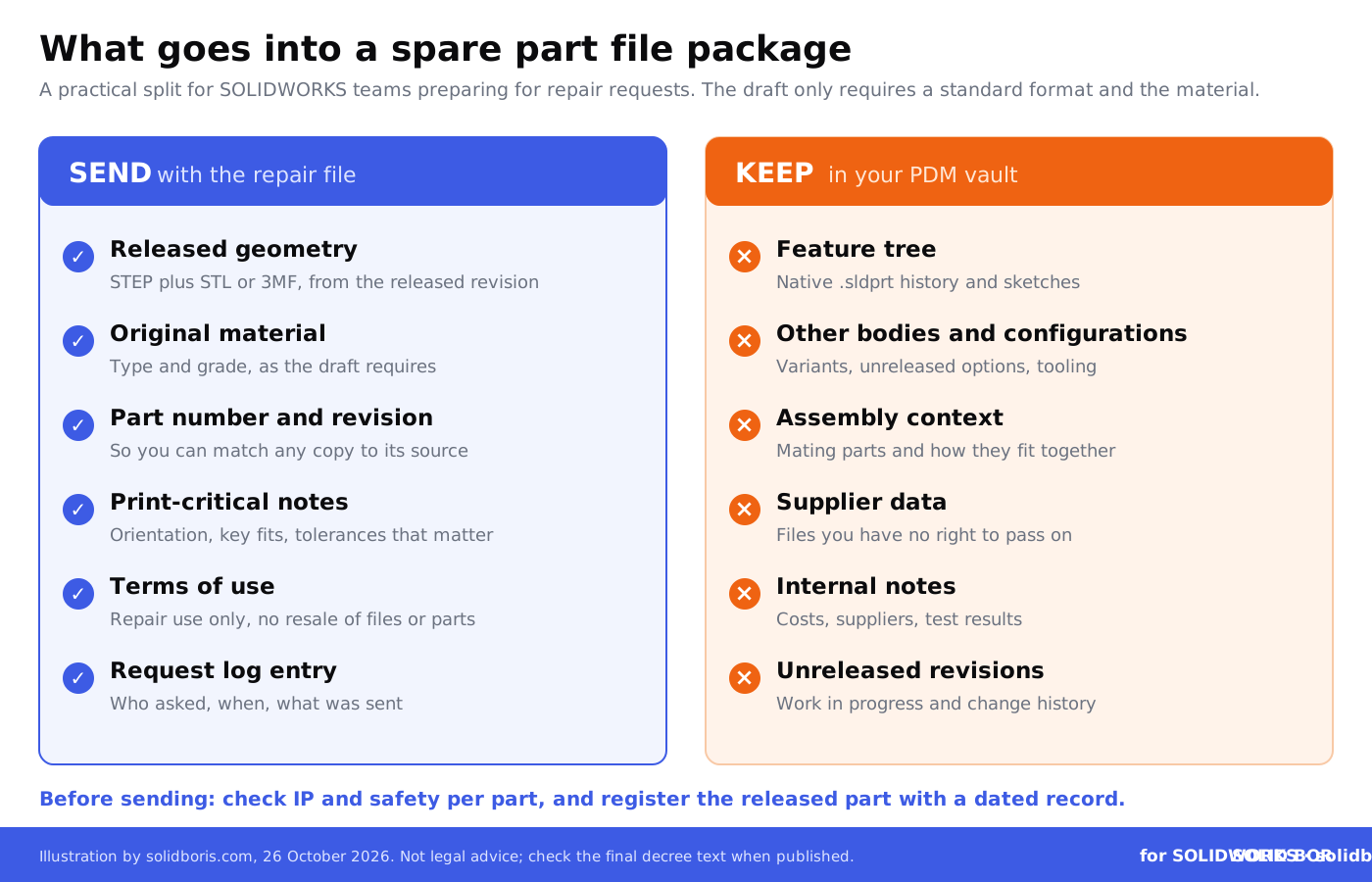
- Prepare clean export files. Agree on a standard format, such as STEP for geometry plus STL or 3MF for printing, and export from the released revision only. Remove internal features, other bodies and configuration data that are not needed. Our article on neutral CAD format risks explains what each format exposes.
- Record the material. The draft requires the original material type in the file. Make sure the material is set in the SOLIDWORKS part and written into the documentation that goes with the export.
- Set up a request log. Record who asked, when, for which part and revision, what you sent and on what terms. This is your evidence if a copy is later sold beyond repair use. See how to share CAD files without exposing IP.
- Check supplier contracts. If a supplier designed the part, does your contract let you hand its file to third-party repairers? Our coverage of the Ford v. InterMotive supplier trade secret appeal shows how expensive unclear supplier terms can become.
- Register what is yours before it leaves. Give each released part an independent, dated record. Our guide to blockchain timestamping for IP explains why a timestamp outside your own systems helps when copies circulate.
Why does dated proof matter more once files are shared?
Under the French draft, files for some parts would leave your company by law, to repairers you do not choose, and some may pass them on. If a copy of your part, or a slightly changed version of it, later shows up in someone else's product, you will need to show what your original looked like and when you made it. Watermarks help you trace a leak, as explained in our guide to digital watermarking for CAD designs, but they do not prove the date of creation.
That is where documented ownership comes in. Our guides on how to prove authorship of CAD designs and CAD ownership documentation cover the records that hold up best.
How does this fit the bigger picture for CAD users?
Across our network this week, one question keeps coming up: who controls your files once they leave, and what can you prove later?
- Timing of claims. On CADChain, read how the Insulet v. EOFlow trade secret verdict over Omnipod CAD files was reversed because the claim was filed too late, and why departures, logs and dated proof matter.
- Files sent for quotes. BORIS Inventor looks at CloudNC's AI quoting agent that reads RFQ emails and CAD files, and at the licence its terms give the vendor over the data shops upload.
- Opt-outs and licences. Blended BORIS covers Australia's debate on an AI training opt-out, where no decision has been made yet and creators are told to keep licences and dated evidence in order.
Conclusion
France's draft decree turns a 2020 principle into concrete deadlines: 15 working days for a print file with the original material, 20 working days for specifications, and a written reason for any safety refusal. If adopted as drafted, it applies from 1 January 2027 to a wide list of products, many of them designed in SOLIDWORKS by small teams.
IP rights still count, but design rights have a repair clause and trade secrets yield to legal duties, so prepare rather than plan to refuse. Map your parts, prepare clean files with the material stated, log every request and keep dated proof of what you designed.
Make your SOLIDWORKS designs provably yours.
BORIS for SOLIDWORKS adds blockchain timestamps and certificates of ownership to your CAD files, so you have independent, dated proof of your designs, wherever copies end up.
👉 Get BORIS for SOLIDWORKS
FAQ: France's 3D-printed spare parts decree and SOLIDWORKS files
Is the French 3D spare parts decree already in force?
No. It is a draft, notified to the European Commission on 2 June 2026 as 2026/0274/FR. The EU standstill period ended on 3 September 2026. We found no publication in the Journal officiel as of 26 October 2026. The draft sets entry into force on 1 January 2027.
Who can request a 3D printing file under the draft?
Professional sellers, refurbishers and repairers. The draft does not give consumers a direct right to request files, but consumers can go through a repairer.
How fast must a manufacturer respond?
Within 15 working days for an existing 3D printing plan in a standard format, or within 20 working days for the technical specifications if no such file exists. A written safety refusal must also be sent within 15 working days.
Which file format is required?
The draft only says "a standard computer format" and does not name one. STEP, STL and 3MF are common choices. The file must allow the complete part to be printed and must state the original material.
Can a manufacturer refuse because the part is protected?
The obligation is subject to IP rights and the rights holder's consent. But EU design law has a repair clause for parts that restore a product's original appearance, and trade secret law allows disclosure when the law requires it, so refusals need a real legal basis per part.
How can I prove a printed copy came from my design?
Keep your PDM history, log every file you send, and register released parts with an independent, dated record. BORIS for SOLIDWORKS adds a blockchain timestamp and a certificate of ownership to each registered file.