
TL;DR: Blockchain CAD Protection Case Studies and Success Stories
Blockchain helps safeguard CAD designs by providing tamper-evident, dated ownership records of each registered file version, while PDM and secure sharing control who can open the files. From limiting file leaks in remote teams to strengthening evidence in legal disputes, the scenarios below show where it helps and where it does not. For SMEs, startups, and manufacturers using platforms like SolidWorks, blockchain builds trust and reduces risks.
💡 Curious about securing your own CAD files? Explore practical examples and solutions in this in-depth guide.
Blockchain CAD Protection Case Studies and Success Stories
How can blockchain provide a game-changing solution for intellectual property protection in the CAD design industry? Over the past decade, blockchain technology has become a practical way to create tamper-evident, dated proof of ownership, particularly for intellectual property. For SolidWorks users operating in manufacturing, engineering, and startups, the application of blockchain has translated into new opportunities for documenting intellectual assets and deterring theft or unauthorized sharing. This article walks through typical scenarios and one published court case that show what blockchain solutions can and cannot do for CAD protection.
Note: the SME, startup and supplier examples below are composite scenarios based on situations SOLIDWORKS teams commonly describe; they are not named client cases. The legal section refers to real, published decisions and laws.
Why Blockchain Matters for CAD File Protection
The problem of CAD file leaks, unauthorized modifications, or disputes over ownership continues to affect industries worldwide, and SMEs that share CAD data with many partners are especially exposed (see IP theft in the CAD industry). Blockchain has emerged as a useful tool for these challenges because it offers tamper-evident ownership records on a distributed ledger. According to Violetta Bonenkamp, co-founder of CADChain, "Blockchain isn't just about better security; it's about fundamentally changing how engineers and companies assert their legal rights to creative output."
Case Study: Preventing CAD File Leaks in Remote Teams
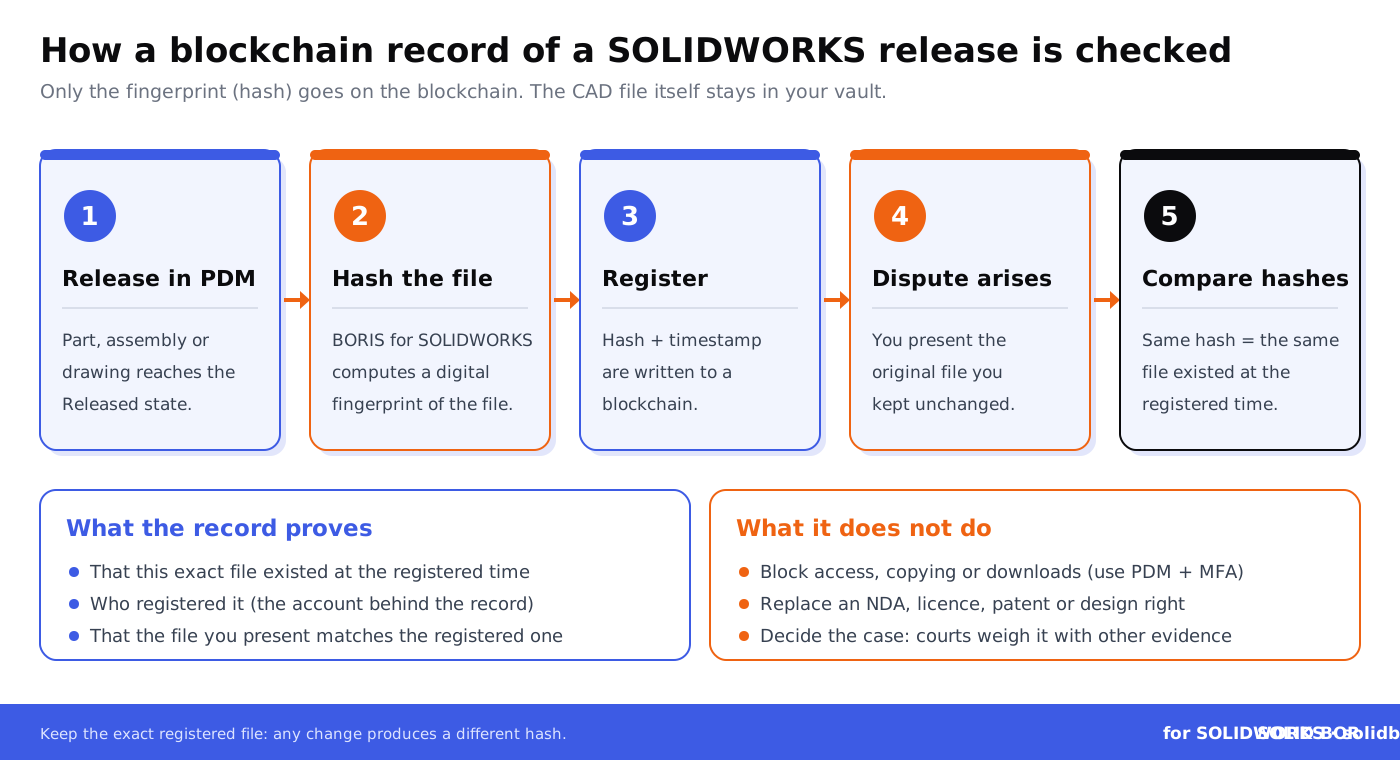
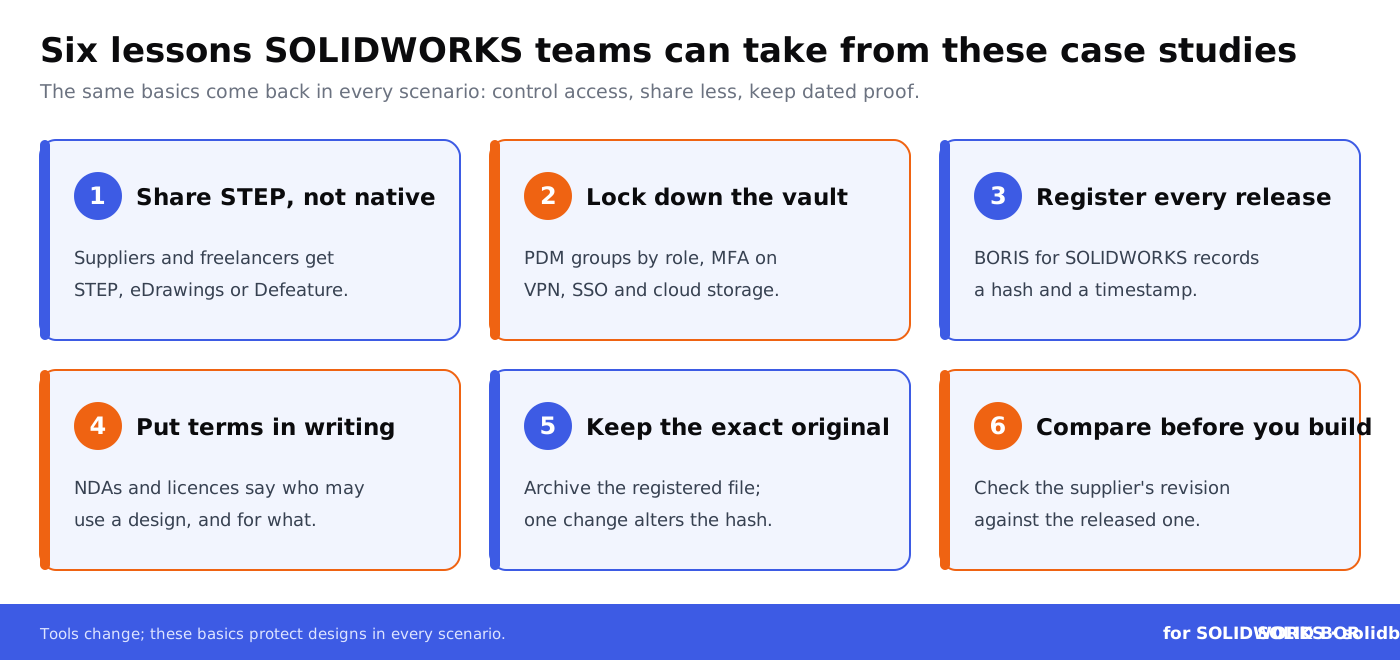
Consider a SolidWorks-using SME specializing in aerospace engineering whose CAD data was exposed through outsourced remote teams. Blockchain on its own cannot lock files, so the fix has two parts: access control and proof. Collaborators get time-limited access through PDM permissions or expiring share links, and receive STEP or eDrawings files instead of native parts where possible. Each released version is registered with BORIS for SOLIDWORKS, so the company can show which version was its own and when it existed. Clear, dated ownership records make disputes with remote contractors easier to settle and build supplier trust. Read how to protect SolidWorks files in remote work environments.
Legal Validation: Blockchain Evidence in IP Disputes
Courts have already accepted blockchain records as evidence. In June 2018 the Hangzhou Internet Court in China accepted blockchain-stored evidence in a copyright infringement case (Huatai Yimei v. Daotong Technology), and in September 2018 China's Supreme People's Court confirmed that internet courts may accept such evidence when its authenticity can be verified. In the United States, Vermont law (12 V.S.A. § 1913, 2016) sets out how blockchain records can be authenticated, and Italy gave blockchain timestamps the legal effect of an electronic time stamp in 2019. These decisions concern web pages and documents rather than CAD files, but the principle is the same: the court checks that the hash of the file you present matches the registered record and weighs it alongside contracts, PDM history and witnesses. Read more about blockchain records as legal evidence.
"Blockchain's ability to create tamper-proof records changes the dynamics of IP protection for designers and engineers."
Dirk-Jan Bonenkamp, CLO, CADChain
Boosting Trust in Supplier Contracts
Picture an SME using SolidWorks that works with international suppliers in automotive part manufacturing, where mistrust and data leakage become an issue. Blockchain does not enforce contracts or NDAs by itself, but it changes what both sides can prove. The company registers each CAD file it sends, shares only what the supplier needs, and refers to the registered hashes in its NDAs and licensing agreements. If a design turns up where it should not, the dated record shows which version was shared and when, which supports the contract claim. This approach strengthens relationships with external partners and discourages unauthorized distribution. Learn more about their success story here and our best practices for sharing CAD files with suppliers.
A Startup's Journey Toward Building an IP Portfolio
Startups often struggle to prove their CAD file ownership in the global competitive landscape. Take a European startup working on green-energy technology that protects its CAD files from the first sketch. With BORIS for SOLIDWORKS, each file version is registered with a hash and timestamp, creating a dated record of what the team designed and when. Combined with employment and contractor agreements that assign IP to the company, this gives investors clear evidence during due diligence. Discover their strategy here.
Want to protect your CAD designs effectively?
BORIS for SOLIDWORKS registers a hash and timestamp of each design version from inside SOLIDWORKS, so you can show which version you created and when.
👉 Learn more about BORIS for SOLIDWORKS
SME Success Story: Cost-Effective CAD IP Security
Think of a mid-sized European SME that adds BORIS for SOLIDWORKS to its SolidWorks workflow as a low-budget approach to CAD protection. By registering each released file before it goes to a vendor, and keeping PDM history for every change, the company builds an audit trail for files shared across multiple vendors. During customer audits it can show which version went to which partner and when, which helps protect its reputation. Compare the costs in our cost-benefit analysis of blockchain CAD security.
"Cost-effective solutions aren't just feasible for SMEs; they're essential for surviving in competitive global markets."
Violetta Bonenkamp, Co-founder, CADChain
Automotive Supplier Case Study: Reinventing CAD File Security
Imagine an automotive parts supplier where unauthorized CAD revisions keep delaying contracts. Registering every released revision with BORIS for SOLIDWORKS gives both sides a reference: before production, the supplier compares the hash of the file it received with the registered hash of the released revision. A match confirms it is building from the approved version; a mismatch shows the file was changed. This reduces revision conflicts and partner disputes. See the automotive industry CAD protection requirements.
Case Studies Compared: What Blockchain Adds
Common Mistakes in CAD File Protection
Engineers and SMEs frequently overlook file protection measures, leading to unintended IP leaks. Common mistakes include ignoring version control, underestimating encryption needs, and relying solely on NDAs. Without tools like BORIS for SOLIDWORKS and well-configured PDM permissions, it is hard to show later which file was yours. Proactive auditing and blockchain registration are important steps in modern CAD workflows.
- Mistake #1: Relying entirely on contractual agreements for file security (see NDA limitations).
- Mistake #2: Sharing CAD files without retaining dated proof of ownership.
- Mistake #3: Neglecting tracking features that record file interactions, such as PDM history.
How Blockchain Transforms the Future of CAD Protection
As industries increasingly adopt 3D printing and collaborative manufacturing, demands for file-level security will continue to rise. Blockchain tools that work alongside platforms like SolidWorks offer tamper-evident, dated proof of ownership, and smart contracts can record licensing terms, which eases compliance work. Dirk-Jan Bonenkamp notes, "Blockchain empowers designers not just to create, but to protect innovatively."
Boost your IP protection today!
Register your SOLIDWORKS designs with BORIS for SOLIDWORKS to keep dated proof of ownership.
👉 Start Now
Conclusion: The Path Forward
These case studies and scenarios show the real advantages blockchain offers for CAD file protection, particularly through tools like BORIS for SOLIDWORKS. Whether you're an SME aiming for budget-friendly solutions or a startup building an IP portfolio for investors, blockchain-backed records complement traditional workflows while reducing risks.
By transitioning to systems that balance security with usability, SolidWorks users not only safeguard their files but also enhance collaboration and trust. To explore more detailed approaches, dive into our extensive guide on Blockchain Technology for CAD and IP Protection.
People Also Ask:
What are the 4 types of blockchain?
The four commonly acknowledged types of blockchain are public, private, consortium, and hybrid. Public blockchains, like Bitcoin, are open and decentralized. Private blockchains are restricted to invited participants and offer centralized control. Consortium blockchains involve collaboration among organizations. Hybrid blockchains combine public and private elements, catering to varied specific needs in sectors like finance and supply chains.
Does Coca-Cola use blockchain?
Coca-Cola bottlers in North America employ a blockchain solution based on Hyperledger Fabric. This system helps manage components of their internal supply chains effectively. Introduced for logistics improvements, the bottlers have observed advancements in operational efficiency within their networks, solidifying blockchain's role in large-scale corporate systems.
What is the biggest problem in blockchain?
Challenges include energy consumption due to mining, scalability concerns for processing multiple transactions, and issues with storage as blockchains grow. Legal complications and regulatory uncertainties add complexity, and the irreversibility of blockchain transactions can be problematic if errors occur. Ensuring environmental and technical sustainability is a prominent focus moving forward.
Is blockchain technology widely adopted?
Blockchain technology is being adopted in sectors such as digital finance, non-fungible tokens (NFTs), supply chain management, and even video gaming. While certain industries have embraced it more fully, others are exploring its potential as infrastructure evolves and democratization of its use continues.
How is blockchain applied in CAD protection?
Blockchain in CAD protection helps document intellectual property and check data integrity. Organizations apply it for timestamping designs, recording registered versions, and enabling verifiable authenticity across collaborative networks. This makes unauthorized modifications detectable and fosters trust in creative and industrial design processes. Read about digital fingerprints and hash functions.
What industries benefit most from blockchain technology?
Industries like supply chain management, healthcare, banking, gaming, and renewable energy have leveraged blockchain to improve transparency, security, and operational efficiency. Healthcare utilizes it for patient data management, while the financial sector benefits from enhanced cross-border transactions and fraud prevention.
Is blockchain environmentally sustainable?
Concerns about blockchain's environmental impact stem from energy-intensive mining, particularly with proof-of-work systems like Bitcoin. Green energy and protocols such as proof-of-stake counteract these issues; Ethereum's switch to proof-of-stake in September 2022 cut its energy use by more than 99%, making blockchain more eco-compatible in energy-conscious economies.
How does blockchain enhance supply chain transparency?
Blockchain provides tamper-evident recording of transactions, enabling traceability of goods from origin to destination. It helps minimize fraud and errors, speeds up administrative processes, and helps document compliance with ethical sourcing standards, making supply chains more open and accountable. The records are only as reliable as the data entered at each step.
How does blockchain ensure data security?
Through decentralization and cryptographic hashing, blockchain protects records against undetected tampering. Every data entry is linked across a network of distributed nodes, ensuring transparency and resilience against disruptions. It does not keep data confidential by itself: public ledgers can be read by anyone, so sensitive files stay off-chain and are protected with access control and encryption.
FAQ on Blockchain CAD Protection Case Studies and Strategies
How does blockchain technology secure CAD files in collaborative environments?
Blockchain records the hash, timestamp and owner of each registered CAD file version on a distributed ledger. Any later change to a file produces a different hash, so tampering becomes detectable, while version control and access stay in PDM. This supports traceability in collaborative workflows and reduces risks during file sharing. Learn more about Blockchain IP Protection.
What role do smart contracts play in CAD file protection?
Smart contracts automate agreements between stakeholders by recording licensing terms on a blockchain and linking them to the hash of a CAD file; the terms are not embedded in the file itself. They can automate payments and permissions in connected systems and give clear evidence in IP disputes, while the written licence and the courts still decide what is allowed. Explore insights on CAD Drawings Protection and smart contracts for IP protection.
Why is blockchain particularly useful for protecting startups' CAD designs?
Blockchain helps startups build an IP portfolio by recording dated ownership of each file version. This provides credibility for investors and evidence in competitive industries, reducing risks of asset disputes or theft. See essential CAD security measures for startups.
Can blockchain support IP protection in outsourced workflows?
Yes. Blockchain records show which file versions were shared and when, which supports transparency and NDA compliance in outsourced workflows. Time stamps help settle disputes, while access to sensitive CAD data is restricted through PDM permissions and by sharing STEP or eDrawings files instead of native models. Read how to share CAD files without exposing IP.
How does blockchain improve trust in supplier agreements for CAD files?
By registering CAD ownership on a blockchain, businesses boost trust in supplier agreements. Blockchain-backed records improve transparency and create audit trails for shared data, which helps prevent IP mismanagement.
What are common mistakes to avoid when implementing blockchain CAD protection?
Avoid these mistakes: relying solely on NDAs, neglecting version tracking, and underestimating encryption needs. Make blockchain integration sustainable by testing workflows in your CAD system like SolidWorks or Autodesk Inventor.
How do blockchain-based tools like BORIS for SOLIDWORKS enhance CAD security?
BORIS for SOLIDWORKS works inside SOLIDWORKS and registers a digital fingerprint (hash) and timestamp of each design version on a blockchain, giving you dated proof of ownership without uploading the file itself. Monitoring who opens files stays a job for PDM. Its user-friendly interface aligns security with workflow efficiency.
Are blockchain certificates considered valid evidence in court disputes?
Courts in several countries have accepted blockchain records as evidence, for example the Hangzhou Internet Court in China in 2018, and laws in Vermont (2016) and Italy (2019) address blockchain records and timestamps. How much weight a record gets is decided case by case, so blockchain certificates strengthen claims against unauthorized use or theft rather than guaranteeing the outcome. See evidence requirements in CAD IP litigation.
How can automotive suppliers utilize blockchain for CAD protection?
Automotive suppliers streamline CAD workflows by using blockchain for file authenticity verification: comparing the hash of a received file with the registered release helps resolve revision conflicts and supports collaboration with partners.
Which industries benefit most from blockchain in CAD protection?
Industries reliant on intellectual property, like aerospace, automotive manufacturing, and green technology startups, benefit greatly from blockchain-backed CAD protection owing to dated, verifiable ownership records and stronger evidence in disputes.