

TL;DR: Plan a 10-12 Week Rollout, and Get First Value Much Sooner
Adopting a blockchain-based CAD file protection system pays off quickly if planned well. Time-to-Value is the time from setup to real benefits. For SolidWorks teams, a planned rollout usually fits into 10-12 weeks, and the first registered file already gives you dated proof of ownership. The process involves a CAD audit, plugin integration, and testing your registration workflow. Key wins include tamper-evident version records, faster ownership proof, and compliance readiness.
💡 Curious how others did it? Read this enterprise CAD collaboration security case study and see the results.
How long does it really take to implement a blockchain-based CAD protection system? The term Time-to-Value has emerged as a critical benchmark for startups and engineering firms seeking measurable benefits from solid safeguards for their CAD files and intellectual property. Realistic implementation timelines directly affect your efficiency, compliance, and ROI.
For SMEs and manufacturing companies relying on platforms like SolidWorks, reducing the time between setup and tangible value can make or break their decision to adopt technologies such as blockchain-based CAD file safeguards. But how long does it truly take, and why does proper planning matter most?
"First-time adopters of blockchain CAD protection see tangible benefits early, provided the integration phase addresses file security protocols upfront."
Violetta Bonenkamp, CEO, CADChain
Breaking Down Time-to-Value for SolidWorks CAD Protection
While fulfilling regulatory compliance and IP protection remains vital, challenges specific to European SMEs heavily dictate timelines. Here's a breakdown of typical stages:
- 1-2 Weeks: Conducting a thorough CAD file audit. Understand risks such as unprotected file transfers and IP theft patterns.
- 3-6 Weeks: Plugin integration with SolidWorks. Install the add-in, connect it to your existing PDM permissions and access rules, and register the first released files.
- 7-8 Weeks: Testing blockchain-driven audit trails to make sure file version tracking produces evidence you can rely on in a dispute.
- 9-12 Weeks: Achieving full operational benefits like registered file versions, streamlined licensing, and collaborative safeguards.
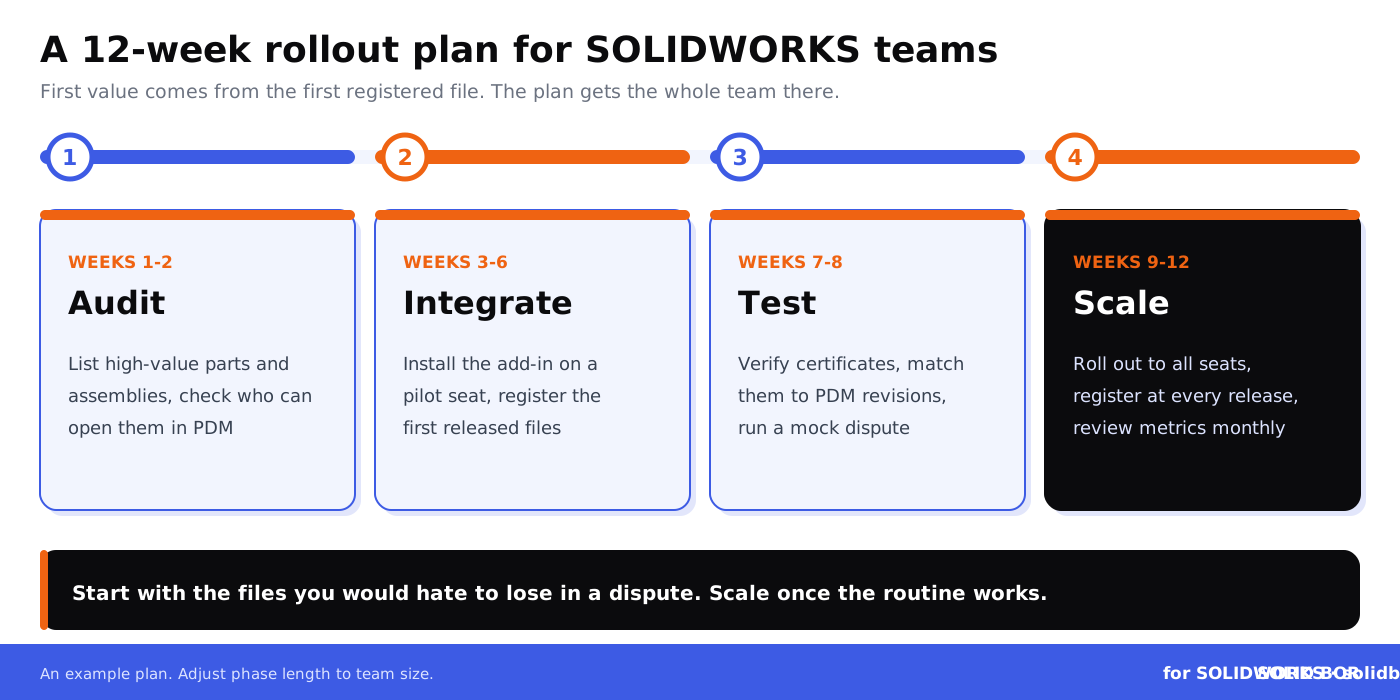
For example, SolidWorks users who build blockchain CAD file protection into their workflow can show when a file existed and that it has not been changed since, using blockchain certificates to support ownership claims.
Here is how blockchain registration compares with other common measures on time-to-value:
The Actionable Guide to Time Efficient Blockchain Implementation
If you're representing a smaller manufacturing company in Europe, here's how you can optimize the setup phases for solid ROI:
- Define the exact value your SME expects to achieve (e.g., preventing designs from being reverse-engineered).
- Audit your current IP risk exposure during early CAD data-sharing stages.
- Collaborate with integration solution vendors to align blockchain workflows directly with SolidWorks workflows.
- Set access and encryption rules for sensitive files, and begin registering CAD files for blockchain certification.
- Measure early-stage success with metrics such as reduced file access errors and how quickly design certificates are generated.
Working in the automotive supply chain?
See what OEMs expect from suppliers when it comes to protecting CAD files and design IP.
👉 Read the automotive CAD protection guide
Tips to Accelerate Time-to-First Value
- Start Small: Implement blockchain protections for high-risk CAD files first before scaling across larger repositories.
- Invest in Training: Knowledge barriers around CAD security tools slow adoption. Train your team early.
- Pick Proven Solutions: Opt for platforms designed specifically to integrate with SolidWorks rather than generic IP protection tools.
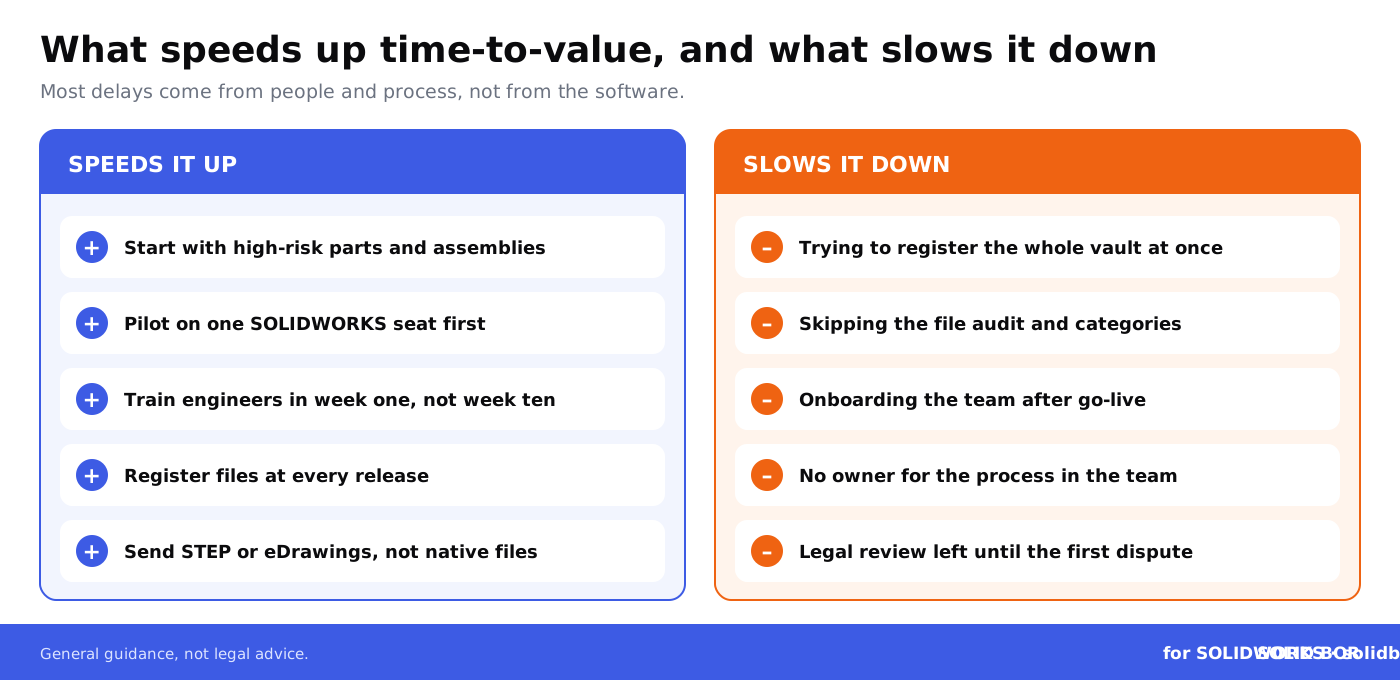
SMEs seeking non-disruptive adoption can use a cost-benefit analysis of blockchain CAD security to benchmark success metrics.
Mistakes to Avoid During Implementation
- Delaying team onboarding: CAD engineers need familiarity with blockchain plugin functionality early.
- Skipping file categorization: High-value CAD designs require priority-focused encryption alongside licensing control.
- Underestimating legal readiness: File certifications must legally align with GDPR and EU IP regimes. Neglecting this can introduce disputes.
As Dirk-Jan Bonenkamp, CLO of CADChain, warns, "You need legal-smart contracts embedded into your CAD processes. Without them, compliance gaps emerge rapidly."
Closing Thoughts: Connect Implementation to Future Insights
Embracing blockchain-based CAD protection for SolidWorks isn't merely about locking your designs; it's about creating traceable digital assets that enhance ownership claims, simplify collaboration, and cement file-level rights dynamically over time.
To deepen your understanding, explore how SMEs can build a CAD security policy in SOLIDWORKS, addressing both current vulnerabilities and preparing for scaling blockchain integrations seamlessly.
People Also Ask:
How do you calculate time to value?
Time-to-Value can be calculated by identifying the start event, often the initial use or purchase, and the end event, when the user achieves the desired outcome. Subtract the start date from the completion date to determine the duration. For example, if a software adoption begins on May 1 and the user gains meaningful results by May 15, the time-to-value is 14 days. Customizing this metric for specific contexts ensures relevancy in various industries.
What is time to value in PMP?
In the context of PMP (Project Management Professional), time-to-value refers to how quickly a project delivers its intended outcomes or benefits. It highlights the time taken from planning initiation to realizing tangible project results. This metric is particularly useful in tracking project efficiency and demonstrating the success of methodologies like Agile or Waterfall.
What is time to value in onboarding?
Time to value during onboarding measures the duration it takes for a new user or customer to achieve their first tangible result using your service or product. Shortening this period builds trust, encourages retention, and improves satisfaction. Many organizations focus on streamlining onboarding processes and offering personalized support to achieve quicker time-to-value.
What is the time to value scale?
The time-to-value scale measures how long it takes for a customer or user to derive meaningful benefits from a product or service. It starts from the initial interaction and ends once a key outcome is achieved. For businesses, reducing time-to-value can drive customer loyalty and enhance the perceived effectiveness of their offerings, making it a critical metric in customer success strategies.
Why does time to value matter for companies?
Time-to-value is essential for companies as it impacts customer satisfaction and retention. Faster time-to-value builds a positive impression of the company’s offerings and boosts trust among users. It encourages repeat business and reduces churn rates, which are crucial for sustainable growth and achieving long-term profitability in competitive markets.
How can businesses reduce time to value?
Businesses can reduce time-to-value by offering clear guidance, enhancing product usability, automating repetitive tasks, and streamlining customer onboarding. Providing self-serve resources, focusing on user experience, and monitoring progress closely during initial interactions can also significantly shorten the time taken to achieve desired outcomes.
What industries benefit most from improving time to value?
Industries such as software development, SaaS (Software as a Service), e-commerce, and healthcare benefit significantly from improved time-to-value. Faster delivery of results leads to higher customer adoption rates, better product perception, and improved user satisfaction. Other sectors like education technology and B2B services also focus on optimizing this metric to deliver effective and timely solutions.
How has time to value evolved in 2026?
As of 2026, advancements in AI have revolutionized time-to-value by enabling predictive user experiences, real-time analytics, and automated workflows. Technologies like onboarding chatbots, zero-code platforms, and adaptive learning systems help businesses shorten the time required for customers to see meaningful outcomes. The focus has shifted to creating seamless, tailored experiences that maximize user success and engagement.
What challenges arise in measuring time to value?
Challenges include defining the exact start and end points for measurement and ensuring all user interactions are properly tracked. Variabilities in user behavior, product complexity, and the subjective nature of what constitutes 'value' can add difficulty. Businesses often address these challenges by segmenting users, customizing metrics, and leveraging AI tools to analyze behavioral data.
What role does time to value play in customer retention?
A reduced time-to-value significantly enhances customer retention by providing early proof of a product's effectiveness in solving their problem. Customers who quickly experience desired outcomes are more likely to stay loyal, refer others, and explore deeper engagements. This metric aligns user expectations with business goals, fostering stronger relationships over time.
FAQ on Time-to-Value for Blockchain-Based CAD Protection
What defines Time-to-Value in CAD security systems?
Time-to-Value measures how quickly users derive measurable benefits, like protecting intellectual property or securing file versions, from CAD security systems. Factors include integration ease, compliance readiness, and ROI tracking. Discover more about optimizing time-to-value for critical systems.
How can SMEs improve implementation timelines?
SMEs can accelerate timelines by auditing CAD risks upfront, prioritizing high-value files, and ensuring plugin compatibility with platforms like SolidWorks. Partnering with vendors experienced in rights management and blockchain integration further reduces setup delays.
What role does blockchain play in preventing IP theft?
Blockchain creates transparent and tamper-evident audit trails for CAD files, which supports ownership claims and shows whether a file was changed. It does not block access on its own, so combine it with role-based access control and encryption.
Is blockchain-based protection eco-friendly?
It can be. Energy use depends on the network: proof-of-stake networks use far less energy than proof-of-work networks, and registering a file fingerprint is a small transaction. Remote verification also reduces paper-based workflows. Learn how CADChain promotes sustainability through these mechanisms.
What is the biggest challenge in scaling blockchain protection?
The main challenge is adapting protocols to increasing file repositories while maintaining compliance with legal frameworks like GDPR. Organizations must invest in scalable solutions and train teams effectively to manage complex encryption layers.
Can blockchain CAD systems eliminate copyright disputes?
Blockchain file certifications establish immutable ownership claims but do not inherently resolve copyright disputes. Adding legal-smart contracts embedded in CAD workflows strengthens compliance readiness for intellectual property claims.
How do blockchain solutions integrate with SolidWorks?
Blockchain solutions integrate with SolidWorks via add-ins that register file fingerprints and track CAD file versions from inside the CAD environment. Compatibility testing ensures seamless operations without disrupting existing workflows.
What are alternative applications of blockchain in engineering?
Beyond CAD file protection, blockchain is used for supply chain tracking, automating licensing agreements, and securing IoT device interactions. Explore additional blockchain applications in engineering and manufacturing industries.
How do smart contracts enhance compliance in CAD protection?
Smart contracts automate licensing processes and align file certifications with regional compliance regulations like EU IP regimes. This ensures operational consistency while minimizing human errors in CAD data governance.
What metrics indicate success in CAD blockchain integration?
Key metrics include reduced file tampering incidents, improved version traceability, and quicker certificate generation timelines. Long-term success is realized through enhanced collaboration safeguards and regulatory compliance adherence.