
TL;DR: Blockchain Interoperability for CAD Systems: Simplify Collaboration Without Losing Control
Sharing CAD files across platforms like SolidWorks and Autodesk is risky without secure oversight. Blockchain-powered tools add a platform-neutral record of design integrity and ownership, with tamper-evident timestamps that every partner can check, whatever CAD system they use. SMEs can protect IP while keeping teams productive.
💡 Curious about future trends in CAD protection? Check out Future-Readiness of CAD Security Technologies. Stay ahead of the curve!
How Blockchain Interoperability is Revolutionizing CAD Systems
Have you ever wondered how engineers, designers, and manufacturers can effectively collaborate while ensuring the protection of intellectual property (IP) upon sharing critical CAD files? Blockchain interoperability for CAD systems has emerged as a key to bridging this gap, offering tamper-evident, verifiable records that stay valid across diverse platforms.
For SolidWorks users and engineering SMEs, this means tackling the longstanding problems of security vulnerabilities and missing verifiable ownership records. File format incompatibility is still handled by neutral formats such as STEP; blockchain adds the proof layer on top. Here’s why blockchain interoperability matters, and how it reshapes the CAD world.
Your CAD files deserve more than basic protection.
Simplify IP management in SolidWorks with CADChain’s blockchain-powered BORIS for SOLIDWORKS add-in.
👉 Discover advanced CAD protection
Why is Blockchain Interoperability a Game-Changer in CAD?
Engineers and manufacturers operate within ecosystems of diverse CAD platforms, such as SolidWorks, Autodesk Inventor, and Blender. Historically, cross-platform inconsistencies have led to incompatible data formats, loss of file integrity, and security risks when collaborating across borders.
Blockchain helps by adding a shared, platform-neutral record layer: each registered version gets a hash and a timestamp that anyone can check, no matter which CAD tool opens the file. For example, European SMEs working on sensitive projects can rely on blockchain records to verify ownership and resolve disputes, while access control stays in tools like SOLIDWORKS PDM.
- Immutable audit trails: Each registered version of a CAD file is time-stamped on the blockchain, giving a verifiable history of modifications.
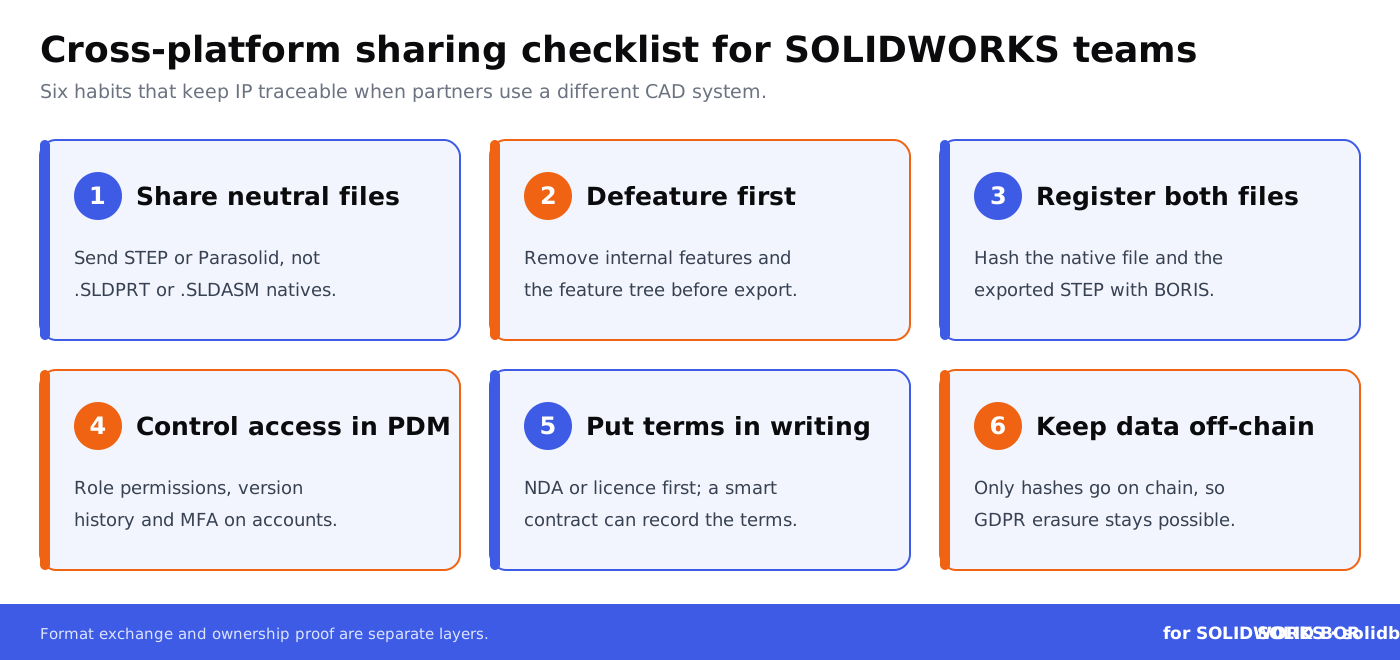
- Neutral formats stay traceable: A STEP export can be registered too, so its hash links back to the same ownership record as the native file (see neutral CAD format risks).
- Enhanced collaboration: Because the record does not depend on the file format, a SolidWorks team and a partner using Inventor (with BORIS for Inventor) can check the same ownership history; smart contracts can add agreed licence terms.
“Blockchain reduces the complex legal and operational friction SMEs face, particularly across distributed supply chains in Europe.”
Dirk-Jan Bonenkamp, CLO, CADChain
How SolidWorks Users Benefit from Blockchain Interoperability
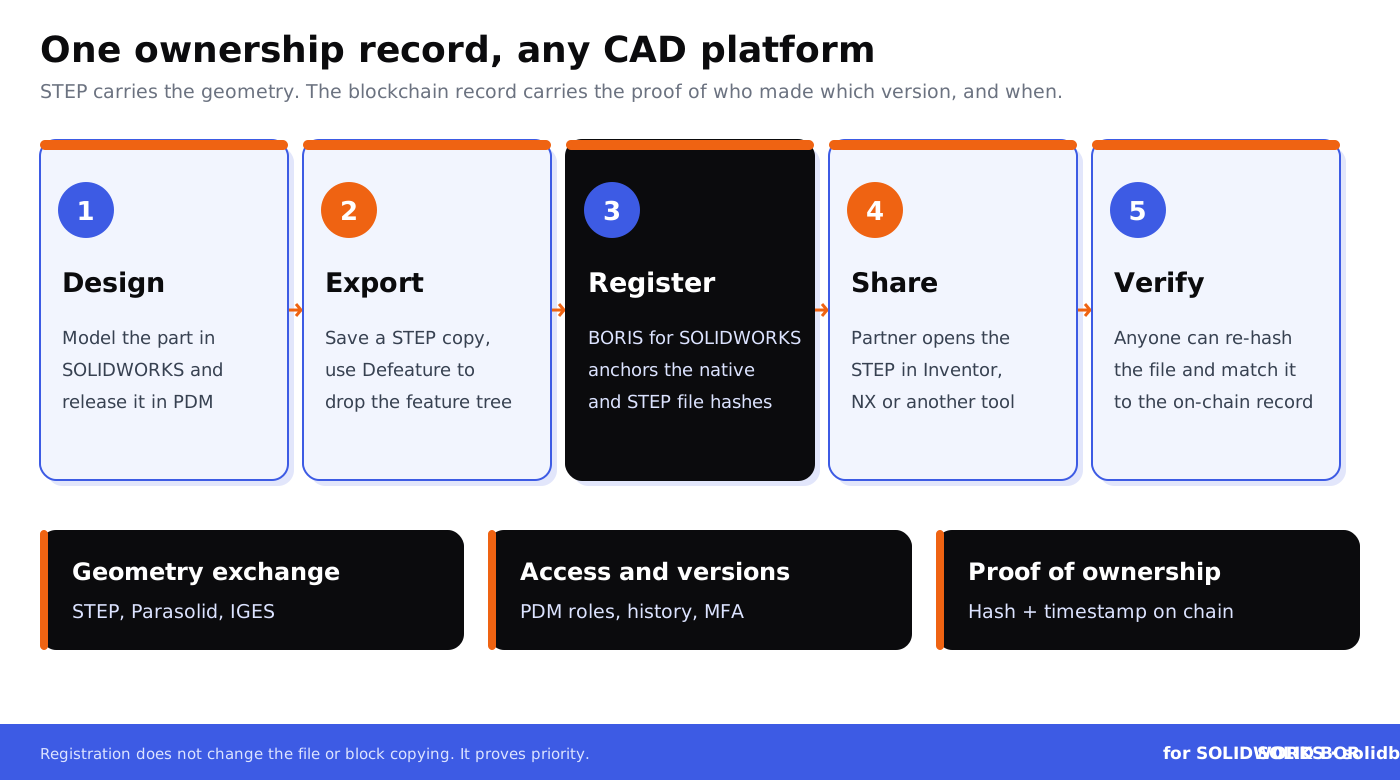
SolidWorks users often share files with external designers, manufacturers, and contractors. By using a blockchain-powered add-in like BORIS for SOLIDWORKS, they can register each version before it leaves the company and keep a verifiable record of ownership, licensing terms and modifications, while the transfer itself runs through PDM or a secure share (see our guide to sharing CAD files with suppliers).
For instance, imagine a Dutch SME developing cutting-edge automotive prototypes and sharing the designs with suppliers in Germany. Blockchain provides tamper-evident documentation of ownership, and agreed licence terms can be recorded and, where both sides agree, executed through smart contracts. This makes unauthorized distribution easier to prove.
- Set up CAD data fingerprinting: SolidWorks users can register their designs on the blockchain, capturing a digital fingerprint (hash) of the file.
- Log events like ownership transfer and released versions to the blockchain for immutable tracking.
- Keep compliance records: the registration history supports GDPR documentation in cross-border CAD collaborations, as long as personal data stays off-chain.
Unchain worries about lost or leaked CAD files.
Add BORIS for SOLIDWORKS to your workflow and register every released design.
👉 Step-by-step implementation guide
Here is what each common exchange route protects when a SOLIDWORKS design goes to a partner on another CAD platform:
Top Adoption Challenges for SMEs (and Solutions)
Blockchain interoperability, while promising, comes with adoption hurdles specific to smaller enterprises. Here are the most common, alongside actionable solutions:
- Resistance to change: Employees may be unfamiliar with advanced add-ins or blockchain use cases. Solution: Offer hands-on training programs and tutorials within the CAD interface.
- High initial costs: Integrating blockchain technology may seem prohibitive for startups. Solution: Start small, for example by registering only the released versions of one key project with BORIS for SOLIDWORKS, and scale up once the workflow works.
- Legal and regulatory confusion: Many SMEs aren’t aware of new compliance evolutions in digital asset protection. Solution: Work with legal experts to align processes with European standards.
“When blockchain adoption feels complex, focus on early wins. Start with file registration and audit trail creation, then expand to shared workflows.”
Violetta Bonenkamp, CEO, CADChain
What Does the Future Hold for Blockchain-Enabled CAD Interoperability?
The transformative power of blockchain extends far beyond CAD file protection. Advances in cross-chain technologies, AI-driven data exchange, and regulatory adoption continue to redefine how companies handle intellectual property.
With the European Union actively supporting blockchain standardization, small and medium enterprises stand to benefit. Engineers using SolidWorks and other platforms may soon work in decentralized collaboration spaces where every key action is securely logged, enhancing transparency and compliance.
Build a tamper-proof audit trail.
Log and track your design versions effortlessly by integrating blockchain into your CAD workflows.
👉 Learn about versioning with blockchain
Closing Thoughts: Engineering More Than Just Designs
For Europe’s engineers, designers, and IP managers, blockchain interoperability represents a significant leap forward. By embracing tools like BORIS for SOLIDWORKS, teams can transform how they share, secure, and scale intellectual property.
Fueled by innovative founders like Violetta and Dirk-Jan Bonenkamp, and supported by European policies prioritizing digital protection, the CAD community is poised for a future where efficiency meets immutability. To explore the finer details of blockchain integration, dive into our comprehensive guide on CAD and IP protection.
People Also Ask:
Which blockchain is recognized for its capacity to connect with others?
Cosmos is renowned for facilitating connections between blockchains via the Inter-Blockchain Communication (IBC) protocol and Peg-Zones. It empowers independent ecosystems to transfer information while maintaining autonomy, with the Cosmos Hub serving as a central coordinator.
How is data sharing enabled in CAD systems?
Solutions like NX CAD from Siemens integrate interoperability tools that simplify file sharing with partners. This system supports seamless interaction across portfolios like the Siemens Xcelerator, ensuring consistent collaboration among team members.
What examples illustrate blockchain connectivity across networks?
Cross-network examples include enabling Bitcoin to function in Ethereum-based applications or exchanging assets between blockchains. These interactions reduce dependency on centralized systems like traditional exchanges, promoting decentralized asset mobility.
What categories do blockchain systems fall into?
Blockchain technology divides into public, private, hybrid, and consortium types. These classifications reflect permissioned and permissionless settings, adaptable based on specific use cases within the evolving Web3 framework.
What challenges arise in combining CAD systems with blockchains?
Linking CAD systems with blockchain platforms involves overcoming difficulties like synchronizing data or aligning various system configurations. Challenges also emerge in maintaining accuracy and adherence to universal standards.
What are potential solutions for blockchain integration in CAD systems?
Addressing integration requires strategies such as employing blockchain nodes within CAD systems, facilitating consensus mechanisms, and ensuring secure information exchanges between networks without loss of integrity.
How does CAD data integrity benefit from blockchain usage?
Blockchain fosters CAD data reliability by providing verifiable records for information sharing among distributed systems. Challenges with implementation require strategic planning to fully optimize its potential in collaborative environments.
In what ways do scalable blockchain solutions aid CAD enterprises?
Solutions enhance transaction throughput, improve security, and foster seamless collaboration in CAD contexts like Autodesk. Advanced scalability improves operational efficiency and ensures trust across networks combining enterprises and partnerships.
What role does blockchain interoperability play in next-generation systems?
Blockchain interoperability ensures various systems interact smoothly to share assets, transmit data, and exchange currencies securely. This feature supports sustainable and scalable frameworks crucial for advancing interconnected networks.
Why is connectivity between systems essential for blockchain's growth?
Establishing connections reduces operational silos, allowing networks to share data efficiently. This facilitates broader adoption, supports innovation, and ensures smoother scaling with reduced barriers to information exchange.
Are blockchain-based partnerships actively reshaping CAD industries?
Collaborations between CAD platforms and blockchain developers unlock secure and transparent avenues for information management. As industries adopt distributed ledgers, the design data flow benefits from measurable system reliability.
FAQ on Blockchain Interoperability for CAD Systems
How does blockchain interoperability enhance data security in CAD systems?
Blockchain creates tamper-evident audit trails, so file integrity can be checked during cross-platform collaborations. Immutable records make unauthorized changes detectable and help trace a leak back to a version, which is particularly useful for SMEs working on sensitive projects; access itself is still controlled by PDM and sharing tools. Learn more in Creating Tamper-Proof CAD File Audit Trails.
Can blockchain help resolve intellectual property disputes in collaborative CAD environments?
Yes, blockchain verifies ownership and tracks registered file versions, providing clear evidence of design authorship and usage. This makes resolving IP disputes more transparent and gives stronger evidence across distributed teams.
What are the biggest challenges in adopting blockchain plugins for CAD tools like SolidWorks?
Challenges include user resistance, costs, and legal compliance. Training programs, small pilot projects, and guidance on EU digital asset regulations help SMEs overcome these barriers. Explore blockchain scalability solutions for practical strategies.
How does blockchain aid cross-platform CAD collaborations?
Neutral formats like STEP handle the geometry exchange between platforms like SolidWorks and Autodesk Inventor. Blockchain adds a format-neutral record: the exported file can be registered and checked against its hash, and smart contracts can record the agreed IP terms.
What are the key benefits of using blockchain-backed plugins like BORIS in SolidWorks?
BORIS for SOLIDWORKS registers each design version on a blockchain and creates tamper-evident ownership documentation. This supports licensing and supplier agreements, lowers IP theft risks through clear evidence, and can be combined with smart contracts between manufacturers and suppliers.
Does blockchain support compliance with data regulations like GDPR?
It can support it, but it does not ensure compliance on its own. Registration records give transparency and accountability for cross-border file exchanges, while personal data should stay off-chain (only hashes go on-chain) so that GDPR rights such as erasure can still be met. See GDPR compliance for CAD data.
How can SMEs implement blockchain-based CAD protection step-by-step?
Start with file registration on the blockchain to capture unique fingerprints, log ownership events, and secure licensing terms with smart contracts. Discover actionable steps in Blockchain CAD Protection Implementation.
What kind of file types can blockchain secure in CAD systems?
Any file type can be registered, because only its hash goes on-chain: native SLDPRT and SLDASM files, DWG, and neutral formats like STEP or IGES. The file itself is not changed and registration does not restrict usage; it proves which version existed and when, which supports IP claims and licence enforcement.
What does the future of blockchain-enabled CAD interoperability look like?
Expect advancements in cross-chain technologies and AI-driven collaboration tools supporting decentralized, secure design exchanges. SMEs using CAD workflows will gain transparency, reduced costs, and better global IP protections.
How do blockchain audit trails improve CAD version control?
Blockchain logs registered versions and ownership changes immutably, preventing mismatch issues in distributed teams. This ensures full transparency during version control. Learn about PDM integration with blockchain.