
A Canadian court has ruled that a competitor's SolidWorks 3D model of a valve did not infringe the copyright in the engineering drawings it was based on. In GE Renewable Energy Canada v. Canmec Industrial, 2026 FC 1145, the Federal Court of Canada published its public reasons on 2 October 2026. GE Renewable Energy Canada (GEREC) owned the copyright in 33 manufacturing drawings, but lost almost all of its claim. It won $60,000 for four drawings that the competitor debranded and sent to suppliers.
GEREC had shared its drawings with Canmec when it considered hiring Canmec as a subcontractor on a hydroelectric refurbishment in Québec. Canmec later won the contract for the remaining work. GEREC argued that Canmec's valves, 3D CAD files, 2D drawings and manufacturing methods copied its work. Justice Tsimberis found that the Copyright Act's rule on "useful articles" defeated almost all of those claims, because every feature at issue was purely functional.
For SOLIDWORKS teams, the message is uncomfortable: copyright in your drawings may not stop a competitor from rebuilding a functional part as a 3D model and making it, at least in Canada. Here is what the court decided, why the SolidWorks model mattered, and what to change when you share files.
TL;DR: copyright in drawings did not protect the functional part
In 2026 FC 1145, the Federal Court of Canada held that copyright existed in GEREC's 33 valve drawings and that GEREC owned it. But section 64.1 of the Copyright Act covered Canmec's manufactured valves, its 3D CAD files and SolidWorks model, its 2D drawings and its methods of manufacture, because all the features were dictated solely by function. Canmec still infringed four drawings by debranding them and sending copies to suppliers: $60,000 in statutory damages. For SOLIDWORKS teams: do not rely on copyright for functional parts. Use contracts you can enforce, trade secret controls, patents or designs where they fit, clear ownership marks and dated proof.
What happened in GE Renewable Energy Canada v. Canmec?
The public reasons and judgment set out a long history. The Isle-Maligne hydroelectric plant in Alma, Québec, owned by Rio Tinto, has 12 turbine units and 24 butterfly water intake valves, each with a winch, in service since 1926. In 2015, Rio Tinto launched a programme to refurbish them: two pilot projects for Units 1 and 2, then a project for Units 3 to 12.
- The pilots. GEREC won Units 1 and 2. It contacted Canmec as a potential subcontractor for the valves and sent it 33 manufacturing drawings of the valves, winches and embedded components. GEREC did not hire Canmec for the valves, but Canmec worked on the winches for Rio Tinto.
- The tender. Rio Tinto then issued a request for proposals for Units 3 to 12. GEREC, Canmec and other companies bid. Rio Tinto chose Canmec for both valves and winches.
- The lawsuit. GEREC sued Canmec for copyright infringement in 2021. Canmec brought Rio Tinto into the case in 2022 with a claim for indemnity.
One procedural detail stands out. In 2024, GEREC tried to widen its claim from the 33 drawings to 305 works, including 254 other versions or revisions and its SolidWorks 3D CAD model. The court refused most of that late amendment, and the Federal Court of Appeal dismissed GEREC's appeal in September 2024. The case was decided on the 33 two-dimensional drawings only, even though a GEREC witness said the design started as a 3D model in SolidWorks.
What did the court decide?
The judgment answers six questions. The results were mixed, but the main claim failed:
- Copyright exists. Each of the 33 drawings came from its authors' skill and judgment and was not a mere copy, so copyright subsists in them.
- GEREC owns it. The court confirmed GEREC as the owner, despite arguments that subcontractors had contributed to the drawings.
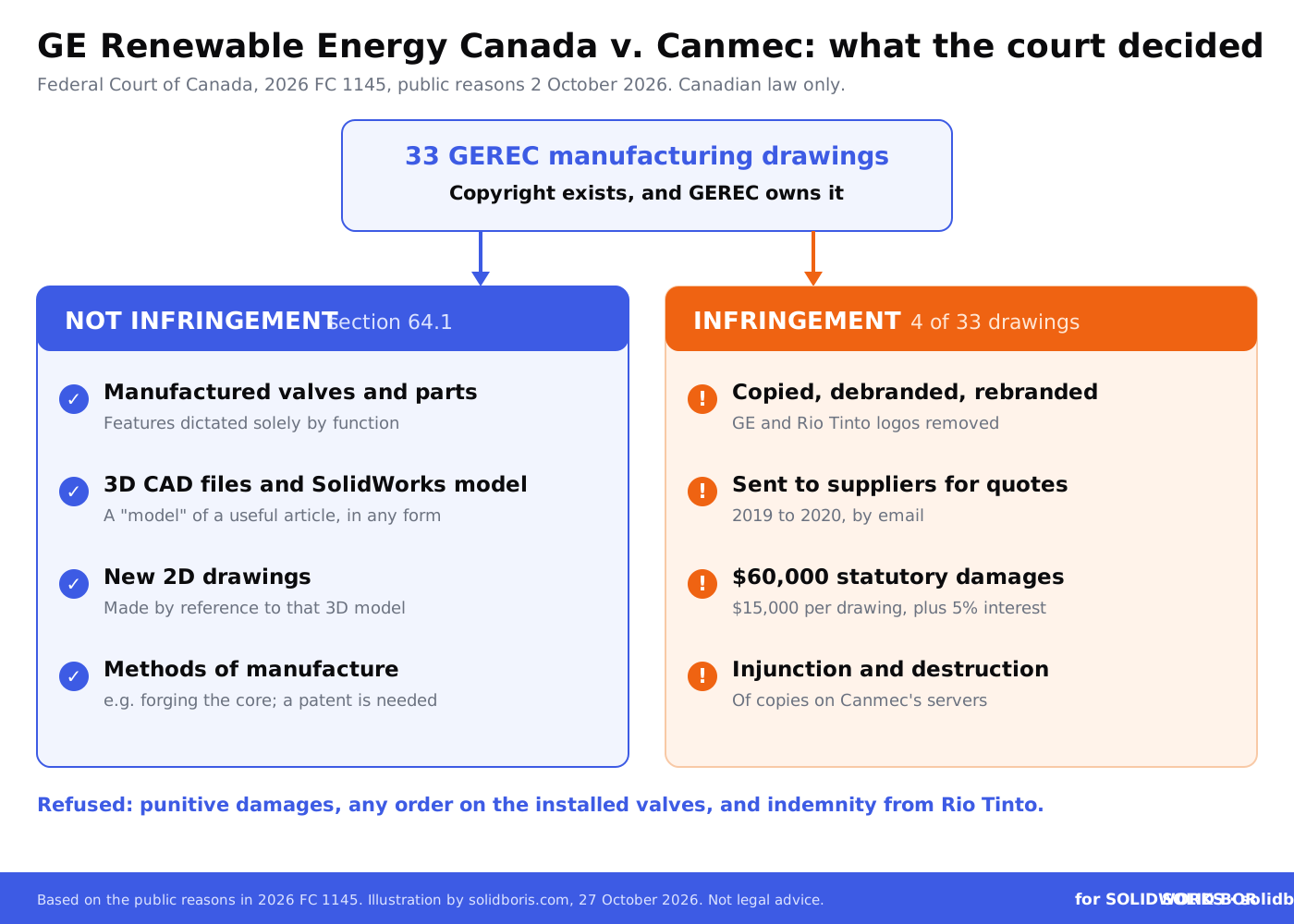
- Section 64.1 defeats the main claim. Canmec's manufactured valves and embedded components, its 3D CAD files and SolidWorks model, its 2D drawings and its methods of manufacture were not infringements.
- Four drawings were infringed. Canmec removed the GE and Rio Tinto names and logos from four drawings, sent them to potential suppliers to get quotes, and once put its own logo on a reproduction. That was infringement.
- Remedies. An injunction, delivery up and destruction of the copies on Canmec's servers within 30 days, and $60,000 in statutory damages ($15,000 per drawing) with 5% interest from 15 December 2020. No order touching the installed valves, and no punitive damages.
- No indemnity. Canmec's claim that Rio Tinto must cover the judgment was dismissed.
Why did the SolidWorks 3D model not infringe the drawings?
Section 64.1 of Canada's Copyright Act lists acts that do not infringe copyright in a work. They include applying to a useful article features that are dictated solely by its utilitarian function, making a drawing of such features by reference solely to a useful article, and using any method or principle of manufacture or construction. The Act defines a useful article as an article with a utilitarian function, including "a model of any such article".
The key step was the word "model". GEREC argued that a model must be physical. Reading the French version of the Act, which uses both "modèle" and "maquette", the court held that it covers models in any form. Because the valves were purely functional, Canmec's 3D SolidWorks model of them was also a useful article. From there, the chain was simple:
- Applying functional features to the valves and to the 3D model is allowed under paragraph 64.1(1)(a).
- Making 2D drawings by reference to that 3D model is allowed under paragraph 64.1(1)(b), and paragraph (c) lets Canmec use them. The court added that a 2D drawing is not itself an article.
- Using forging for the valve core is a method of manufacture, covered by paragraph 64.1(1)(d). A monopoly on a method would need a patent.
The most striking point for designers is the court's view on where the features came from. For applying functional features to a useful article, the judge wrote that "it matters not where the features come from", even if they originate from the GEREC drawings. And because GEREC brought no evidence that any feature was aesthetic rather than functional, the court said that if the defence did not apply in this case, it would not apply anywhere.
This is Canadian law, and the outcome depends on the facts. But other systems also limit copyright for functional designs, as our overview of the limits of traditional IP law for CAD explains. Copyright protects how a drawing expresses a design, not the functional part it describes.
Keep dated proof of every SOLIDWORKS design you share.
BORIS for SOLIDWORKS registers your parts, assemblies and drawings with a blockchain timestamp and a certificate of ownership, right from SOLIDWORKS, so you can show what you designed and when, before files go to suppliers or subcontractors.
👉 See how BORIS for SOLIDWORKS works
What still counted as infringement?
The part of the claim that succeeded is the one most shops will recognise from daily work. According to the judgment, Canmec sent two debranded drawings of the bearing housing to eight potential suppliers in July 2019, and shared two debranded drawings of the forged core 25 times between September 2019 and May 2020. In November 2019, an employee sent a supplier a drawing that reproduced the forged core drawings with the GE logo replaced by Canmec's.
Copying a drawing and sending it out is reproduction, which section 64.1 did not cover. But the court did not find it malicious. Both GE and Rio Tinto logos appeared on the drawings, Canmec believed the IP belonged to Rio Tinto, and witnesses for both sides said anonymising drawings for procurement is common. A GEREC witness also accepted that a logo on a drawing does not necessarily show who owns the IP. That is why damages stayed at statutory levels, and punitive damages were refused.
If your team sends customer or partner drawings to vendors for quotes, this is the risk to manage. Our guides to sharing CAD files with suppliers and sharing CAD files without exposing IP cover safer ways to get quotes, such as sending only the views a supplier needs.
Why did the NDA not save GEREC?
GEREC and Canmec had signed a non-disclosure agreement on 25 June 2019. GEREC relied on it to argue that Canmec acted with full knowledge and deserved punitive damages. The court disagreed for practical reasons: the NDA was governed by New York law, GEREC brought no evidence of how New York law would read it, and it was unclear whether the NDA covered the Isle-Maligne project at all or only another project. A Canadian court cannot simply assume what foreign law says.
The lesson is contract hygiene. Our article on the limits of NDAs for CAD files and our guide to contract clauses for CAD IP protection explain how to write terms that name the project, the files, the permitted use and the governing law you can actually enforce.
Which protection works for functional parts?
Each IP right protects something different. Here is how the main options compare for purely functional parts like the valves in Canmec.
For background on each route, read our overviews of IP rights for CAD designs, trade secret protection for CAD and industrial design protection for CAD.
What should SOLIDWORKS teams do now?
Whether you share drawings or receive them, these steps reduce your risk.
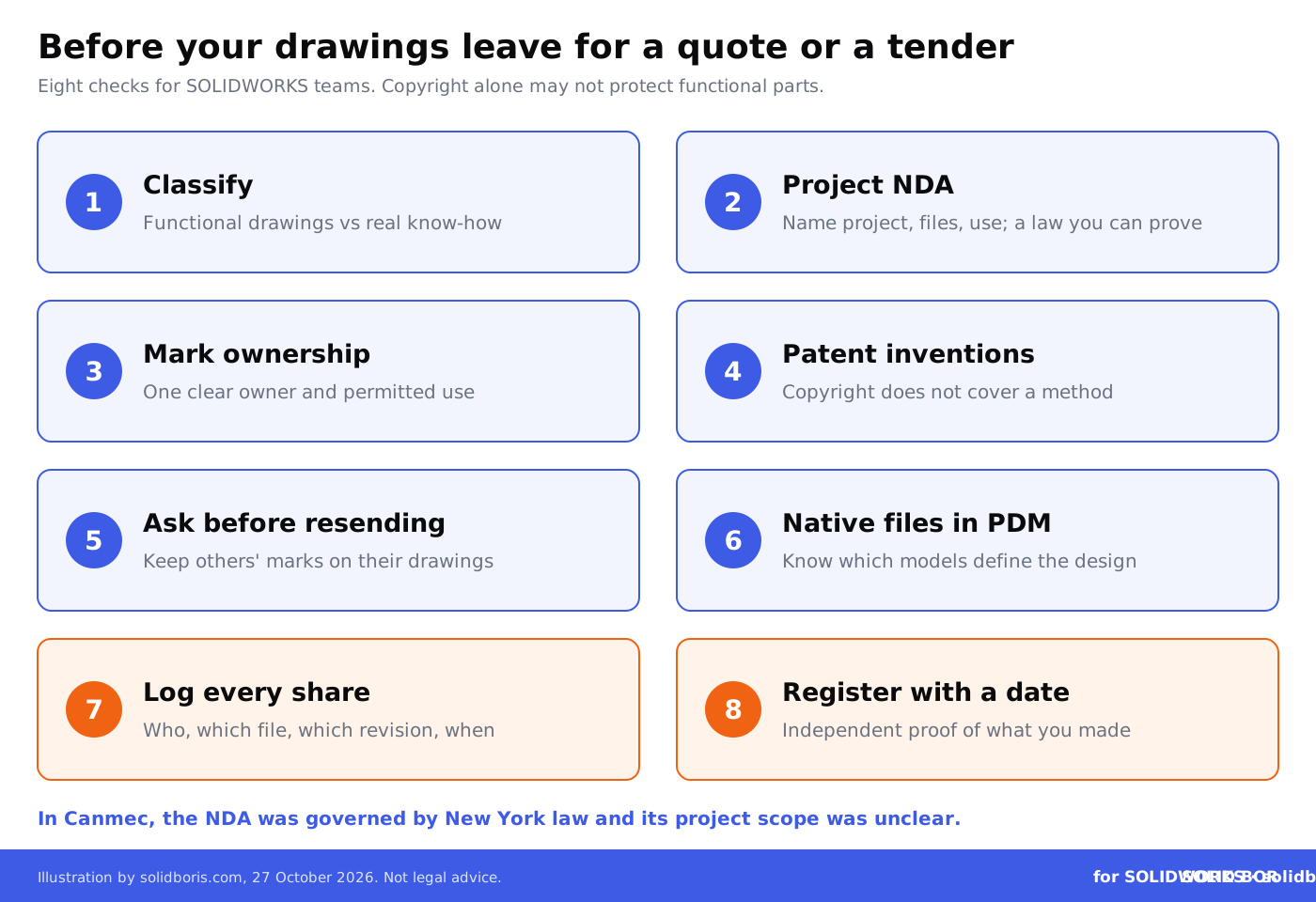
- Classify what you share. Before a tender or quote, separate functional drawings anyone could rebuild from files with real know-how. Send only what the recipient needs.
- Write the NDA for the project. Name the project, the files and the permitted use, and say that files are to be returned or deleted when the work ends. Choose a governing law that you could prove in the court where you would sue.
- Mark ownership clearly. In Canmec, two logos on the drawings blurred who owned them. State the owner and the permitted use in the title block, and make sure your contract with the end client says who owns the design data.
- Patent real inventions. Copyright will not cover a method or technical solution. Talk to a patent attorney before you share.
- Control supplier quotes on your side too. If you send a customer's or partner's drawings to vendors, ask for permission first and do not strip their marks. Our coverage of the Ford v. InterMotive supplier trade secret appeal shows how costly unclear supplier sharing can become.
- Keep your 3D models in the record. GEREC's SolidWorks model was left out of the case because it was added too late. Know which native files and revisions define your design, and keep them in PDM.
- Log what leaves the company. Record who received which file, which revision and when. That log becomes evidence, as our guide to CAD IP litigation evidence explains.
- Register what you design, with a date. Ownership and authorship took evidence and expert reports at trial. An independent timestamp makes that part easier. See blockchain timestamping for IP.
Why does dated proof matter when copyright is weak?
The Canmec judgment shows how much of a design dispute turns on evidence: who drew what, which revision was shared and who knew whose IP it was. You cannot stop functional features from being copied by copyright alone. But you can make sure that your contract claims, trade secret claims and authorship claims rest on clean, dated records. Our guides on how to prove authorship of CAD designs and CAD ownership documentation explain what holds up best, and digital watermarking for CAD designs helps you trace a copy that has lost its logo.
How does this fit the bigger picture for CAD users?
Across our network this week, the same theme comes up again and again: your design data travels further than you think, and you need to know who touches it.
- People who approach suppliers. On CADChain, read about the suspected Russian spy arrested in Germany over defence industry contacts and what engineering suppliers should do now.
- Systems around your design files. BORIS Inventor explains the php2shell PHP vulnerabilities: Autodesk says Inventor and Vault are not impacted, but the websites, portals and file sharing tools around your designs may be.
- Labels and provenance. Blended BORIS covers Tim Sweeney's attack on Steam's AI disclosure labels and what it means for artists who sell 3D assets.
Conclusion
GE Renewable Energy Canada v. Canmec gives SOLIDWORKS users a clear answer on one narrow point. In Canada, when every feature of a part is dictated by function, copyright in the drawings does not stop someone from building a 3D model of the part, drawing it again and manufacturing it, even if the features came from your drawings. What did count was the direct copying of four drawings for supplier quotes, and that cost $60,000.
Treat copyright as a backstop, not a shield. Share less, write NDAs you can enforce, mark ownership, patent real inventions and keep dated proof of what you designed and sent.
Make your SOLIDWORKS designs provably yours.
BORIS for SOLIDWORKS adds blockchain timestamps and certificates of ownership to your CAD files, so you have independent, dated proof of your designs before they go to a tender, a supplier or a subcontractor.
👉 Get BORIS for SOLIDWORKS
FAQ: the Canmec ruling on SolidWorks models and drawing copyright
Did the court say CAD drawings have no copyright?
No. The court held that copyright existed in all 33 drawings and that GEREC owned it. It held that section 64.1 of the Copyright Act made Canmec's functional valves, 3D CAD files, SolidWorks model, 2D drawings and manufacturing methods non-infringing.
Why was the SolidWorks model treated as a useful article?
The Act's definition of a useful article includes a model of such an article. Reading the French version, the court held that a model can be in any form, not only physical, so a 3D model of purely functional valves is itself a useful article.
What did Canmec have to pay?
$60,000 in statutory damages, $15,000 for each of four drawings it debranded and sent to suppliers, plus 5% interest. It must also destroy copies of GEREC's drawings on its servers. Punitive damages and an order against the installed valves were refused.
Does this ruling apply outside Canada?
The judgment applies Canadian law only. Other countries also limit copyright for functional designs, but the rules differ, so check with a lawyer where you operate.
Is the decision final?
We could not confirm whether an appeal has been filed as of 27 October 2026. Check the court records before relying on it.
How can SOLIDWORKS teams protect functional parts?
Combine project-specific contracts, trade secret controls, patents for real inventions, clear ownership marks and dated proof, such as a BORIS for SOLIDWORKS certificate of ownership.