
TL;DR: Federated Learning Secures Collaborative CAD Design
Federated learning keeps sensitive CAD files private while enabling engineering teams to train AI models collaboratively. By processing data locally instead of centrally, intellectual property remains protected, reducing risks like theft and unauthorized distribution. Teams gain the ability to innovate securely without compromising compliance or workflows.
💡 Curious about the future of CAD security? Dive into upcoming trends in future-ready CAD security for 2026 to 2030.
Exploring Federated Learning for Collaborative CAD Security
How do engineering teams collaborate effectively without compromising sensitive data and intellectual property (IP)? This question has become central as the manufacturing landscape dives deeper into digital transformation. Federated Learning for Collaborative CAD Security is a cutting-edge solution addressing this dilemma by enabling decentralized AI model training while maintaining data localization and privacy compliance.
As co-founder of CADChain, a European company focused on IP protection for industrial design data, Violetta Bonenkamp emphasizes that federated learning's power lies in its ability to balance collaboration and security. Team members across Europe can train robust AI models while keeping their design files away from theft or unauthorized distribution.
“Federated learning allows multi-party collaborations to thrive without exposing raw data, ensuring both innovation and regulatory compliance.”
Violetta Bonenkamp, CEO, CADChain
Protect Your CAD Designs with BORIS
Guard your intellectual property with blockchain-powered tools designed specifically for SOLIDWORKS: BORIS for SOLIDWORKS registers each design version so you can prove who created it and when.
👉 Explore BORIS for SOLIDWORKS
How Federated Learning Addresses CAD Security Challenges
CAD files shared across engineering teams or external collaborators often face risks such as IP theft, unauthorized modifications, and untraceable access. Traditional solutions, like NDAs or centralized repositories, fall short in preventing these issues, especially in distributed manufacturing ecosystems. When the goal is to train AI on design data, federated learning solves these challenges in critical ways:
- Localizes data processing to each participant, eliminating the need to centralize sensitive CAD files.
- Leverages secure aggregation methods, so the coordinating server only sees the combined result, not any single participant’s model update.
- Supports legal defensibility when paired with blockchain registration, which adds tamper-evident logs and audit trails.
Here is how federated learning compares with the other ways teams handle shared design data:
The integration of federated learning with blockchain technologies gives teams much more control over CAD workflows. Dirk-Jan Bonenkamp, CLO of CADChain, points out that blockchain provides the immutable ledger required to support IP ownership claims and resolve disputes faster. Learn more about these integrations in our guide to integrating blockchain into CAD workflows.
Deploying Federated Learning: A Step-by-Step Guide
Implementing federated learning in a SolidWorks-driven environment involves three main phases:
- Phase 1: Assessment: Identify key collaboration workflows and security challenges specific to your design files.
- Phase 2: Configuration: Install an open-source federated learning framework, such as TensorFlow Federated or Flower, on the training machines at each site, next to your CAD environment.
- Phase 3: Integration: Link federated learning tools with encryption protocols and blockchain registration for audit trails.
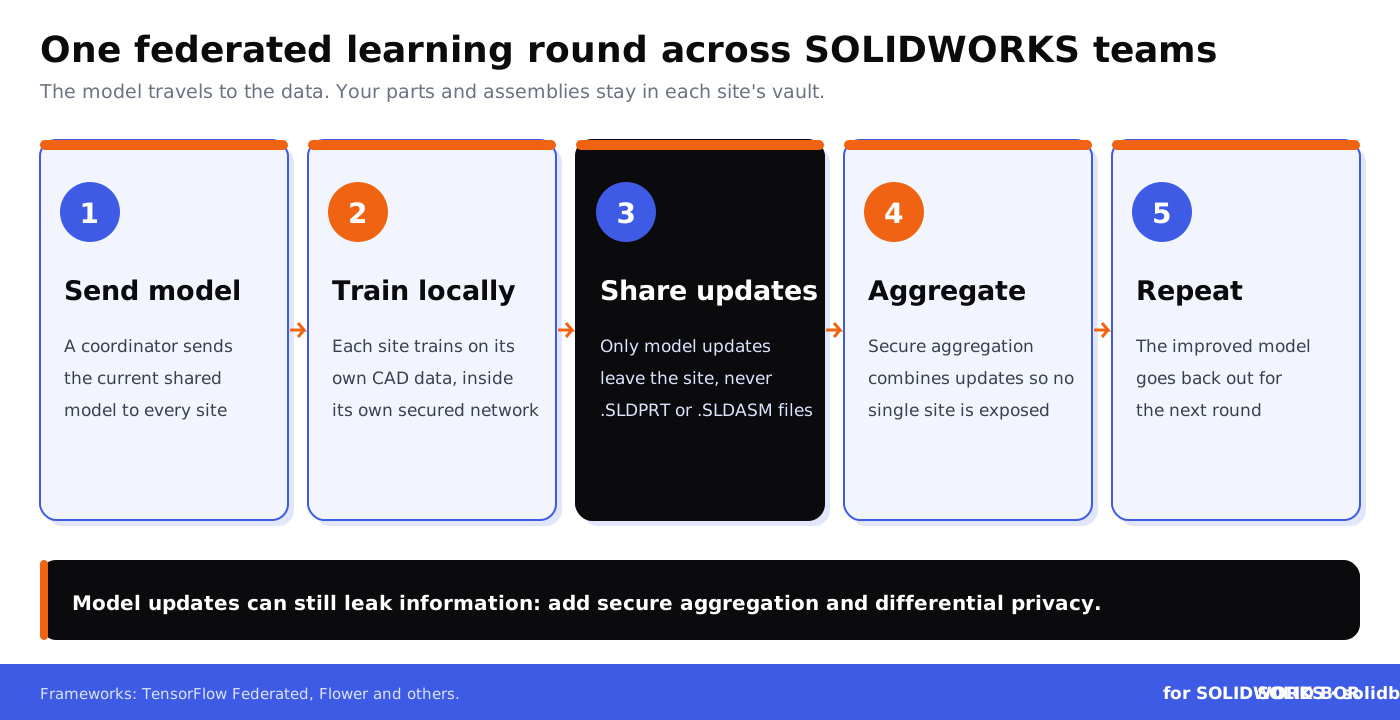
For SMEs focused on rapid adoption, CADChain’s BORIS for SOLIDWORKS covers the ownership side: it registers a fingerprint of each design file on a blockchain, so you can show who created which version and when, while the federated setup handles the AI training. BORIS is not a federated learning framework itself. As Violetta explains, “Accessible frameworks minimize complexity while ensuring thorough protection.” For further insights, review this CAD collaboration platforms security comparison.
Keep a Tamper-Evident Version History with BORIS
Register every released version and keep a dated, blockchain-backed record of who created what, alongside your SOLIDWORKS PDM history.
👉 Learn more
Avoiding Missteps in Federated Learning Deployment
While federated learning is transformative, engineering teams must navigate common challenges for successful implementation:
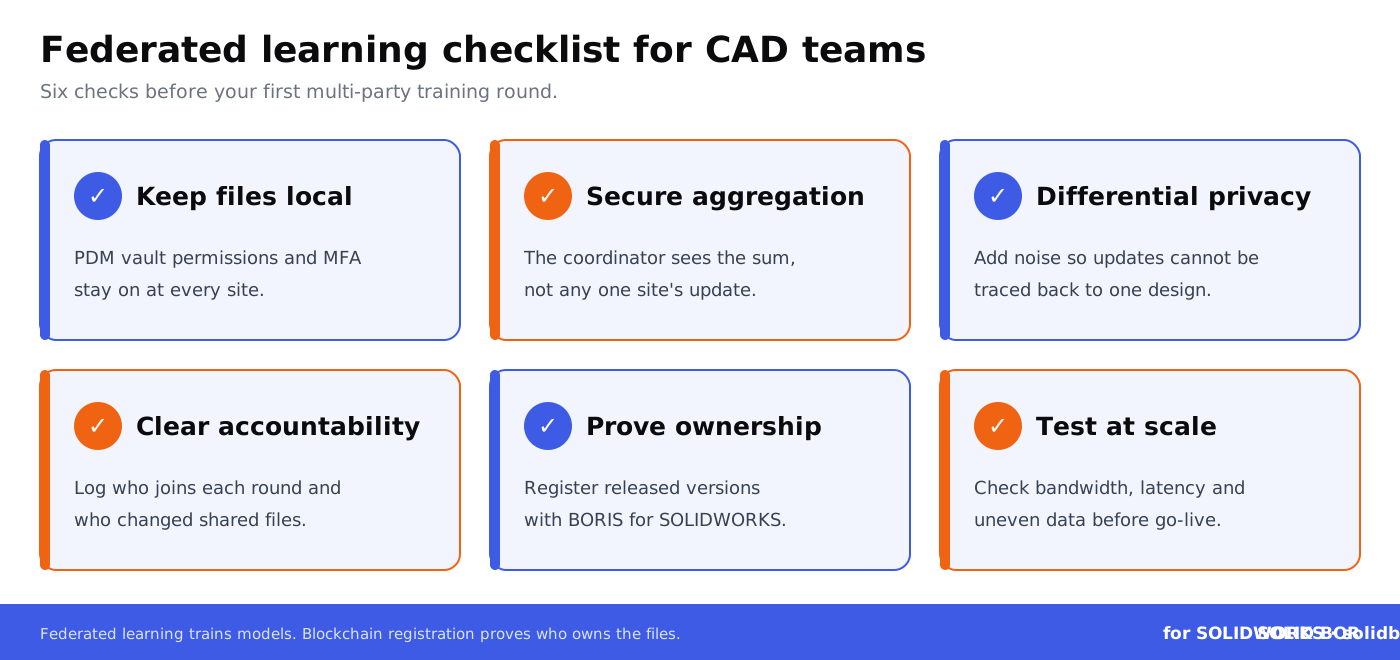
- Ensuring encryption protocols are robust enough to prevent data inference between collaborators.
- Maintaining a clear accountability framework when participants modify shared files.
- Testing scalability to prevent performance bottlenecks during heavy multi-party collaboration.
Dirk-Jan advises SMEs on balancing customization with standardization: “Regulatory demands like GDPR impose strict compliance, yet templates can streamline legal documentation for SMEs.” Our guide to GDPR compliance for CAD data covers the basics.
“The success of federated learning in CAD workflows depends on blending technical security with legally defensible frameworks.”
Dirk-Jan Bonenkamp, CLO, CADChain
Making CAD Security Accessible for Distributed Teams
The adoption of federated learning in CAD systems transforms distributed collaboration. By decentralizing model training, teams can securely innovate without exposing sensitive design files.
Thinking ahead, Violetta highlights the path forward: “Federated learning must evolve alongside advancing CAD security tools. Integrated platforms like BORIS provide early-stage accessibility that small-to-mid-sized enterprises desperately need.” For those looking to develop long-term strategies, review our Secure CAD Collaboration Framework.
The next phase of CAD security innovation continues with scalable frameworks tailored to SMEs. Dive deeper into how blockchain, AI and other technologies fit together in our guide to optimizing CAD security for SOLIDWORKS.
People Also Ask:
What is Federated Learning?
Federated Learning is a machine learning approach where models are trained collaboratively across multiple devices or servers without sharing raw data. This ensures data privacy while enabling robust model training.
How does Federated Learning improve CAD security?
Federated Learning enables secure collaboration on CAD projects by training models directly on distributed data without centralizing sensitive information. This protects intellectual property and prevents data breaches.
Is Federated Learning widely used in design industries?
While Federated Learning is being explored in various industries, its application in the design sector, including CAD workflows, is still emerging. However, its potential for enhancing data security and collaboration is gaining interest.
What challenges exist when implementing Federated Learning?
Federated Learning faces challenges such as maintaining model accuracy with non-uniform data across devices, ensuring system scalability, and managing communication latency between distributed nodes.
What role does encryption play in Federated Learning?
Encryption is vital in Federated Learning for securing data during transmission and aggregation. Techniques like homomorphic encryption ensure that computations can occur without revealing sensitive data.
Can Federated Learning be combined with other security tools?
Yes, Federated Learning is often paired with additional security measures such as secure multi-party computation and differential privacy to enhance data protection and mitigate vulnerabilities.
How sustainable is Federated Learning in large-scale use cases?
Federated Learning shows promise for large-scale use with high computational power and bandwidth. Its sustainability depends on advancements in reducing communication costs and improving model efficiency.
Does Federated Learning comply with data regulations like GDPR?
It can support compliance with frameworks like GDPR by keeping data localized and reducing the need for data transfer, thereby preserving user privacy. It does not make processing compliant on its own: model updates can still reveal personal data, so the usual GDPR obligations still apply.
What industries are utilizing Federated Learning today?
Industries including healthcare, finance, telecommunications, and autonomous vehicles utilize Federated Learning to protect sensitive information while achieving shared insights through collaborative training.
Will Federated Learning continue to evolve in 2026?
Yes, advancements in computational capabilities and encryption methodologies are driving the evolution of Federated Learning, widening its adoption and addressing current limitations in scalability.
FAQ on Federated Learning for Collaborative CAD Security
What makes federated learning crucial for protecting CAD files?
Federated learning decentralizes AI training, ensuring that sensitive CAD files remain localized and protected. This minimizes risks like IP theft or unauthorized modifications while allowing collaborative model development. Learn more about privacy-driven solutions in federated learning.
How does federated learning ensure regulatory compliance?
Federated learning supports compliance with GDPR and similar regulations by keeping raw data decentralized. Secure aggregation hides each participant’s model update from the coordinating server, protecting confidentiality during collaborative workflows. It does not replace a legal review, but it makes adhering to evolving data privacy laws in distributed environments easier.
Can federated learning address CAD-specific security vulnerabilities?
Partly. Federated learning reduces exposure by keeping data decentralized, and pairing it with blockchain registration adds tamper-evident audit trails. Coupled with strong encryption and access control, it helps secure collaborative CAD workflows. For more, explore common CAD vulnerabilities and solutions.
What industries can benefit from federated learning in CAD?
Federated learning can enhance security in sectors like aerospace, automotive, and industrial design by facilitating distributed yet secure AI training. These industries often face strict IP protection and data compliance needs, making federated approaches ideal for collaborative projects.
Are there scalability issues with federated learning for CAD workflows?
Scalability remains a challenge, as federated learning requires robust communication protocols and computational resources. However, advances in distributed computing and optimized aggregation algorithms are helping overcome these issues, enabling effective operations even for large-scale CAD collaborations.
How does federated learning complement blockchain technologies?
Blockchain delivers tamper-evident tracking of ownership and audit trails, while federated learning ensures secure AI training without exposing raw data. Together, these technologies fortify CAD security for collaborative yet compliant workflows, as explained in blockchain-backed CAD solutions.
What are the key technical requirements for deploying federated learning?
To implement federated learning for CAD security, you need secure aggregation protocols, encryption tools, and infrastructure that supports decentralized data processing, such as TensorFlow Federated or Flower. BORIS for SOLIDWORKS can add the ownership record for the design files themselves.
What mistakes should be avoided during federated learning adoption?
Avoid inadequate encryption, ignoring scalability tests, and neglecting regulatory frameworks like GDPR. Implement clear accountability mechanisms and robust secure-aggregation methods to ensure successful and effective collaboration.
How does federated learning handle scalability in SME contexts?
SMEs can start small with an open-source framework such as TensorFlow Federated or Flower and a few participants, keeping design files in each site’s PDM vault. CADChain’s BORIS for SOLIDWORKS can register ownership of released versions alongside it; BORIS is a blockchain registration add-in, not a federated learning framework.
Is federated learning cost-effective for CAD security?
It can be. Federated learning can reduce costs by training on local data and avoiding a central data store for sensitive files, although each participant needs local compute and you still need standard security measures. It offers SMEs an accessible path to secure AI collaboration while enhancing IP and CAD file protection.