
On 23 October 2026, TraceParts became part of the KEYENCE Group. TraceParts runs one of the best-known free CAD content platforms for engineers, with more than 6.5 million registered users and over 2,300 supplier-certified catalogs. KEYENCE, the Japanese maker of sensors, machine vision and measuring systems, already bought CADENAS, the company behind 3Dfindit and PARTcommunity, in May 2025.
For SOLIDWORKS users this is not distant corporate news. If you have ever dropped a bearing, a cylinder, a linear guide or a sensor into an assembly, there is a good chance the model came from TraceParts or CADENAS. TraceParts has been a SOLIDWORKS Certified Solution Partner since 1998 and delivers native .sldprt and .sldasm files. With today's announcement, two of the most widely used supplier part libraries now sit in the same industrial group.
The announcement promises continuity: the brand, teams and contracts stay, and TraceParts keeps full responsibility for the user and catalog data it manages. That is a good moment to look at what that data actually is. Every search and download tells a part vendor something about what you are designing. This article explains what was announced, what the TraceParts terms say about your download data, and what SOLIDWORKS teams should check now.
TL;DR: one group now owns two big part libraries, so check what your downloads reveal
TraceParts joined the KEYENCE Group on 23 October 2026. No price was disclosed, and TraceParts says contracts, teams and data responsibility stay as they are. Under the TraceParts terms, downloading a supplier's model lets TraceParts send your personal data to that supplier for commercial follow-up, and TraceParts does not warrant the accuracy of the models. Use company accounts with clear rules, keep downloaded parts in a controlled PDM library, check critical dimensions against datasheets, and keep dated proof of what your own team designed around those parts.
What exactly was announced on 23 October?
TraceParts published the news in a press release dated 23 October 2026 from Saint-Romain, France. The text is short. It says TraceParts becomes part of the KEYENCE Group on that day and wants to use KEYENCE's international experience, resources and industrial expertise to speed up development of its solutions.
The release does not give a purchase price, a deal structure or any approval conditions. It does not name a spokesperson either. The only quote is a general company statement: "We are pleased and proud to begin this new chapter in TraceParts' history."
The facts it does give are useful for anyone who depends on the platform:
- TraceParts: founded in 2001, more than 6.5 million registered users, over 2,300 supplier-certified product catalogs and billions of 2D drawings, 3D CAD models and datasheets.
- Business model: TraceParts helps component makers and distributors publish their product data and also sells them targeted digital advertising.
- KEYENCE: founded in Japan in 1974, about 400,000 customers in 110 countries, 250 offices in 46 countries, more than 12,000 employees and revenue of about $7.3 billion.
- Continuity: the TraceParts brand, teams and contacts remain, and all existing contracts and commitments with customers and partners stay valid.
Nothing changes in the SOLIDWORKS workflow today. You still search the TraceParts site, choose the SOLIDWORKS format and get a native part or assembly file. What has changed is who owns the company that records those searches and downloads.
Why should SOLIDWORKS users care who owns a part library?
Supplier models are part of almost every machine design. TraceParts says more than 100 million CAD models can be downloaded free of charge in SOLIDWORKS format, and its files carry BOM properties such as part number, supplier name and description, so they flow straight into your BOM, ERP and PDM. That makes a part library a quiet piece of your design infrastructure, like your PDM vault or your Toolbox settings.
In May 2025, KEYENCE took over CADENAS, the Augsburg company founded in 1992 that runs the 3Dfindit platform and says it connects around 10 million engineers and designers with component suppliers. At the time CADENAS said it would remain a neutral, reliable partner and that customer data would continue to be handled internally. TraceParts now makes a very similar promise.
Both promises are reasonable, and there is no sign that either will be broken. But they are promises, not technical controls. KEYENCE is also a component maker in its own right, selling sensors, code readers and vision systems that engineers place in their designs. When the owner of a platform also competes with some of the suppliers on it, engineers and suppliers will reasonably want to know how neutrality and data separation are kept. The 23 October release says TraceParts stays independent but does not describe how that is organised.
What happens to your data when you download a supplier model?
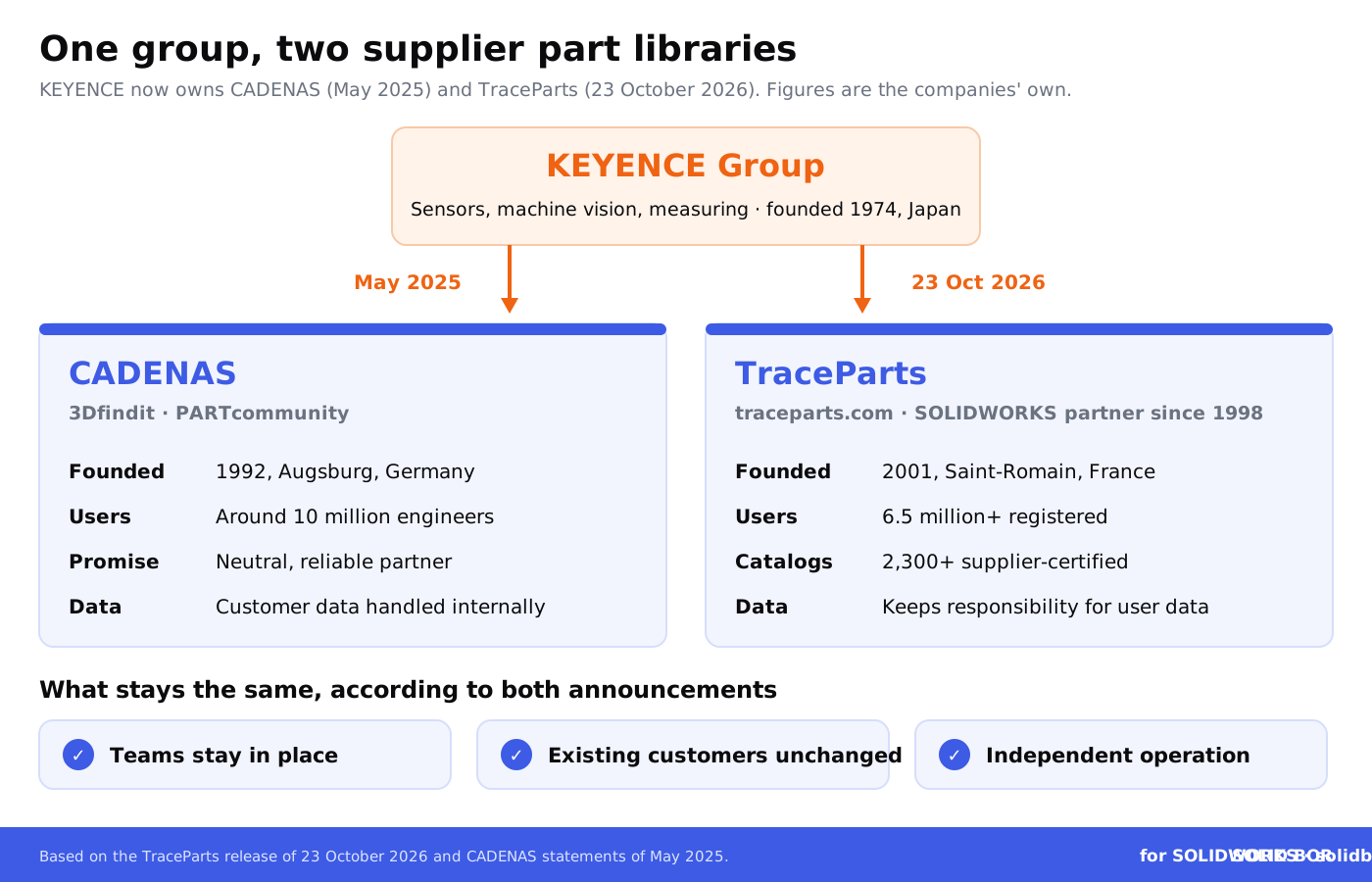
This is the part most engineers never read. The TraceParts General Terms of Use and Privacy Policy, last updated on 10 June 2026, say that all actions on objects on the website are stored in a database. Through a service called TraceParts Analytics, part vendors can see trends in real time and full reports, and the terms describe this as "giving them access to Users for their commercial follow-up".
The consequence is spelled out clearly: by accessing a vendor's content, the user consents to TraceParts sending their personal data to that vendor, which then processes it under its own privacy policy. The terms add that a supplier only receives data about users who downloaded data from its own products. Personal data is kept for the duration of the account relationship and then for archival purposes.
None of this is hidden or unusual. Free part libraries are paid for by the suppliers who publish their catalogs, and leads are part of what suppliers pay for. But it has two practical effects for a SOLIDWORKS team:
- Your downloads describe your project. A burst of downloads for a vision sensor, a gripper, a specific linear axis and a certain motor size says a lot about the machine you are building, and for whom, before anything is announced.
- The data leaves with a person, not a project. Accounts are usually personal. When an engineer leaves, their download history and supplier contacts stay tied to their own profile, not to your company records.
This matters most for teams working under an NDA or on a product that is not yet public. Your contract clauses for CAD IP probably cover what you share with suppliers, but rarely what your engineers reveal by searching a supplier's catalog. Under GDPR you can ask TraceParts and each vendor what they hold about you, and our guide to GDPR compliance for CAD data explains how personal data and design data overlap.
How do CADENAS and TraceParts compare after the deal?
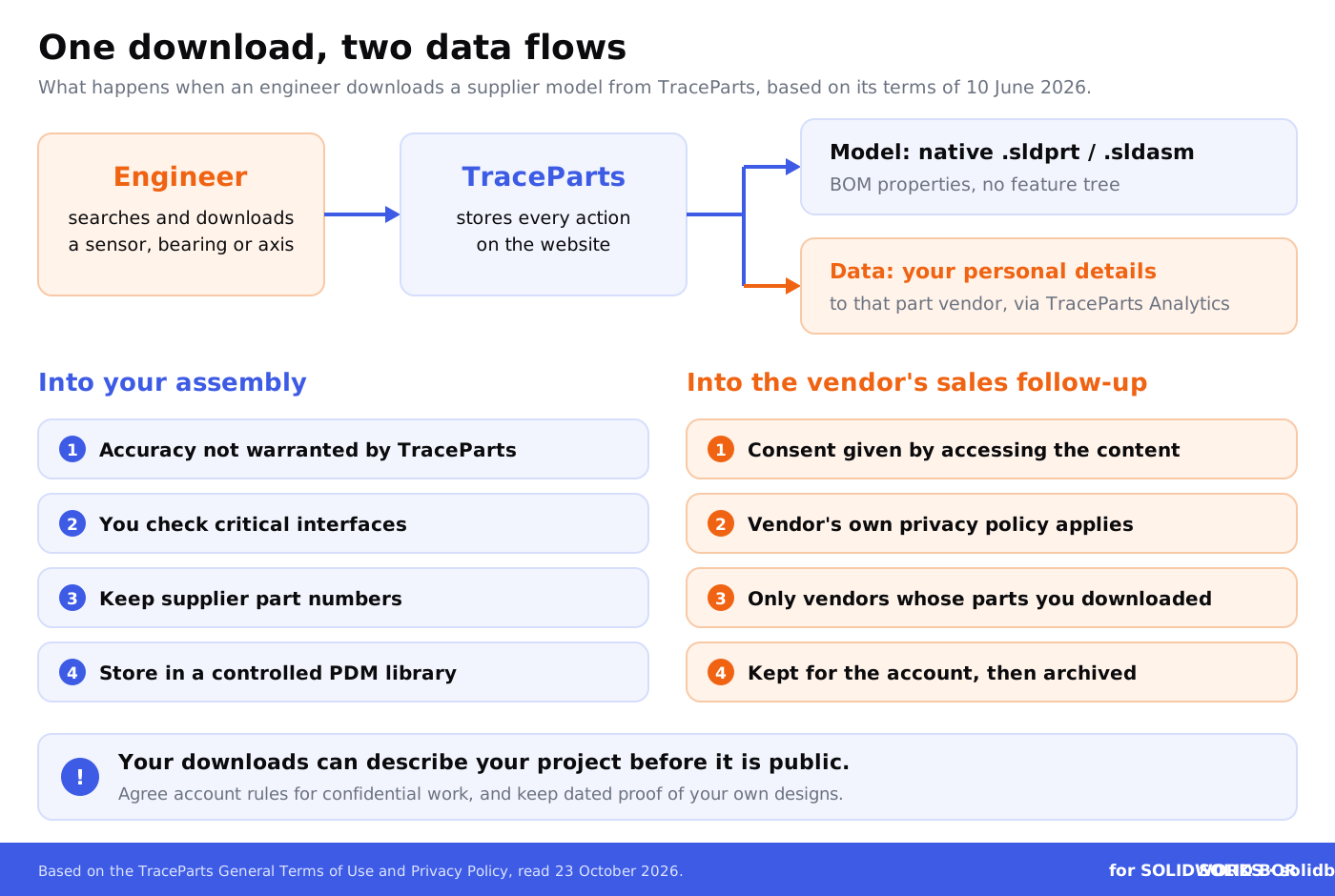
Here is what each company has said publicly about itself and its move into the KEYENCE Group. Figures are the companies' own.
The two platforms still run separately, and neither company has announced a merger of catalogs, accounts or data. If that changes, the privacy terms of each platform are where you will see it first, so it is worth saving today's versions.
Can you trust the geometry you download?
Ownership does not change the quality of the models, but the terms are a reminder of who carries the risk. TraceParts states that it cannot warrant the accuracy, integrity or quality of the data, or that the data is free of viruses or harmful code. The models conform to the source data provided by the part vendors, and users are responsible for assessing the risks of using them.
TraceParts SOLIDWORKS files do not include a feature tree, on purpose: the dimensions follow a standard or a supplier part number, and changing them would create ordering problems. Some models include threads or mates. In practice that means three habits: check critical interfaces against the datasheet, do not edit the supplier geometry, and keep the supplier part number in the file properties so purchasing orders the right thing.
Downloaded archives also arrive from outside your network. Treat them like any other incoming file, as our guide to endpoint protection for CAD workstations explains, and look at the common vulnerabilities in CAD file sharing if parts travel on to your own suppliers.
Keep proof of what your team designed around supplier parts.
BORIS for SOLIDWORKS registers your CAD files with a blockchain timestamp and gives you a certificate of ownership for each version, right inside SOLIDWORKS.
👉 See how BORIS for SOLIDWORKS works
Where does supplier geometry end and your IP begin?
A typical assembly mixes three kinds of content: standard parts from Toolbox, supplier models from libraries like TraceParts, and the parts, layouts and integration work your own team created. The value, and the IP, sits in the last group and in how the whole assembly fits together. The terms are clear that using TraceParts gives you no licence to its trademarks, copyrights or other IP, and supplier models remain the suppliers' content.
When a dispute comes up, for example with a former employee, a customer or a competitor who claims the same idea, you need to show which parts and which version of the assembly were yours, and when. Our articles on CAD ownership documentation and proof of ownership in IP litigation describe what courts and partners look for. For large assemblies, registering multi-file assemblies lets you prove the state of your own files without claiming supplier geometry as yours.
The KEYENCE deal is also a reminder that ownership of tools and platforms changes all the time. Our guide to CAD rights in mergers and acquisitions covers the same question from the other side: what happens to design data when a company you work with is bought.
What should SOLIDWORKS teams do now?
- Save today's terms. Download or print the current TraceParts terms and the 3Dfindit terms, so you can compare them if anything changes after the deal.
- Decide which accounts engineers use. Company email addresses and a short written rule make download history part of company records, not private profiles. Review marketing settings in each profile.
- Think about sensitive projects. For confidential or pre-launch work, agree before the project starts how parts are sourced, since each download can reach the vendor as a sales lead.
- Use one controlled library. Store approved supplier models in your PDM vault with clear permissions instead of on each desktop. The SOLIDWORKS PDM security guide shows how to set up groups and folders, and version control in PDM keeps the history.
- Keep BOM properties intact. Do not delete the supplier part number, supplier name or description that TraceParts writes into the file properties.
- Check critical dimensions. Compare mounting holes, shaft diameters and envelopes with the current datasheet before release, and record that you did.
- Treat incoming archives as external files. Scan and open them on protected workstations, as you would any file from outside.
- Keep dated proof of your own work. Register your parts and assemblies at key milestones, so you can always separate your design from third-party geometry.
If you pass assemblies that contain supplier models on to manufacturers, our guides on sharing CAD files with suppliers and supplier collaboration security explain how to share only what each partner needs.
How does this fit the bigger picture for CAD users?
Across our network this week, the common thread is who sees your design data and what you can prove about it:
- Insider leaks. On CADChain, read how a Seoul court cut the sentence of an ex-Samsung engineer in the DRAM leak to CXMT, and why notebooks, printouts and photos still beat many technical controls.
- Data that moves across hubs. BORIS Inventor looks at the Autodesk Fusion October 2026 update and its copy across hubs feature, and what Inventor teams should check about data control.
- Characters copied by AI. Blended BORIS covers Gruffalo illustrator Axel Scheffler considering legal action over ChatGPT copies, and the evidence character artists should keep.
The link with the TraceParts deal is simple: the platforms you use decide what they record about you, and you decide what you record about your own work. For a recent example of design data that left a company in a much less friendly way, see how ransomware gangs steal and publish CAD drawings.
Conclusion
TraceParts joining the KEYENCE Group does not change how you download a part into SOLIDWORKS tomorrow morning. The brand, the files and the contracts stay the same, and both TraceParts and CADENAS promise independence and responsible data handling.
What the deal does is make one fact easier to see. Free part libraries run on data about engineers, and the TraceParts terms say plainly that your downloads can reach the part vendor for commercial follow-up. Set clear account rules, keep supplier models in a controlled library, check the geometry you rely on, and keep independent, dated proof of the designs that are truly yours.
Make your SOLIDWORKS designs provably yours.
BORIS for SOLIDWORKS adds blockchain timestamps and certificates of ownership to your CAD files, so you can show what you designed and when, whatever parts you used.
👉 Get BORIS for SOLIDWORKS
FAQ: TraceParts, KEYENCE and your SOLIDWORKS data
When did TraceParts join the KEYENCE Group?
On 23 October 2026, according to a TraceParts press release published the same day from Saint-Romain, France.
How much did KEYENCE pay for TraceParts?
The price was not disclosed. The announcement gives no financial terms or deal structure.
Does anything change for TraceParts users now?
Not according to the announcement. The brand, teams and contacts remain, all existing contracts and commitments stay valid, and TraceParts keeps full responsibility for the user and catalog data it manages.
Does KEYENCE also own CADENAS?
Yes. CADENAS, the Augsburg company behind 3Dfindit and PARTcommunity, became part of the KEYENCE Group in May 2025. Both platforms still operate separately.
Do part vendors see who downloads their models on TraceParts?
Yes. The TraceParts terms say that by accessing a vendor's content you consent to TraceParts sending your personal data to that vendor, which uses it for commercial follow-up under its own privacy policy. Vendors only receive data about users who downloaded their products.
Are TraceParts SOLIDWORKS models guaranteed to be accurate?
No. The terms say TraceParts cannot warrant accuracy, integrity or quality, or that files are free of harmful code. Models follow the vendor's source data, and users must check them, especially critical interfaces.
Do TraceParts SOLIDWORKS files have a feature tree?
No. TraceParts delivers native .sldprt and .sldasm files without a design tree, with BOM properties such as part number and supplier name in the file properties. Some models include threads or mates.
How can I separate my own design from supplier models when proving ownership?
Keep supplier part numbers in the properties, store supplier models in a controlled library and register your own parts and assemblies with a dated record. BORIS for SOLIDWORKS adds a blockchain timestamp and a certificate of ownership to each registered version.