
On 14 October 2026, the AI start-up Spectral Labs said its AI agent had passed the Certified SOLIDWORKS Professional (CSWP) exam, completing all three segments in one sitting of about three hours. In the same report, the company said the TesterPRO software that delivers the CSWA and CSWP exams exposes the answer keys in an unsecured local database, and that it reported the flaw to Dassault Systèmes before publishing.
The CSWP is one of the best-known SOLIDWORKS certifications. Many companies list it in job adverts, and many engineers use it to show they can build parts, edit models and assemble mechanisms under time pressure. Two things happened at once: software showed it can do that work inside SOLIDWORKS, and the exam itself turned out to have a security hole.
For SOLIDWORKS engineers, CAD managers and manufacturing SMEs, the story raises three practical questions. What does a CSWP certificate still prove? What happens when AI agents start driving SOLIDWORKS on your own workstations? And who can prove they designed a part when software did part of the modelling? Here is what was announced, what is still unclear, and what to do about it.
TL;DR: an AI agent passed the CSWP, and the exam had a flaw
Spectral Labs says its agent, built on its own CAD harness called Quartz and its SGS-Mk2 foundation model, passed the live CSWP exam many times, though never with a perfect score. It acted only through CAD tools, the SOLIDWORKS COM API and an answer-submission function. The company also found that the TesterPRO exam client stores answer keys in an unsecured local SQLite database, which it says calls into question TesterPRO-based certifications issued in 2026. We found no public statement from Dassault as of 17 October. For your team: treat certificates as one signal among several, set rules before AI agents touch your SOLIDWORKS files, and keep dated proof of who designed what.
What did Spectral Labs announce?
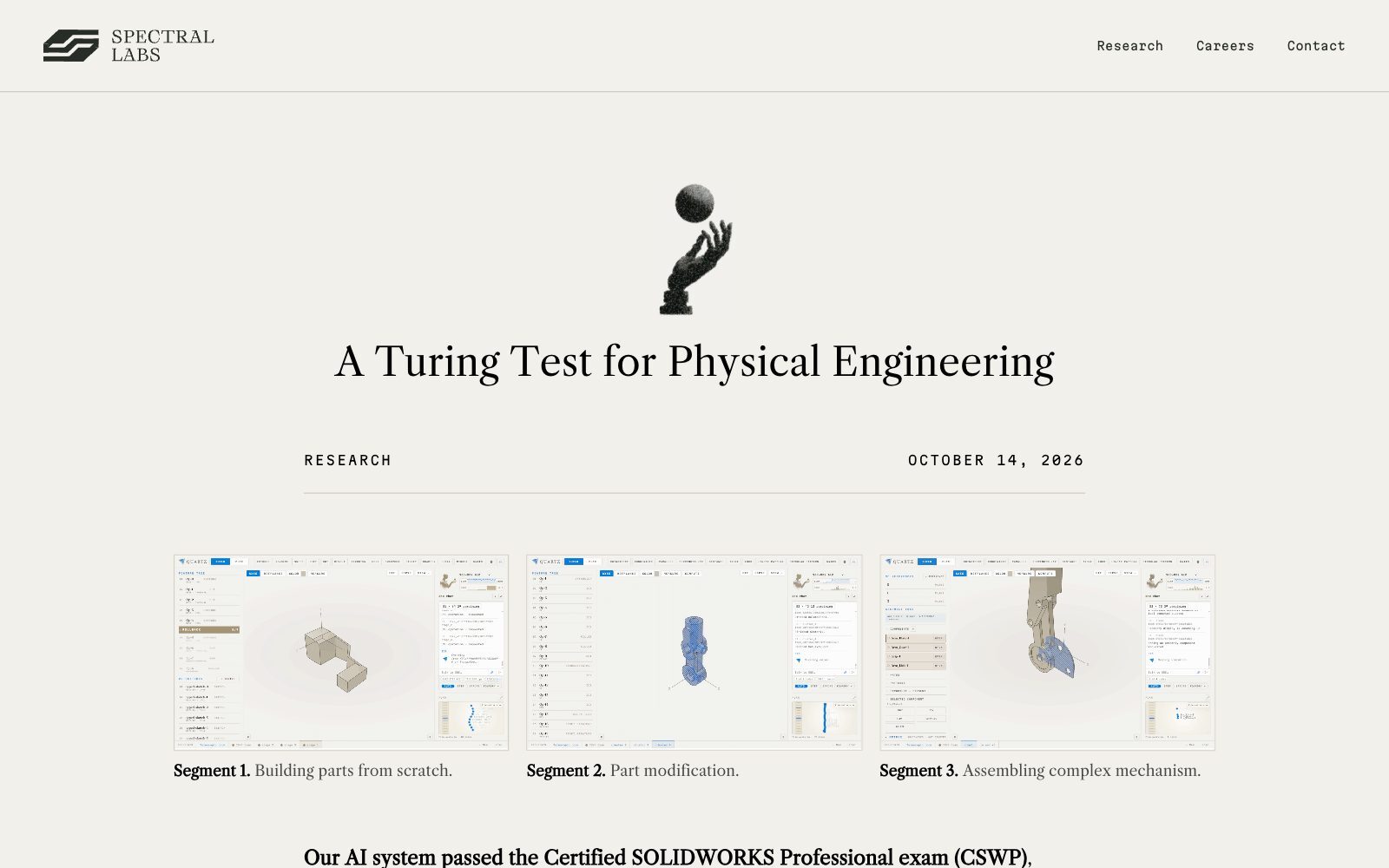
Spectral Labs published its results in a research post titled "A Turing Test for Physical Engineering". According to the Spectral Labs report, the agent works through the exam unassisted: no person tells it which features to use. The company says that, to its knowledge, this is the first AI system to pass a professional CAD certification.
The key points of the announcement:
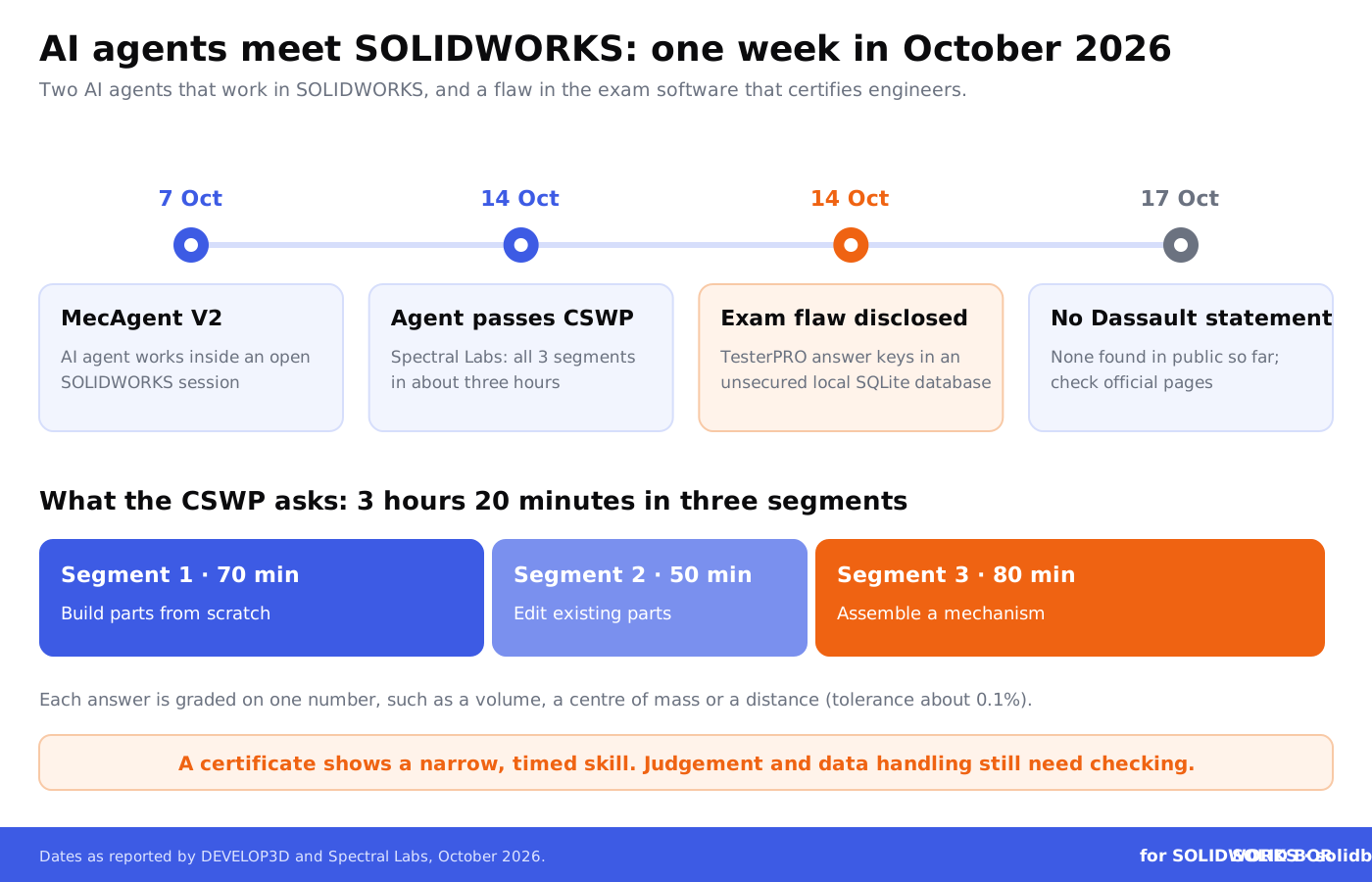
- The exam: the CSWP takes 3 hours 20 minutes in three segments: part construction from scratch (70 minutes), part editing (50 minutes) and assemblies (80 minutes). Answers are graded on a single number such as a volume, a centre of mass or a distance.
- The agent: a general AI model acts as the orchestrator, and SGS-Mk2, Spectral's own CAD model, handles the geometric reasoning. Both work through Quartz, Spectral's CAD software and harness.
- The result: the agent has passed the live exam many times, though not yet with a perfect score, mainly because the harness times out in the assembly segment.
- The access: during certification runs, the agent could act only through Quartz's CAD tools, the SOLIDWORKS COM API and an answer-submission function. It had no shell, file or database access.
- The cost: one frontier AI model reliably passed when used as the orchestrator, but cost about 20 times as much as a human operator in its best run. Adding SGS-Mk2 cut per-problem cost by 46% to 87% on problems that need real geometric reasoning, measured on 45 practice problems the team wrote itself.
The team also says that none of its members claims a CSWP certificate from the agent's passes. Several team members already hold CSWA or CSWP certificates of their own.
What is the TesterPRO answer-key flaw?
The CSWA and CSWP exams are delivered through TesterPRO, a client from Tangix that candidates download through the SOLIDWORKS VirtualTester site and run on their own computer. While testing its harness, Spectral found that TesterPRO exposes the exam answer keys through an unsecured local SQLite database. The company published a short demonstration in which a simple program solves a CSWA exam in under a minute using only Windows APIs.
Spectral Labs is direct about the consequence:
“…this finding unfortunately calls into question TesterPro-based certifications issued in this calendar year.”
Spectral Labs, A Turing Test for Physical Engineering, 14 October 2026
The company says it reported the issue to Dassault Systèmes before it published. As of 17 October 2026 we found no public statement from Dassault about the flaw, a fix, or what it means for certificates already issued. That may change, so check the official certification pages before you act on any certificate decision.
What does a CSWP certificate prove now?
A CSWP has always proved one thing well: that someone could build, edit and assemble SOLIDWORKS models to a precise result within a time limit. It never proved good design judgement, knowledge of your standards, or honesty with confidential data. This week adds two new limits.
First, if the answer keys could be read from a local database, a 2026 TesterPRO certificate on its own is weaker evidence than it used to be. That does not mean anyone cheated. Most holders earned their certificate honestly, and this flaw does not change their skills. It means the paper alone no longer settles the question.
Second, an AI agent can now pass the same test. The exam measures a narrow, well-defined task, which is exactly what software does well.
For hiring managers, the practical answer is simple: keep the certificate as a useful signal, and add a short practical test and a conversation about design decisions and data handling. For engineers, the value of a certificate now rests more on what you can explain than on the score.
What does it mean when AI agents drive SOLIDWORKS?
Spectral is not the only one. On 7 October 2026, MecAgent released version 2 of its AI tool, which DEVELOP3D reports works inside an open SOLIDWORKS session. It offers text-to-CAD, image-to-CAD, drawing-to-CAD, CAD-to-drawing and STEP-to-SLDPRT conversion with a rebuilt feature tree, and it can write macros. MecAgent's demo was a model helicopter of about 56 parts built in under five hours of unattended runtime.
Tools like these work through the same routes as any add-in or macro: the SOLIDWORKS API, your file system and, often, a cloud AI model. That makes them useful. It also means an agent can open, change, export and send files at machine speed. Before anyone installs one, read our notes on how SolidWorks plugins access your CAD files, plugin security best practices and SolidWorks API security.
Spectral's report shows a sensible pattern: during its exam runs, the agent had only the tools it needed and no shell, file or database access. Apply the same rule in your company. An AI agent should work on a copy of the files it needs, with the narrowest access possible, and its actions should be logged.
Ask every AI vendor the same questions: where do my files go, which AI model processes them, is anything stored, and may anyone train on my geometry? Dassault has answered part of this for its own tools. SOLIDWORKS CEO Manish Kumar said on 7 October that its AI models are trained on data Dassault owns and generates, never on customer data. Third-party agents have their own terms, so read them. Our guides to integrating third-party security tools with SolidWorks and SolidWorks cloud security cover the basics.
Keep dated proof of every design, whoever or whatever helped model it.
BORIS for SOLIDWORKS registers your CAD files with a blockchain timestamp, so you have a certificate of ownership for each version that matters.
👉 Try BORIS for SOLIDWORKS
Who owns a design an AI agent helped build?
This is where the story meets intellectual property. In most countries, copyright protects the work of human authors. In the United States, the Copyright Office has said that material generated by AI without enough human control is not protected, while human choices and edits can be. Patents, design rights and trade secrets have their own rules, but all of them reward the same thing: being able to show who created what, and when.
When an engineer models every feature, the PDM history and file metadata tell a reasonable story. When an agent builds 56 parts overnight from a specification, that story gets thinner. The engineer's real contribution sits in the specification, the review and the edits, and those need to be recorded too.
Contracts matter as well. Check that employment and freelance agreements cover work done with AI tools. Our articles on CAD asset ownership in employment contracts, creator versus owner in CAD projects and how to prove authorship of CAD designs explain the basics, and our earlier news on Nvidia's open-source B-rep kernel covers why exact geometry is becoming more valuable to AI tools.
What should SOLIDWORKS teams do now?
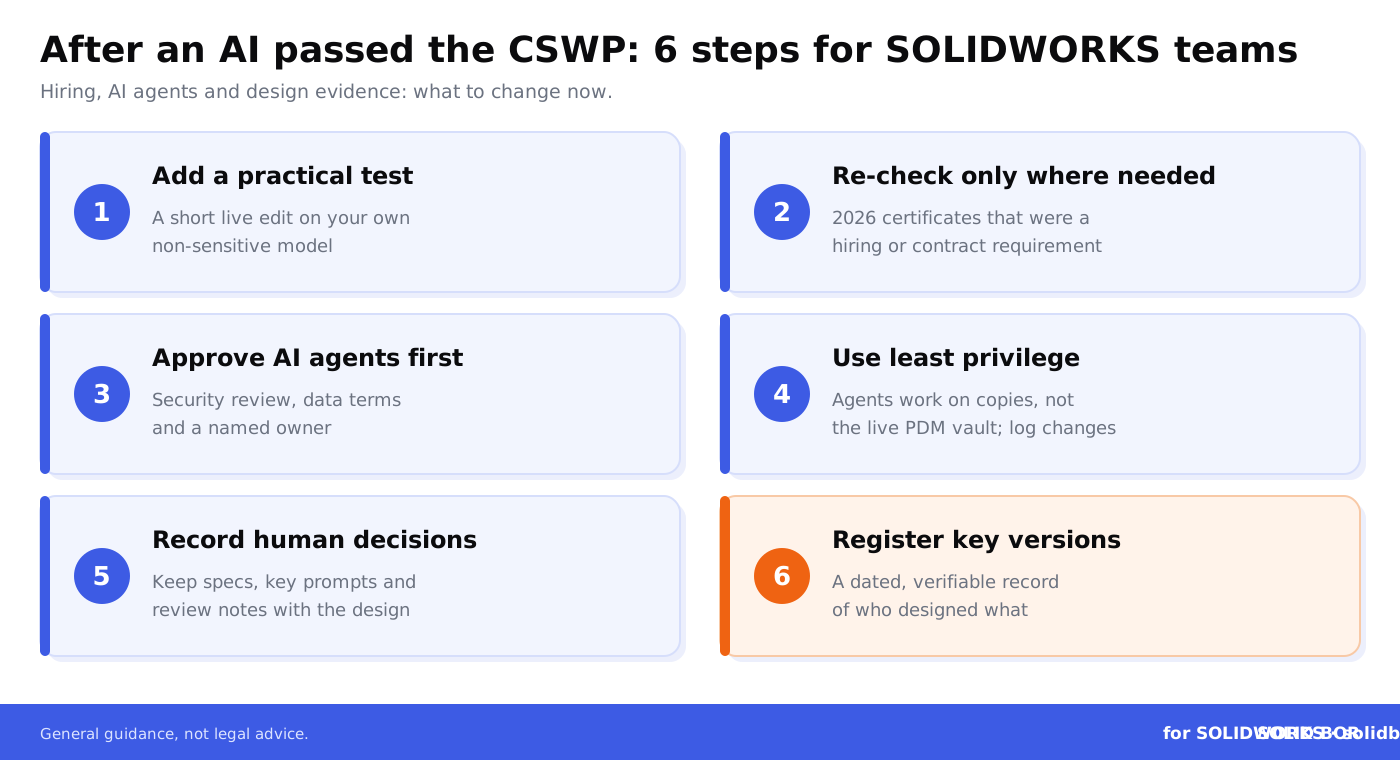
- Do not panic about existing certificates. Most holders earned them honestly. Where a 2026 CSWP or CSWA was a hiring or contract requirement, add a short practical check instead of relying on the paper alone.
- Update your hiring test. Ask candidates to edit one of your non-sensitive models live and explain their choices. That tests what neither an exam nor an agent shows: design judgement.
- Watch for Dassault's response. Check the official certification pages for any change to TesterPRO or to 2026 certificates.
- Approve AI agents before installation. Treat every AI add-in like any other plugin: security review, data terms, and a named owner.
- Use least privilege. Let agents work on copies in a test folder, not on your live PDM vault, and log what they change. Our SOLIDWORKS PDM security guide shows how to set vault permissions.
- Keep human decisions on record. Save the specification, the prompts that matter and the review notes with the design, so you can show who decided what.
- Register the versions that matter. A dated, independent record of each key design version is strong evidence when authorship is questioned. See why blockchain timestamping proves "first in time".
How does BORIS for SOLIDWORKS help prove authorship?
As AI agents take on more modelling, the question "who designed this, and when?" gets harder to answer from the file alone. PDM histories help, but they sit inside systems that can be migrated, reconfigured or lost, and they were not built as evidence for a dispute.
BORIS for SOLIDWORKS, the add-in by CADChain, works inside SOLIDWORKS and registers your CAD files with a blockchain timestamp, giving you a certificate of ownership for each registered version. That record does not depend on a certificate exam, an AI vendor or a cloud platform, and it works alongside PDM. To get started, see the BORIS plugin installation guide for SolidWorks.
How does this fit the bigger picture for CAD users?
Across our network this week, the same theme keeps coming back: AI is getting closer to design data, and the rules about who controls that data are still being written.
- Trade secrets are holding up EU data rules. On CADChain, read how trade secret concerns under the EU Data Act stalled the Digital Omnibus in October, and what manufacturers should do while the rules are unsettled.
- Companies are spending more on AI than they are getting back. BORIS Inventor looks at Autodesk's 2027 State of Design & Make report, where 75% of companies plan to spend more on AI but only 40% say they are close to their AI goals.
- AI now edits 3D models part by part. Blended BORIS explains what the Meshy Edit launch and Meshy's terms mean for who owns AI-assisted 3D models.
For more on keeping engineering knowledge inside your company, see our guide to trade secret protection for CAD files.
Conclusion
An AI agent passing the CSWP is a real milestone, and an honest one: Spectral Labs is open about the cost, the failures and the limits. It shows that well-defined SOLIDWORKS tasks can now be automated. It does not show that an agent can replace an engineer's judgement on a real product.
The TesterPRO flaw is the more urgent part for employers, until Dassault says how it will respond. Meanwhile, the steps are clear: test skills, not just paper; give AI agents the least access they need; and keep a dated record of who designed what. Those habits will matter more each time an agent does more of the modelling.
Prove what your team designed, before anyone asks.
BORIS for SOLIDWORKS adds blockchain timestamps and certificates of ownership to your CAD files, right inside SOLIDWORKS.
👉 Get BORIS for SOLIDWORKS
FAQ: AI agent and the CSWP exam
Did an AI really pass the SOLIDWORKS CSWP exam?
Spectral Labs says its agent passed the live CSWP exam many times, completing all three segments in about three hours, though not yet with a perfect score. This is the company's own report; we found no independent confirmation or statement from Dassault as of 17 October 2026.
What is the TesterPRO flaw?
Spectral Labs says the TesterPRO client, which delivers the CSWA and CSWP exams, exposes exam answer keys through an unsecured local SQLite database. It reported the issue to Dassault Systèmes before publishing.
Are 2026 CSWP certificates still valid?
Dassault has not announced any change as of 17 October 2026. Spectral Labs says the flaw calls into question TesterPRO-based certificates issued this year. Most holders earned theirs honestly; where it matters, add a practical skills check.
Did the AI agent use the flaw to pass?
Spectral Labs says no. During certification runs its agent could only use CAD tools, the SOLIDWORKS COM API and an answer-submission function, with no shell, file or database access.
What is MecAgent V2?
An AI tool released on 7 October 2026 that works inside an open SOLIDWORKS session and offers text-to-CAD, drawing-to-CAD, STEP-to-SLDPRT conversion and macro writing, according to DEVELOP3D.
Is it safe to let an AI agent work in SOLIDWORKS?
It can be, with rules. Review the vendor's data terms, give the agent the narrowest access it needs, let it work on copies rather than your live vault, and log what it changes.
Who owns a CAD model built with an AI agent?
It depends on your contracts and on the law where you work. In the United States, AI-generated material without enough human control is not protected by copyright, while human choices and edits can be. Record the human decisions and keep dated proof of each key version.
How can I prove I designed a part?
Keep PDM history, specifications and review notes, and add an independent record. BORIS for SOLIDWORKS registers CAD files with a blockchain timestamp and gives you a certificate of ownership for each registered version.