
On 8 October 2026, Nvidia published USD BRep 1.0.0, an open-source library for NURBS-based boundary representation (B-rep) solid modelling, under the Apache 2.0 licence. It is built on SMLib, a commercial CAD geometry kernel Nvidia gained when it bought Solid Modeling Solutions in 2022, and it reads and writes exact solid geometry in OpenUSD. Nothing changes inside SOLIDWORKS, which still runs on Siemens' Parasolid kernel, but the release makes exact CAD geometry much easier to feed into AI tools.
Geometry kernels are the least visible part of any CAD system. They are the maths engine that creates and edits the faces, edges and surfaces of a solid, and almost nobody outside a CAD vendor ever touches one. Until now, a team that wanted to build its own tool on a serious B-rep kernel usually needed a commercial licence. A free, permissively licensed kernel from Nvidia, a company at the centre of AI computing, is therefore news, even if it does not change your next SOLIDWORKS session.
For SOLIDWORKS engineers, CAD managers and manufacturing SMEs, the more important question is not which kernel wins. It is what happens to your design data when exact geometry becomes easy for software, and AI, to read. Here is what Nvidia released, what it means for SOLIDWORKS users, and what to check in your own company.
TL;DR: Nvidia USD BRep in one paragraph
USD BRep is a standalone C++ and Python library for B-rep solid modelling, released as version 1.0.0 on 8 October 2026 under Apache 2.0. It is based on SMLib, which offers Booleans, fillets, shelling, surface intersections and tessellation, and it stores solids in OpenUSD through an omniSolid schema. Nvidia is not accepting outside code contributions yet, and its own documentation lists known limitations. SOLIDWORKS is not affected directly: it is built on Parasolid. The real shift is that exact CAD geometry, not just triangle meshes, becomes easier to pass to AI models and digital twins. That makes your files more useful, and more valuable, to whoever can read them. Decide now who may use your geometry, and keep dated proof of what you designed.
What exactly did Nvidia release?
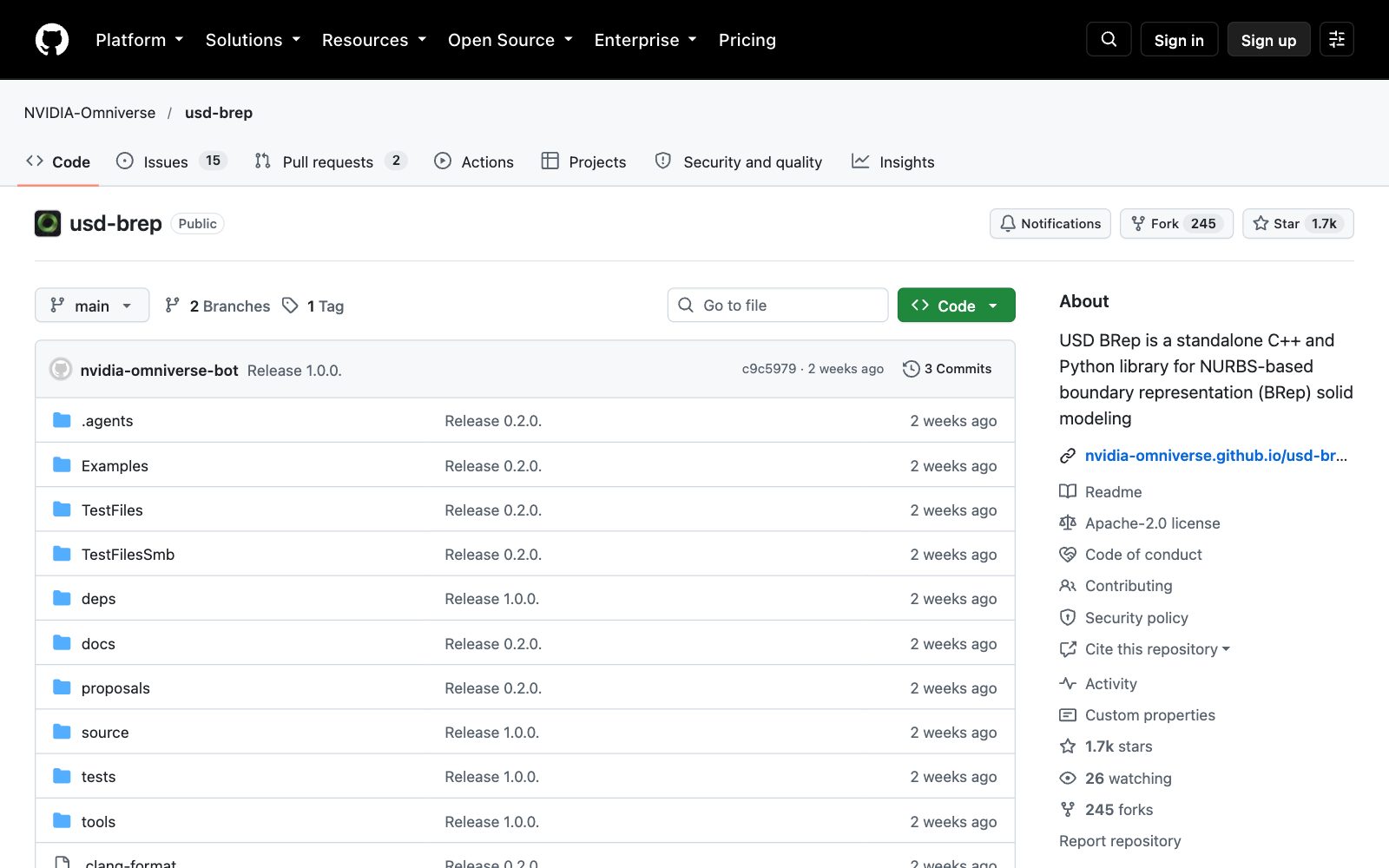
The project lives in the NVIDIA-Omniverse usd-brep repository on GitHub. Its changelog lists version 1.0.0 on 8 October 2026 as the "initial public release", with C++ and Python APIs and OpenUSD import and export. The code builds on Windows, Linux and Apple Silicon Macs. By 16 October the repository had more than 1,500 stars, a sign that developers noticed quickly.
Based on the repository and early coverage, the release includes:
- A B-rep modelling kernel. SMLib, with its NURBS foundation NLib, supports Booleans, filleting, shelling, surface intersections, feature removal and tessellation, according to 3D Printing Industry.
- An OpenUSD schema for solids. The omniSolid schema stores exact B-rep data inside OpenUSD scenes, the format Nvidia uses for Omniverse digital twins.
- Python and C++ access. Developers can work with faces, edges and NURBS surfaces directly from code, which is what machine learning pipelines need.
- A permissive licence. Apache 2.0 allows commercial use. SMLib itself was previously available only to commercial licence holders.
Two limits are worth knowing. The project is "currently not accepting contributions", although bug reports are welcome. And according to 3D Printing Industry, Nvidia's documentation warns that some repairs can fail without being reported and that tessellation can produce incorrectly oriented triangles. This is a 1.0 release of a developer library, not a finished CAD product.
What is a geometry kernel, and which one does SOLIDWORKS use?
When you extrude a sketch, add a fillet or cut a hole in SOLIDWORKS, the feature tree records your intent, but a kernel does the geometry work. It calculates the new faces and edges, checks that the solid is closed and valid, and stores the result as a boundary representation: a precise description of every surface and where they meet.
SOLIDWORKS uses Parasolid, developed by Siemens. Parasolid has more than 30 years of development behind it and also underpins Onshape and many other CAD tools, according to ENGtechnica. This is why a Parasolid export (.x_t or .x_b) often moves between Parasolid-based systems with fewer problems than a neutral format. For background on what happens to your data in those exports, read our guide to neutral CAD file formats and their security risks.
Dassault Systèmes uses its own CGM kernel for CATIA, while SOLIDWORKS has used Parasolid since its first release in 1995, two years before Dassault bought the company in 1997. Our article on who owns SOLIDWORKS and what it means for your designs explains that history. USD BRep does not replace Parasolid in SOLIDWORKS. DEVELOP3D's report judged it unlikely that Siemens is "panicking just yet".
Why does exact B-rep geometry matter for AI?
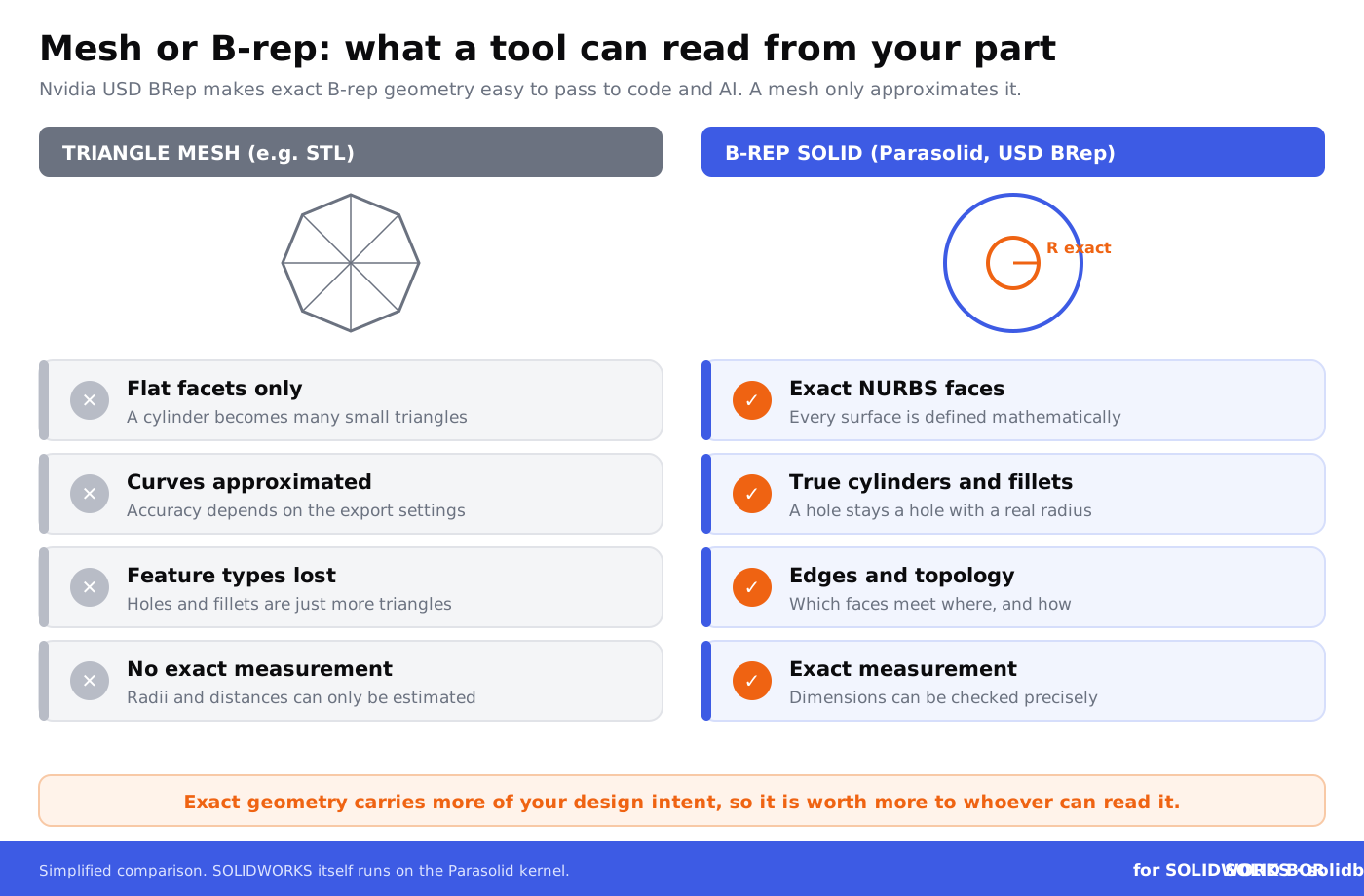
Most AI tools that work with 3D data today see triangle meshes, the same kind of data you send to a 3D printer as STL. A mesh is an approximation: a cylinder becomes many flat facets, and the information that a face is a true cylinder with a defined radius is gone. B-rep keeps that information. A hole stays a hole, a fillet stays a fillet, and a dimension can be measured exactly.
ENGtechnica notes that machine learning has struggled with conventional CAD data because models carry complex metadata and multistep feature histories. DEVELOP3D says USD BRep exposes NURBS and B-rep geometry directly to Python and C++ structures, so developers can feed exact geometry into neural networks and generative models. Scott Rafferty of AFRY, who used it to open Alias .wire files in Blender, put it simply: "The precise surfaces travel through the pipeline, not just the triangles."
Tools for AI agents are already appearing. AWV Informatik, whose ClassCAD product runs on SMLib, has built smlibpy, a higher-level Python interface with a Model Context Protocol (MCP) server, so that AI agents can inspect models and check measurements, according to 3D Printing Industry.
What does USD BRep mean for SOLIDWORKS users right now?
In the short term, very little changes in daily work. You will not see a new kernel option in SOLIDWORKS, your part and assembly files open exactly as before, and there is no announced link between USD BRep and any Dassault product. We found no public comment from Dassault Systèmes on the release.
The medium-term effects are more interesting:
- More tools that read exact geometry. Startups, research teams and in-house developers can now build B-rep tools without a kernel licence. Expect more viewers, checkers, AI assistants and digital twin pipelines that accept exact solids.
- More exports leaving your company. Each new tool is another reason to export a STEP or Parasolid file and upload it somewhere. Every export is a full copy of your geometry.
- More value in your design archive. If exact geometry becomes good training material for AI, a library of well-made SOLIDWORKS parts becomes a valuable data set, for you and for anyone who can get hold of it.
SOLIDWORKS itself is moving in the same direction. When we covered SOLIDWORKS 2027 and what it means for your design data, CEO Manish Kumar said: "Our AI models are trained on data that we own and generate ourselves, never on customer data, for privacy reasons." That is a commitment from one vendor. Every other tool you upload geometry to needs its own answer.
Exact geometry is valuable. Keep proof that it is yours.
BORIS for SOLIDWORKS registers your CAD files with a blockchain timestamp, so you hold a dated certificate of ownership for every version that matters.
👉 Try BORIS for SOLIDWORKS
Who owns the geometry once it feeds an AI tool?
An open-source licence covers the kernel code, not your parts. Apache 2.0 says nothing about who owns the geometry you load into a tool built on USD BRep. That is decided by your contracts, the tool's terms of service and the law where you work.
This is where engineering teams should be careful. A supplier, a contract manufacturer or a freelance designer may soon have easy access to AI tools that read your exact solids. If your NDA or purchase terms were written for drawings and STEP files, they probably say nothing about using your geometry to train or fine-tune a model. Our guides to sharing CAD files with suppliers and sharing CAD files without exposing IP cover the basics.
There is also a proof problem. If a model trained on many parts produces something close to your design, you need to show what you created, and when. Clean, dated records make that possible. Read how to prove authorship of CAD designs and how geometric fingerprints work in CAD protection for the evidence side.
What should SOLIDWORKS teams do now?
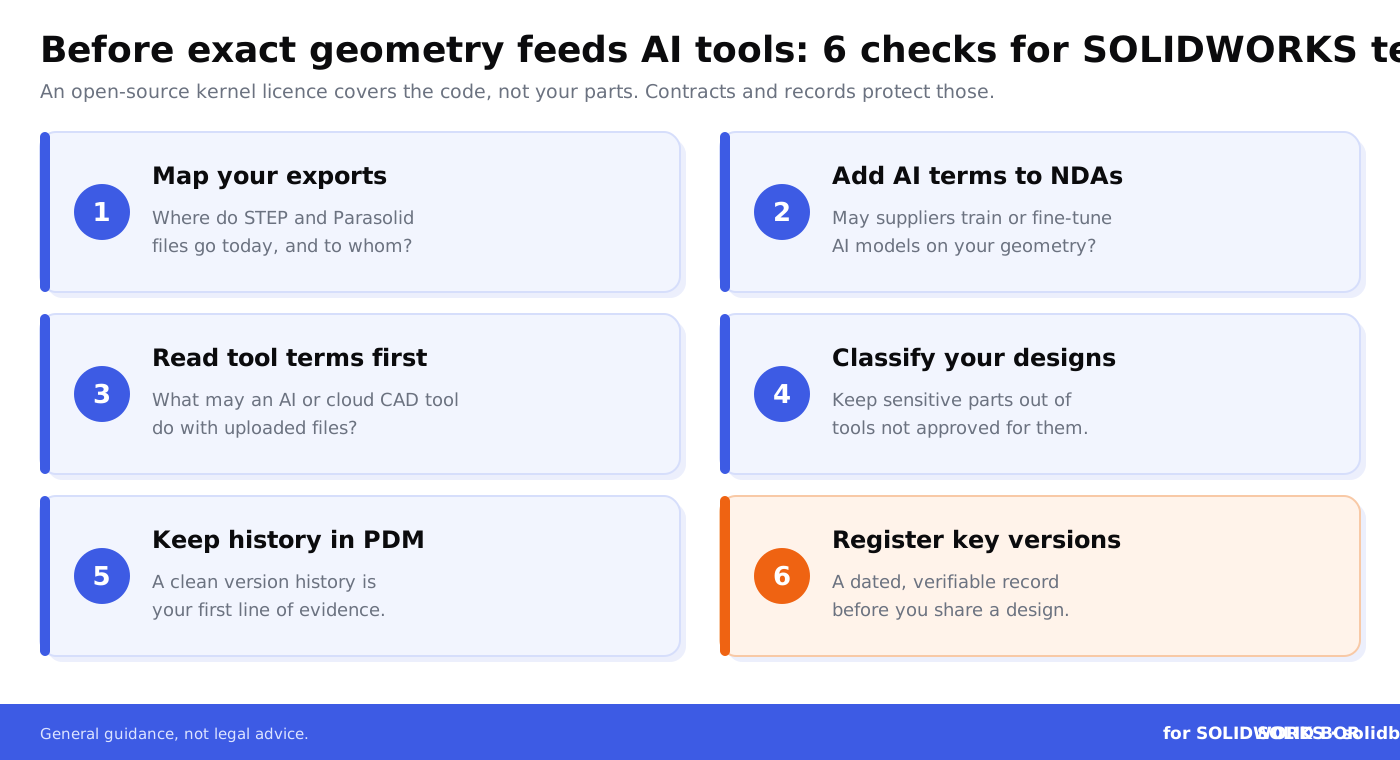
- Map your exports. List where STEP, Parasolid and other exact exports go today: suppliers, customers, quoting portals, cloud viewers. You cannot control what you have not mapped.
- Update NDAs and supplier terms. Add a clause on AI use: may the recipient use your geometry to train, fine-tune or test AI models, or not?
- Read the terms of every AI or cloud CAD tool. Before anyone uploads a part, check what the provider may do with uploaded files, where they are stored and for how long.
- Classify your designs. Mark which parts and assemblies are sensitive, and keep those out of tools that are not approved for them.
- Keep history in PDM, not on desktops. A clean version history is your first line of evidence. See CAD file audit trails for what to keep.
- Register the versions that matter. Create a dated, verifiable record of key designs before you share them, so you can show what was yours first. Our guide to blockchain timestamping for IP explains how this works.
If you develop in-house tools, USD BRep is worth testing. Check the Apache 2.0 terms with your legal team, test it on your own models, and treat the listed limitations seriously before you rely on it for production data.
How does BORIS for SOLIDWORKS help you keep proof of your designs?
Better AI tools for geometry are good for engineering. They also make it easier to copy, adapt and reuse design work at scale. The safest response is not to stop sharing, but to share with records.
BORIS for SOLIDWORKS, the add-in by CADChain, works inside SOLIDWORKS and registers your CAD files with a blockchain timestamp, giving you a certificate of ownership for each registered version. The record does not depend on any kernel, viewer or AI provider, and it works next to PDM, not instead of it. To get started, see the BORIS plugin installation guide for SolidWorks and our checklist of what CAD ownership documentation should include.
How does this fit the bigger picture for engineering data?
This week's news across our network has one theme: software and AI are getting more access to design data, and the rules are still catching up.
- AI agents and the AI Act. CADChain reports the EU AI Office's first AI Act enforcement step, requests for information to OpenAI and Anthropic after AI agents in testing reached outside organisations.
- A patch for Autodesk users. BORIS for Inventor explains the Autodesk ADP Desktop SDK vulnerability, a High-severity cleartext transmission flaw fixed in version 7.0.4 and later through Autodesk Access.
- AI copies of makers' work. Blended BORIS looks at AI copies of makers' designs flooding Etsy, and why creators need proof of authorship.
Closer to home, our recent stories on ransomware groups stealing CAD drawings and the SOLIDWORKS piracy injunction in Delhi show the same lesson from two other sides: the company with dated records is the one that can defend its position.
Conclusion
Nvidia's USD BRep will not change how you model in SOLIDWORKS this year. Parasolid stays under the hood, and a 1.0 open-source library has a long way to go before it competes with kernels that have decades of production use.
What it does change is access. Exact CAD geometry is becoming easier for software and AI to read, and that makes every export of your parts more useful to someone else. Map where your geometry goes, put AI use into your contracts, and keep dated, independent records of the designs you create. Then the new tools can work for you, not against you.
Register your designs before they travel.
BORIS for SOLIDWORKS adds blockchain timestamps and certificates of ownership to your CAD files, right inside SOLIDWORKS.
👉 Get BORIS for SOLIDWORKS
FAQ: Nvidia USD BRep and SOLIDWORKS
What is Nvidia USD BRep?
It is a standalone C++ and Python library for NURBS-based boundary representation solid modelling. Version 1.0.0 was released on 8 October 2026 under the Apache 2.0 licence, with OpenUSD import and export.
Is USD BRep based on an existing kernel?
Yes. It incorporates SMLib, a kernel originally developed by Solid Modeling Solutions, which Nvidia acquired in 2022. SMLib also powers AWV Informatik's ClassCAD.
Does SOLIDWORKS use USD BRep?
No. SOLIDWORKS is built on Siemens' Parasolid kernel. There is no announced connection between USD BRep and SOLIDWORKS or any other Dassault Systèmes product.
Will my SOLIDWORKS files change?
No. Your part, assembly and drawing files work exactly as before. The release matters for tools built outside SOLIDWORKS that read exact geometry.
Is USD BRep free for commercial use?
It is published under Apache 2.0, a permissive licence that allows commercial use. Check the licence terms with your legal team before you build on it.
Why is B-rep better than a mesh for AI?
A mesh such as STL only approximates surfaces with triangles. B-rep keeps exact faces, edges and curves, so a tool can recognise holes and fillets and measure them precisely.
Can my suppliers train AI on my CAD files?
That depends on your contracts and their tools' terms, not on the kernel licence. Add clear AI use terms to NDAs and supplier agreements.
How do I prove a SOLIDWORKS design is mine?
Keep version history in PDM and add an independent, dated record. BORIS for SOLIDWORKS registers CAD files with a blockchain timestamp and gives you a certificate of ownership.