

TL;DR: Employee Adoption Fuels Engineering Success
Driving employee adoption in engineering relies on trust, inclusion, and tailored training, not just introducing tools like SolidWorks or blockchain. Include employees early, offer hands-on support, and address concerns upfront to reduce resistance and secure intellectual property effectively. Documented cases, such as Adobe’s switch to regular Check-in conversations and a SOLIDWORKS PDM training overhaul at a large medical equipment maker, show how planning and role-based support align teams.
💡 Discover real-world examples of secure CAD adoption, check out Blockchain CAD Protection Case Studies. Secure your designs and boost team collaboration today.
Employee Adoption: Change Management Success Stories and Their Lessons for Engineers and Designers in Europe
How does successful organizational change management intersect with technologies like SolidWorks, blockchain, and intellectual property (IP) management? The key lies in aligning employee adoption with technological innovation. As businesses across Europe innovate, they face challenges in getting employees to embrace new processes, systems, and roles. But what makes success stories stand out in industries reliant on CAD designs and engineering? Let’s dive deeper.
Employee adoption is not just about presenting new tools or workflows; it’s about building trust, addressing real concerns, and laying the groundwork for a future-ready workforce. Whether it’s a retail giant restructuring its customer experience (see case study insights here) or a leading software company redesigning human resources, change management stories provide blueprints for success.
"The question isn't whether innovation will bring challenges; it's how you prepare your people to become the drivers of that change."
Violetta Bonenkamp, CEO, CADChain
Struggling to protect CAD designs in your team?
Discover how SolidWorks and blockchain technology combined can secure intellectual property with our proven strategies.
👉 Protecting SolidWorks Files in Remote Work
What Is Employee Adoption and Why Does It Fail?
Employee adoption refers to the willingness and ability of your workforce to embrace and efficiently implement new systems, tools, or processes. It’s a core part of change management. In sectors like manufacturing and engineering, failure to adopt often results in poorly used tools, security vulnerabilities, or wasted resources.
Consider this example: A European SME decided to implement blockchain-based IP certificates in its SolidWorks environment. Initially, adoption was slow. Employees expressed concerns about unfamiliar workflows and possible errors during file registration. This resistance reflects common factors behind failed adoption:
- Lack of clear, ongoing communication about the benefits of change
- Insufficient training or hands-on support
- Decision-making processes that exclude end users
- Absence of real-world success demonstration before full rollout
These issues are common causes of failure. However, when addressed effectively, they can become stepping stones for success.
Lessons from Adobe and a SOLIDWORKS PDM Rollout: Transforming Workflows and Retaining Talent
A published SOLIDWORKS PDM case shows the engineering side. SPK and Associates describes working with a Fortune 100 medical equipment manufacturer whose engineers and designers kept getting blocked in SOLIDWORKS PDM while other users fixed problems. Many users had been given engineering-level permissions and made unintended changes, and new hires had no consistent PDM training, so many taught themselves from material they found online. SPK wrote a training plan with role-specific sessions on workflows, permissions and custom add-ins, and tightened the permission groups using the existing permission data. According to SPK, the recurring support tickets and workflow interruptions fell sharply afterwards. The lesson: give people training that matches their role, and permissions that match what they actually do.
Adobe offers the people side of the same lesson. In 2012 it replaced annual performance reviews and ratings with Check-in, an ongoing two-way conversation in which employees and managers discuss performance and career growth and exchange real-time feedback, according to Adobe’s own account of Check-in. Employees had found the annual reviews cumbersome and bureaucratic, and being rated and stack-ranked had created barriers to teamwork. Adobe has since moved Check-in to a digital-first format with one central place to document goals and career plans. In both cases, being open about goals and giving people regular support built the trust that change needs.
Engineering SMEs: Secure CAD IP Without Big Budgets
Explore effective strategies SMEs and startups are applying to protect valuable CAD assets while minimizing security investments.
👉 See Our Startup Case Study
How European SolidWorks Users Can Boost Employee Adoption
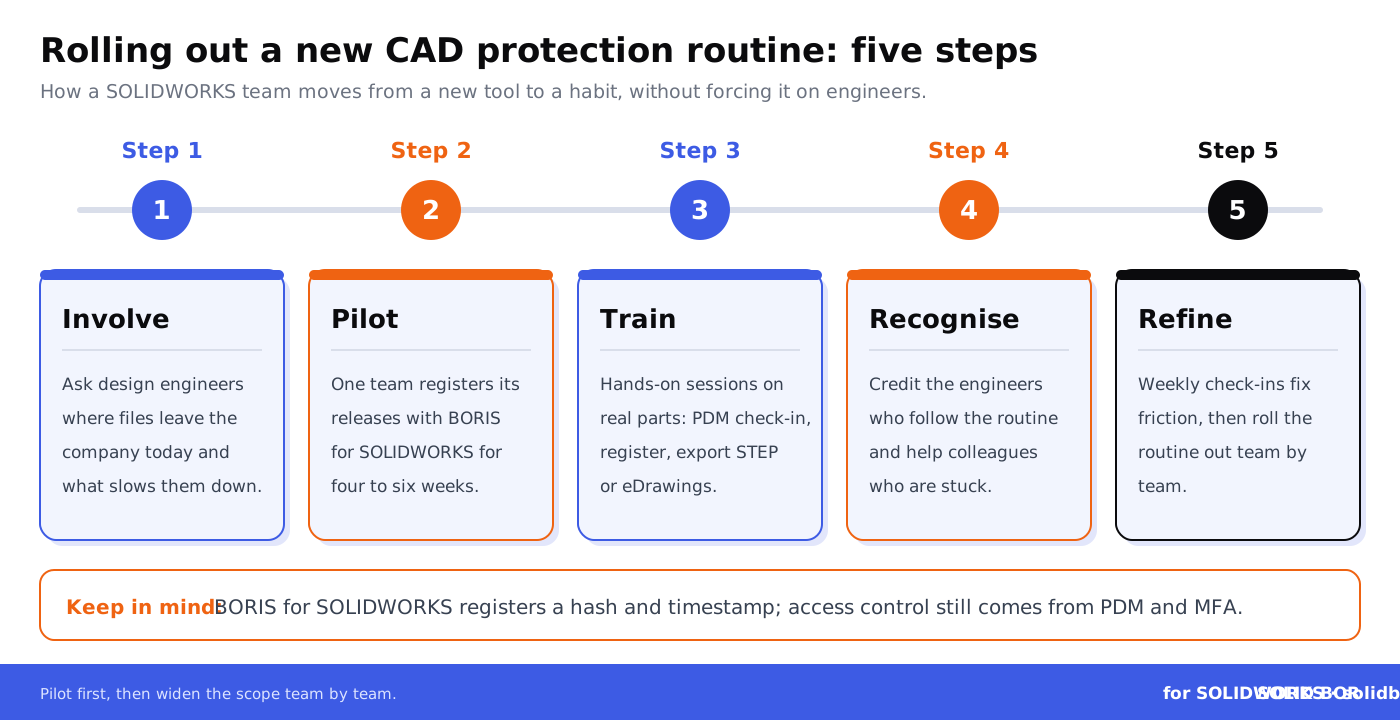
Consider an illustrative scenario: a design-focused SME in Spain faces resistance when introducing BORIS for SOLIDWORKS, an add-in that registers CAD files on a blockchain as proof of ownership. Steps like these help a team move from low adoption to a routine most engineers follow within a few months:
- Involve design engineers early: Employees take part in selecting the tools most relevant to their daily workflows, creating immediate buy-in.
- Provide hands-on demonstrations: Interactive training sessions show how BORIS for SOLIDWORKS registers each released file with a hash and timestamp, and how that fits next to PDM permissions and sharing STEP or eDrawings files instead of native models.
- Gamify rewards: Employees receive recognition for following the new routine and for helping colleagues, with leaders setting the example by registering their own releases.
- Refine processes with feedback: Weekly check-ins with pilot users gather insights for adjusting software flows and solving minor hiccups proactively.
The combination of participatory planning and agile tweaks creates workplaces where employees feel empowered to adopt tech designed to secure trade secrets and collaboration. For the technical side of the rollout, see our step-by-step guide to implementing blockchain CAD protection.
"Adoption thrives when employees don’t see change as a burden but as a tool that empowers them to solve real problems."
Dirk-Jan Bonenkamp, CLO, CADChain
Mistakes to Avoid When Promoting Employee Adoption
Mistakes in change initiatives not only reduce adoption success but also lead to cultural aversion to change. Avoid these critical errors commonly found in sectors reliant on CAD tools:
- Skipping end-user involvement during pilot testing phases
- Failing to articulate specific benefits of new systems
- Underestimating the complexity of workflows engineers handle day-to-day
- Ignoring continuous training, especially when regulations like GDPR affect how personal data in design or IP processes is handled
For CAD-centric SMEs, rolling out SolidWorks-based IP solutions quickly runs into these challenges. The table below compares common rollout approaches.
Next Steps for European SMEs and Startups
While change management remains a complex puzzle, it is an essential enabler of sustainable innovation. By leveraging tools like blockchain IP solutions for SolidWorks, tools tailored to CAD workflows, and employee-centered design approaches, businesses gain more than retention: they gain trust.
Looking for a holistic guide on building resilient CAD security programs? Head over to our breakdown of industry-specific CAD security playbooks, or explore how to enable smooth cross-border CAD collaboration within distributed design teams.
Make proof of ownership part of the routine
BORIS for SOLIDWORKS registers a hash and timestamp of each released CAD file from inside SOLIDWORKS, so your team can show which version it created and when, without changing how engineers work.
👉 Explore BORIS for SOLIDWORKS
People Also Ask:
What are examples of successful change management stories?
Documented examples include Adobe, which replaced annual performance reviews with regular Check-in conversations in 2012, and engineering teams that pair new tools such as SOLIDWORKS PDM with role-based training. Iterative approaches such as Lean Change Management help teams adjust the change as they go.
Why is employee adoption crucial in organizational change?
Employee adoption ensures that new processes, systems, or policies are effectively integrated into daily operations. Without buy-in, efforts can face employee resistance, leading to decreased productivity or project failures. Organizations with high adoption rates report improved morale and operational ease.
How can communication impact change management success?
Clear and consistent communication shapes employee understanding and acceptance of changes. Structured feedback and communication loops address employee concerns, ensuring smoother transitions while minimizing negative impacts.
Which frameworks assist in better managing changes?
Iterative approaches such as Lean Change Management are widely used. Frameworks like these emphasize adaptability, clear guidelines, and regular assessments to predict and overcome barriers.
What are the main challenges to achieving employee buy-in?
Common obstacles include lack of trust in leadership, limited understanding of the change, and fear of skillset obsolescence. Addressing these concerns through transparent discussions and training can build trust and confidence among employees.
What role do leadership figures play in successful transitions?
Leaders act as role models and communicators during changes. Organizations ensure success by involving leadership in strategy formation and keeping open channels for employee queries, fostering a sense of ownership at every level.
Can real-world stories inspire organizational changes?
Case studies detailing success stories, such as companies overcoming challenges to achieve high productivity and reduced miscommunication, offer replicable insights for other organizations. These stories highlight methods that align with their unique challenges.
Is training pivotal in effective change implementation?
Training ensures employees are prepared to adopt changes without disruptions. Structured methods, when combined with continuous support, have shown to significantly enhance adjustment speeds and reduce implementation errors.
What tools can assist in managing transitions effectively?
Survey and feedback tools and low-code platforms allow for simulation and real-time feedback during change efforts. These tools help refine strategies to meet organizational objectives while addressing staff challenges simultaneously.
How can small businesses handle employee resistance to changes?
For smaller entities, open dialogues, detailed explanations, and fostering active participation in planning processes can make significant differences. Highlighting clear benefits and addressing individual concerns fosters acceptance.
FAQ on Employee Adoption and Change Management for Engineers and Designers in Europe
How does employee adoption impact technology investments in engineering?
Employee adoption directly influences the ROI of technology investments like SolidWorks and CAD tools. Engaged teams use tools efficiently, create collaborative workflows, and minimize resource wastage. Ignoring this leads to underutilized software and delayed innovation, increasing operational costs and risks.
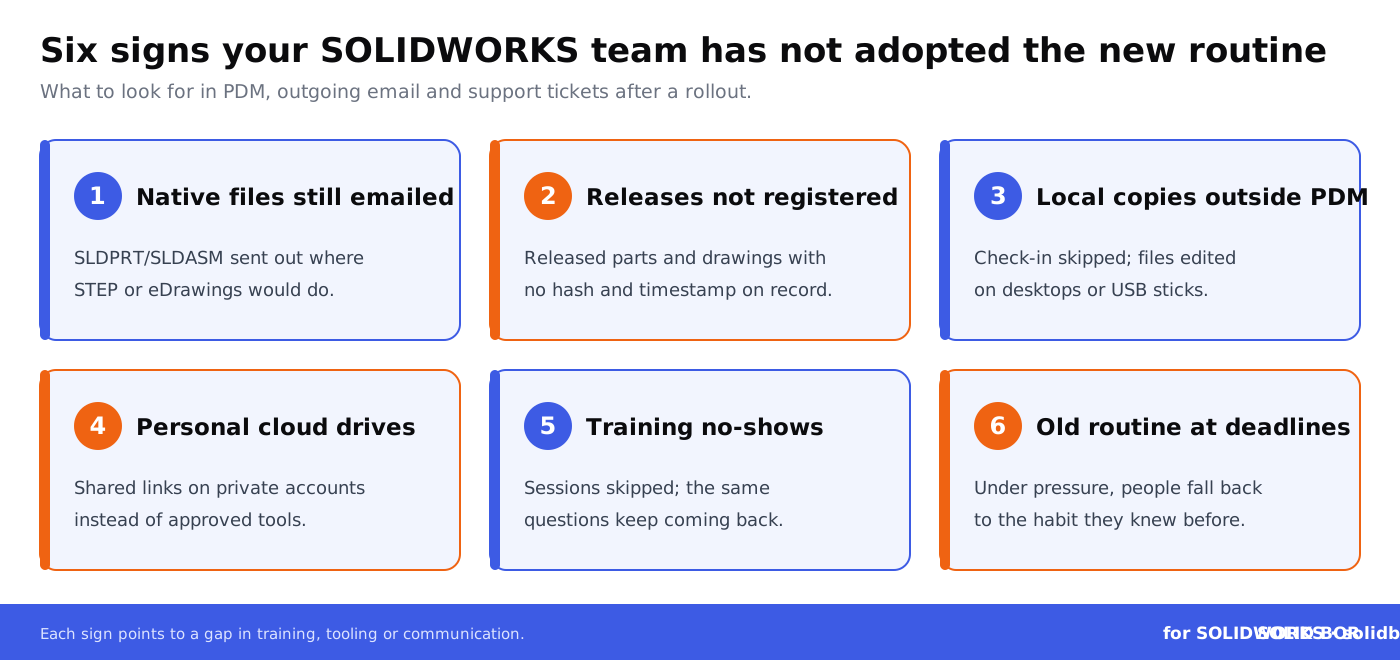
What are early signs of slow adoption within engineering teams?
Common signs include resistance to training, reliance on outdated methods, frequent errors during new workflows, and hesitation towards collaborative tools like IP blockchain solutions. Addressing these through ongoing communication and hands-on support can prevent costly delays.
Can gamification improve adoption rates in technical teams?
Yes, gamification like rewarding employees for mastering tools can boost engagement. Adobe’s HR overhaul relied on frequent feedback conversations rather than games, which shows that recognition works best when it is tied to regular check-ins. Start with attainable goals to maintain momentum and motivation. Learn more about other proven strategies here in a leadership case study.
What risks do SMEs face when deploying advanced technology?
SMEs risk data leaks, underutilized tools, and disruptions during implementation. For example, poor adoption of blockchain IP solutions in SolidWorks can leave released designs without a dated record of ownership. Proactively train teams and choose solutions sized for SMEs to keep setup costs and protection in balance; see essential CAD security measures for startups.
How crucial is leadership involvement in driving change?
Leadership involvement is pivotal. Leaders who model and communicate acceptance of change reassure employees of its value. Intuitive.Cloud exemplifies this by integrating leadership into training sessions, ensuring smooth transitions. Check the example here for insights on leadership synergy.
What are key adoption obstacles among SolidWorks users?
Obstacles often include a lack of training on IP solutions, insufficient IT infrastructure, and fear of automation replacing roles. Address these with tailored onboarding programs, open dialogues about benefits, and workflow alignment to ensure relevance for design engineers.
What success strategies can smaller teams adopt?
Smaller teams should focus on pilot testing tools, refining workflows iteratively, and using feedback loops to iron out usability issues. Engage early adopters to mentor others and emphasize how BORIS for SOLIDWORKS fits into the existing release routine while recording proof of ownership.
How can blockchain simplify engineering workflow integration?
Blockchain supports CAD IP protection by recording a hash and timestamp of each registered file version, which gives teams a transparent, dated record of who registered which design and when; see digital fingerprints and hash functions. It does not stop anyone from using a file, so combine it with PDM permissions and careful file sharing. The record helps settle disputes and answer audit questions, especially for SMEs working across regulated industries.
How does fostering company culture support adoption?
A trust-based culture encourages employees to embrace change as a growth opportunity. Open communication, responsiveness to feedback, and celebrating small accomplishments lead to sustainable adoption, as Adobe’s move to regular Check-in conversations shows.
Why does ongoing training matter in high-tech industries?
High-tech tools evolve rapidly; without regular training, employees can fall behind industry standards. Continuous skill enhancement aligns teams with innovations, ensuring tools like SolidWorks or blockchain plugins are used optimally in dynamic environments.