
TL;DR: Cross-Platform CAD Security in Hybrid Environments
Protecting CAD designs across hybrid settings is now critical for intellectual property safety. By integrating encryption, access control, and blockchain proof of authorship, companies can minimize risks. Hybrid environments introduce vulnerabilities as files move between local and cloud systems; encryption and access rights protect the files, while tools like BORIS for SOLIDWORKS add proof of ownership that travels with every registered version.
💡 See what lies ahead: read Future-Readiness of CAD Security Technologies to explore emerging security technologies.
How Cross-Platform CAD Security Protects Innovation in Hybrid Environments
Have you ever wondered how secure your CAD designs are when they're shared across different platforms and hybrid environments? Cross-platform CAD security aims to answer this question by minimizing intellectual property theft, reducing operational risks, and ensuring more efficient collaboration between teams. For these reasons, it has become an essential component for designers, engineers, and manufacturers worldwide.
The increased reliance on hybrid systems, where CAD files seamlessly transition between on-premises networks and cloud platforms, introduces challenging vulnerabilities. When engineers upload a design file to the cloud or share encrypted data with third-party collaborators, every point of interaction becomes a potential risk. Without the proper security measures in place, intellectual property could end up in the hands of competitors or malicious actors.
"Hybrid environments aren't the future; they're already the standard. Your CAD security must be resilient enough to adapt to this shift."
Violetta Bonenkamp, CEO, CADChain
Certify and Secure Your CAD Designs
Guard your intellectual property using blockchain-anchored proof of authorship and ownership.
👉 Learn about robust blockchain interoperability
Why CAD Security Matters in Hybrid Environments
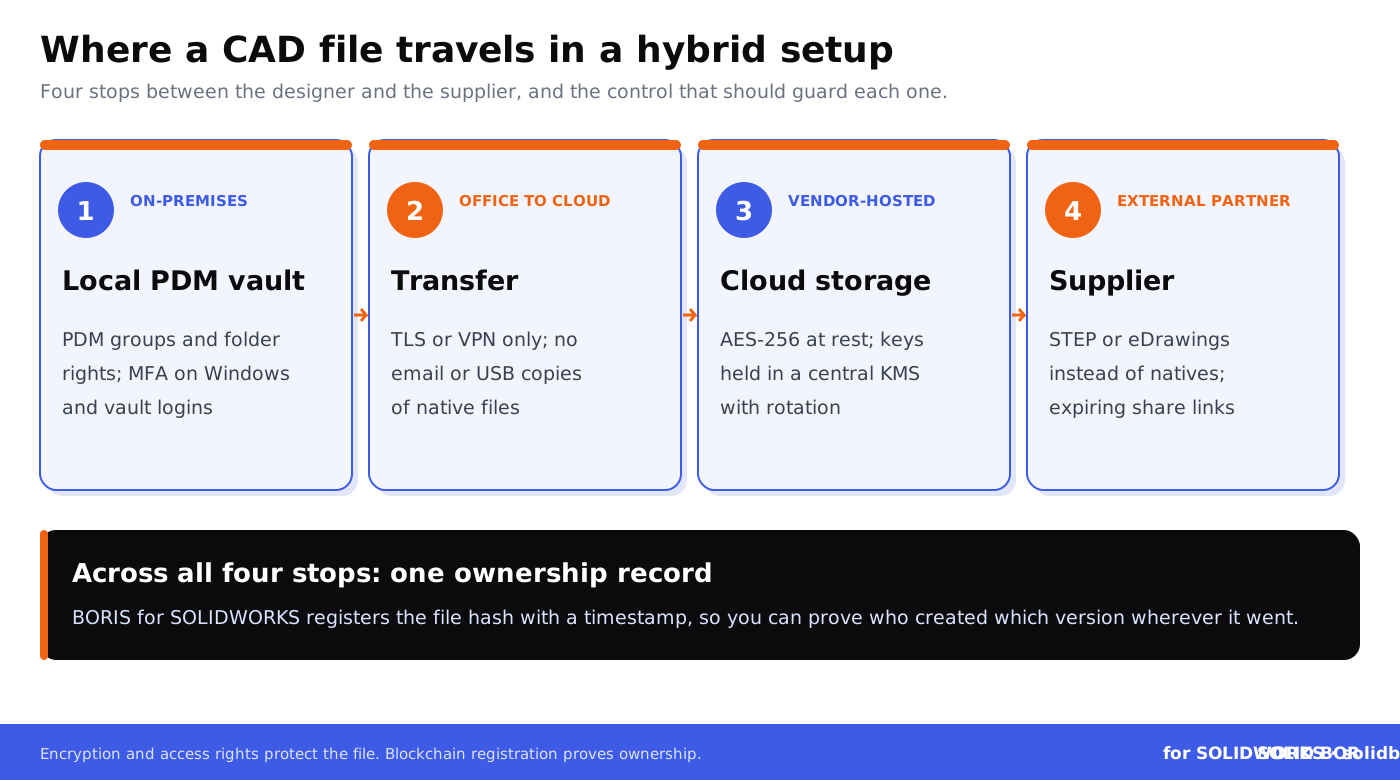
The growing adoption of hybrid environments means that engineering teams no longer operate within a single, isolated network. Many manufacturers now run a mix of private infrastructure and cloud services to manage their workflows: a local PDM vault, a cloud drive for sharing, and supplier portals on top. This shift creates immense potential for collaboration but also leaves intellectual property vulnerable to breaches. For the cloud side of that mix, see SolidWorks cloud security: what you need to know.
Hybrid encryption combines the speed of symmetric methods like AES-256 for data-heavy CAD files with the security of asymmetric encryption for exchanging keys. This means files can stay protected as they move across platforms. When storage and transfer tools are configured for it, design engineers using SolidWorks can keep their IP behind several security layers, whether files sit in a local PDM vault or are uploaded to vendor-hosted clouds. More detail is in AES-256 encryption for CAD files explained.
Hybrid cloud platforms come with unique risks. If policies regarding key management and encryption aren't enforced, designs could be exposed during transfer or storage. Implementing a centralized Key Management Service (KMS) helps keep cryptographic protection consistent across all environments.
How Does Cross-Platform CAD Security Work?
Securing CAD files in hybrid environments requires implementing stringent practices at every stage of the workflow. Here's what a reliable system should include:
- Access control based on identity verification to ensure files aren't accessed by unauthorized personnel.
- Encryption applied automatically during file generation, transit, and storage.
- Blockchain records that provide an immutable, time-stamped ledger proving design ownership and authorship.
- Session keys for file-sharing that expire after a specific use to prevent prolonged system access.
For SolidWorks users, tools like BORIS for SOLIDWORKS add tamper-evident proof through blockchain registration. For instance, before Engineer A sends a design to a collaborator, BORIS for SOLIDWORKS registers a hash of the file with a timestamp. The file itself is not changed, and any later copy can be checked against that record. Who can open and decrypt the file is still decided by your PDM permissions, your sharing platform and its encryption keys; see the SOLIDWORKS PDM security configuration guide.
"SolidWorks integration ensures engineers can protect data without disrupting their workflows."
Dirk-Jan Bonenkamp, CLO, CADChain
Which Control Covers Which Risk?
No single tool secures a hybrid setup on its own. This comparison shows what each layer protects in a SolidWorks environment, and what it leaves to the other layers:
Implementation Tips for Secure CAD Collaboration
Successful implementation of cross-platform CAD security involves meticulous planning. Whether your team uses cloud integrations, remote collaboration tools, or exporting files for 3D printing, following these steps ensures optimal security:
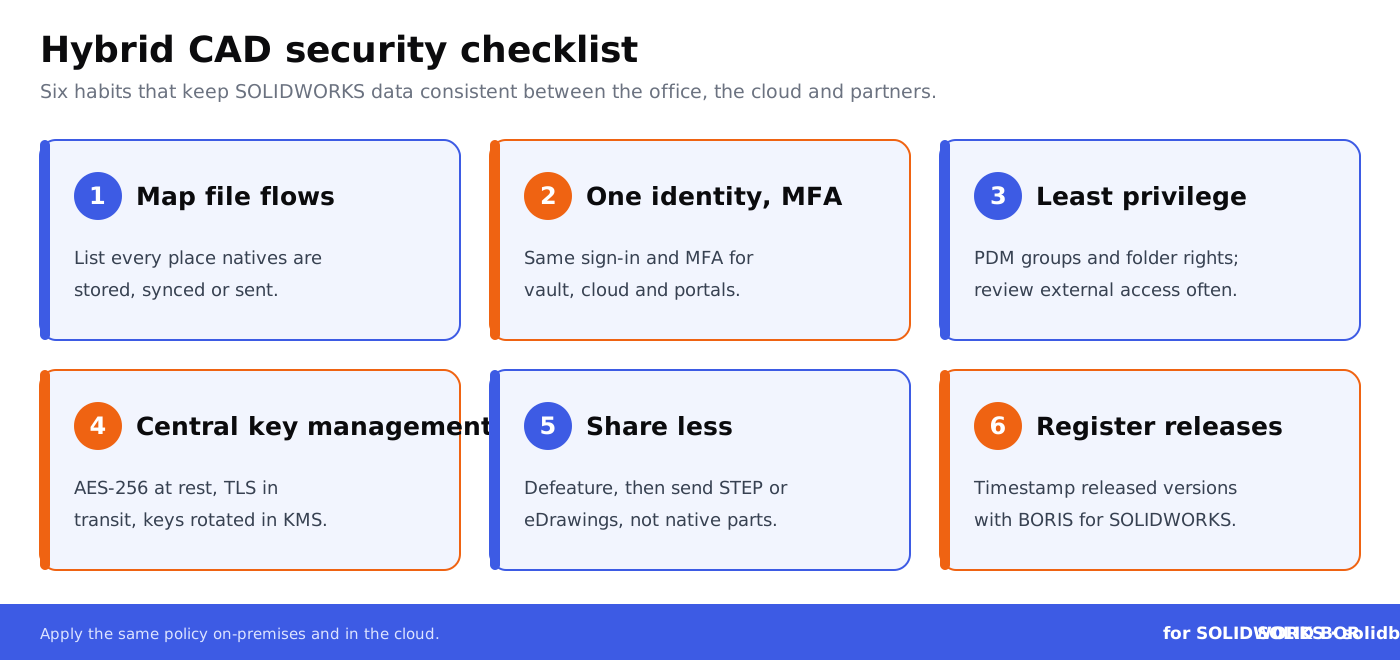
- Audit File-Sharing Workflows: Ensure every file transfer uses encrypted protocols.
- Layer Permissions Beyond NDAs: Set granular access permissions for both internal and external collaborators.
- Use Secure APIs: Platforms that leverage API security ensure integrations maintain consistent safety measures.
- Incorporate Blockchain Certificates: Provide teams with tamper-proof proof of authorship and design ownership.
- Train Teams: Educate employees on handling encrypted data and spotting phishing attempts.
Take Your CAD Security to the Next Level
Discover how to keep CAD files safe once they leave the office network and land in cloud storage.
👉 Explore cloud storage security for CAD files
Challenges and How to Overcome Them
Cross-platform CAD security isn't without its complexities. Here are common challenges preventing companies from fully protecting their designs:
- Fragmented Tools: Teams using multiple CAD systems in one workflow often face compatibility issues.
- Poor Encryption Discipline: Some organizations fail to enforce encryption across the board, leaving files vulnerable.
- Human Factor: Employees unintentionally sharing files over insecure channels.
Building protection into the tools engineers already use reduces the reliance on user discipline: PDM permissions, automatic storage encryption and approved sharing portals do the work in the background, and BORIS for SOLIDWORKS registers ownership from inside the CAD software. Additionally, blockchain records give a tamper-evident trail for every registered version, so any later change to a file can be detected. For partner exchanges, see best practices for sharing CAD files with suppliers.
Final Thoughts: The Next Step in CAD Security
Cross-platform CAD security is more than a technical challenge. It is an essential process for protecting innovation, preserving competitive advantage, and ensuring smooth collaboration. For SMEs and startups across Europe, the investment in proper systems will prevent costly breaches and save time navigating IP disputes.
As we move forward in a hybrid and decentralized design landscape, ensuring CAD designs are secure underpins everything from enterprise scalability to team collaboration. With innovations like blockchain proof of ownership and edge computing integrations, even the smallest firm can achieve enterprise-grade security.
To take your CAD security into the collaborative future, discover how to build a complete framework for distributed collaboration. Protect your designs while empowering your team to create without compromise.
People Also Ask:
What challenges do hybrid environments pose for cybersecurity?
Hybrid environments present unique difficulties for cybersecurity due to their reliance on varied infrastructures such as on-premises, public cloud, and private cloud setups. This range often results in inconsistent visibility and policies. Major risks include configuration errors, credential abuse, ransomware, and supply chain threats. To address these, it's crucial to have harmonized security measures across all platforms.
What is a hybrid security control?
A hybrid security control refers to a safeguard that's partially implemented as a common control applicable to multiple systems and partially tailored for specific systems. This dual approach ensures broader application while also fulfilling unique security requirements in specific contexts.
What is a hybrid security model?
A hybrid security model combines features from on-premises security setups with tools native to cloud platforms and third-party services. This helps achieve adaptable, scalable, and unified protection for businesses operating in diverse environments such as offices, remote setups, and multiple cloud systems.
How does cross-platform CAD security benefit hybrid environments?
Cross-platform CAD security ensures that digital design files are protected seamlessly across different devices and operating systems. This is especially valuable in hybrid environments, where teams collaborate across varied locations and platforms. It supports secure file sharing, reduces data breaches, and enhances project consistency.
Why is configuration management crucial in hybrid CAD environments?
Configuration management is essential in hybrid CAD environments to prevent misconfigurations that could lead to vulnerabilities. Proper configuration ensures consistent application of security policies across tools and platforms, making systems less prone to breaches and simplifying compliance with regulatory standards.
What role does encryption play in hybrid CAD security?
Encryption plays a vital role in hybrid CAD security by protecting sensitive project data from unauthorized access. It ensures that even if data is intercepted during file sharing or collaboration, it remains unreadable without the correct decryption keys, adding a critical layer of defense.
How do hybrid security solutions adapt to changing technologies?
Hybrid security solutions are designed to adapt to evolving technological advancements by incorporating machine learning, threat intelligence, and automation. These capabilities allow systems to detect and respond to new vulnerabilities and cyber threats proactively, ensuring continuous protection.
What are the potential risks of inadequate hybrid environment security?
Inadequate security in hybrid environments can lead to data breaches, system downtime, and loss of sensitive intellectual property. Weak safeguards increase the likelihood of cyberattacks, mismanagement of credentials, and vulnerabilities in interconnected systems, potentially causing financial losses and reputational damage.
Why is user training important for hybrid security effectiveness?
User training is crucial in hybrid environments to ensure that employees understand best practices for safeguarding digital assets. Educating users about phishing, password management, and incident reporting minimizes human errors and strengthens the overall security posture.
What tools enhance CAD security in hybrid environments?
Tools such as advanced file-sharing platforms with built-in encryption, multi-factor authentication, and real-time activity monitoring are integral to enhancing CAD security. Additionally, endpoint detection and response (EDR) tools and cloud-native application protection platforms (CNAPP) are commonly used to monitor and secure hybrid environments.
FAQ on Cross-Platform CAD Security in Hybrid Environments
What makes hybrid encryption ideal for CAD security?
Hybrid encryption combines symmetric AES-256 encryption for speed and asymmetric RSA encryption for secure key management. This dual approach ensures robust protection during CAD file creation, transit, and storage across hybrid environments. Learn more about advanced encryption methods in CAD systems by reviewing this CAD file encryption guide.
How does blockchain enhance CAD security?
Blockchain offers immutable design ownership proof by timestamping registered file versions, reducing disputes and intellectual property theft. It integrates with existing CAD workflows to strengthen trust in cross-platform collaboration. Blockchain-based solutions are discussed comprehensively in this future-proof CAD security article.
What are the risks of using public clouds for CAD storage?
Public clouds can expose CAD files to unauthorized access if encryption and centralized key management policies are not enforced. Implementing robust access controls and encryption protocols minimizes these risks while securing files during transit and storage.
How does CAD security prevent design theft in hybrid environments?
CAD security prevents design theft through identity-based access control, automatic encryption and session keys with expiration, which keep sensitive files away from unauthorized users during collaboration. Blockchain registration adds a timestamped record of each registered version, so authorship can be proven if a design turns up where it shouldn't.
What is the ROI of investing in reliable CAD security tools?
Investing in CAD security reduces breach-related costs, intellectual property disputes, and operational downtime. Tools that automate encryption and verify design authenticity offer long-term savings. For detailed ROI insights, see this CAD security ROI guide.
Do AI tools play a role in CAD file protection?
Yes, AI tools detect vulnerabilities in CAD workflows, predict potential breaches, and automate corrective actions. They strengthen platforms by analyzing patterns and securing data without disrupting design processes, especially in hybrid environments.
Can CAD security systems defend against quantum computing threats?
Quantum-safe (post-quantum) cryptography is the main defence against future quantum attacks on today's encryption, and zero-trust architectures limit what any stolen key can reach. Planning the move now helps keep CAD files protected as quantum computing matures. For guidance, consult this article on CAD security against quantum threats.
What are the best practices for enhancing CAD security in hybrid systems?
Best practices include auditing workflows, enforcing encryption protocols, layering access control, utilizing secure APIs, and incorporating blockchain certification. Training teams on encryption handling further enhances system resilience.
Why is centralized key management critical for CAD security?
Centralized Key Management Services (KMS) streamline encryption across hybrid environments, reducing file exposure risks. By automating key generation, rotation, and destruction, KMS ensures consistent data protection during collaboration.
What impact has AI-powered CAD security had on SolidWorks users?
AI-powered security tools used alongside SolidWorks help detect unusual file activity and vulnerabilities, while encryption, PDM permissions and blockchain ownership records protect the files themselves. Together they secure IP while keeping workflows smooth. Explore key tips for securing SolidWorks in this proven SolidWorks security guide.