
TL;DR: DAOs Could Redefine How SolidWorks CAD IP Is Managed
Decentralized Autonomous Organizations (DAOs) offer a new way to manage CAD intellectual property by combining tamper-evident blockchain records with automated smart contracts. This can improve ownership tracking, licensing transparency and royalty payments, all critical for creators using SolidWorks or similar platforms. Tools like BORIS for SOLIDWORKS register a hash and timestamp of each design version from inside SOLIDWORKS, which gives a DAO's smart contracts a verified version to refer to.
💡 Curious about where CAD IP protection is headed? Check out Emerging Trends in CAD IP Management for 2026-2030.
Can Decentralized Autonomous Organizations (DAOs) truly transform Intellectual Property (IP) management for CAD files like those created in SolidWorks? The short answer is: yes, but the road is complex and revolutionary. DAOs use blockchain-based smart contracts to govern collaboration, ownership, and licensing processes. For manufacturers and engineers relying on CAD systems, this could mean a shift toward decentralized, transparent IP management.
Unlike traditional approaches to securing IP, a process often fraught with inefficiencies, jurisdictional complexities, and human error, DAOs offer a predefined set of governance rules executed automatically. In essence, they create a tamper-evident digital environment where ownership and transaction histories are recorded and hard to alter. The rights themselves still come from copyright, design law and contracts, but a clear on-chain history makes those rights easier to document and license.
"DAOs promise a future where IP ownership does not depend on trust, but on code."
Dirk-Jan Bonenkamp, CLO, CADChain
What Makes DAOs Relevant for CAD IP Management?
DAOs leverage blockchain technology, combining smart contracts and decentralized governance mechanisms to address specific challenges inherent to managing intellectual property. Here's why they matter in the CAD world:
- Smart Contract Automation: DAOs can execute on-chain licensing payments automatically, reducing the need for manual intervention.
- Tamper-Evident Proof of Ownership: Blockchain records show when a specific CAD design version existed and who registered it, which is strong evidence in a dispute.
- Transparent Collaboration: Votes, proposals and payments are visible to every member, so partners, stakeholders and teams can see how decisions about a design were made.
- Cross-Border Coordination: Smart contracts run the same way in every country. Enforcing IP rights against an infringer still goes through national courts, so DAOs complement local legal systems rather than replace them.
How Can DAOs Revolutionize IP in SolidWorks?
For SolidWorks users, integrating DAOs into workflows can address persistent IP-related challenges. Imagine a scenario where engineers and designers use BORIS for SOLIDWORKS to register each CAD design version on a blockchain the moment it is released, and a DAO's smart contracts then refer to those registrations. This setup can give you:
- Ownership permanence: registration records of each version are stored on a blockchain, where they can be checked later.
- Automated licensing: usage terms live in a smart contract that points to the registered file hash; the CAD file itself does not enforce them, so licence agreements still matter.
- Tamper-evident audit trails: every registered version gets its own timestamp, while day-to-day version control stays in SOLIDWORKS PDM.
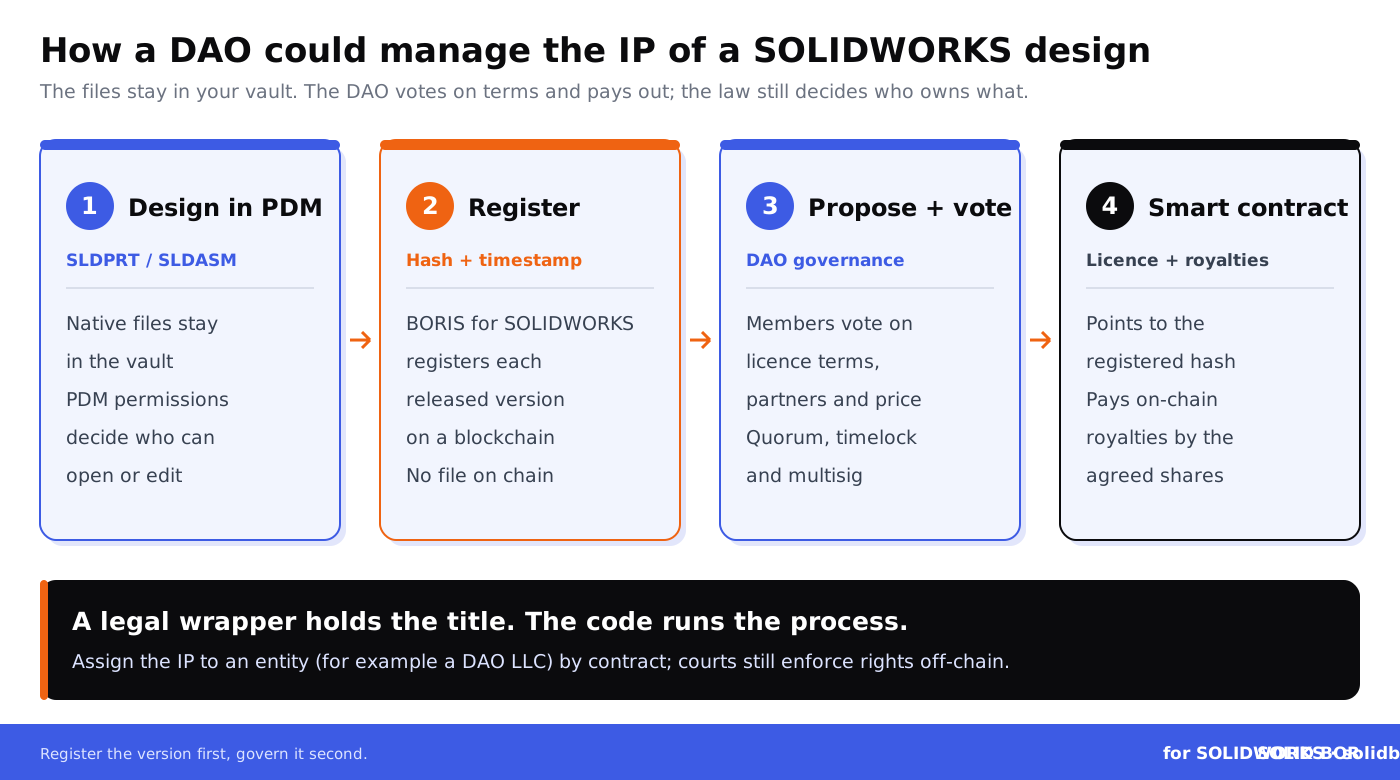
Because BORIS for SOLIDWORKS registers a hash (digital fingerprint) of the file rather than the file itself, the native SLDPRT and SLDASM files never leave your vault.
Practical Example: Protecting CAD Assets in Licensing Agreements
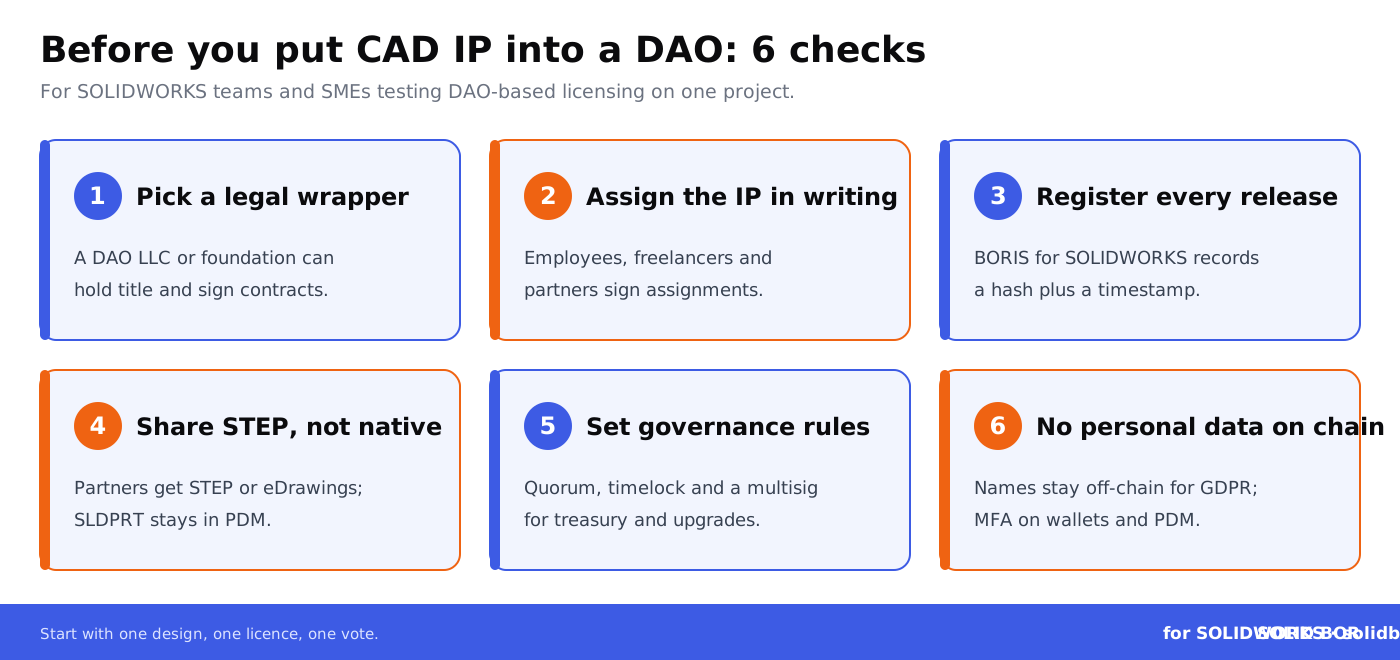
For instance, SolidWorks users collaborating across Europe can use DAO-backed systems to set licensing terms before a design is shared, in a smart contract that refers to the registered version of each CAD file. Once a file has been sent, nobody can track every time it is opened or copied, so share STEP or eDrawings files with partners and keep native files under SOLIDWORKS PDM permissions. In case of disputes, the blockchain registration can serve as evidence of which version existed first and who registered it, which can simplify litigation and enforcement proceedings; see blockchain records as legal evidence. Blockchain interoperability for CAD systems explains how such records can move between tools and chains.
Not every IP management model needs a DAO. This comparison shows what each approach handles, and what it still leaves to contracts and courts:
How to Start Implementing DAOs for Your CAD Files: Step-by-Step
Ready to explore DAOs for SolidWorks CAD management? Here's a roadmap:
- Understand DAO architectures: Spend time reading about DAO systems, smart contract structures and legal wrappers such as a DAO LLC.
- Register designs from inside SOLIDWORKS: BORIS for SOLIDWORKS registers a hash and timestamp of each design version on a blockchain, so the DAO's contracts have verified versions to refer to.
- Develop licensing smart contracts: Start from audited templates and have a lawyer check that the on-chain terms match the written licence. Our guide to smart contracts for IP protection covers the basics.
- Test with small-scale projects: Before moving fully to DAO-based workflows, trial with a single CAD design or department.
Challenges to Watch Out For
DAOs’ promise comes with specific challenges. SolidWorks users adopting these systems will encounter:
- Legal Uncertainty: Some jurisdictions lack clarity on DAO governance and liability.
- Interoperability concerns: Ensuring seamless integration between SolidWorks workflows and DAO ecosystems is complex.
- Cultural Adoption: From engineering teams to executives, convincing stakeholders of DAOs’ benefits can be an uphill battle.
Protect your CAD design ownership with BORIS.
BORIS for SOLIDWORKS registers a hash and timestamp of each design version on a blockchain, right inside SOLIDWORKS, so you have dated proof of authorship for licensing and disputes.
👉 Explore BORIS for SOLIDWORKS
Closing Thoughts: The Next Step for CAD-Based DAO Management
As SolidWorks users navigate the future of digital manufacturing and shared economies, implementing blockchain frameworks through DAOs offers more control and accountability over how designs are licensed and paid for. The growing recognition of CAD as critical intellectual property aligns closely with blockchain's potential for integrity and evidence. For projects with several contributors, read how to go about establishing ownership of collaborative CAD projects. Curious how deeper blockchain integration could be your next strategic move? Read our ultimate guide to blockchain for CAD and IP protection.
People Also Ask:
What are Decentralized Autonomous Organizations (DAOs)?
Decentralized Autonomous Organizations (DAOs) are entities that operate on blockchain technology, utilizing smart contracts to make governance rules and decisions transparent, automated, and community-driven. They enable collective actions without centralized oversight, allowing members to vote on initiatives and contribute to shared goals.
How do DAOs apply to intellectual property (IP) management?
DAOs can manage intellectual property by decentralizing ownership and decision-making. They allow communities to collaboratively negotiate licenses, allocate royalties, and fund innovation using blockchain-based records and smart contracts. This improves transparency and fosters collective accountability in IP handling.
Can DAOs legally own intellectual property?
Yes, DAOs can own intellectual property through a legal entity, but the legality varies by jurisdiction. Wyoming has recognised DAO LLCs since 2021 and the Marshall Islands since 2022, while in most places a DAO without a legal wrapper cannot hold title itself and its members may be treated as partners. Recent efforts are evolving to incorporate DAOs within legal frameworks globally.
What are the advantages of using DAOs for IP management?
DAOs offer numerous advantages for IP management, including increased transparency, collective decision-making, reduced administrative expenses, and streamlined royalty distribution. Using blockchain, they keep tamper-evident records of ownership and licensing agreements, giving all stakeholders greater visibility into the process.
What are some challenges DAOs face in managing IP?
Challenges include navigating varying legal recognition across jurisdictions, ensuring compliance with traditional IP regulations, and mitigating disputes over governance decisions. DAOs also face technical barriers, such as secure integration with existing IP systems and ensuring equitable participation in large communities.
How are royalties managed in DAO-based IP systems?
Smart contracts within DAOs can automatically distribute royalties to stakeholders based on predetermined agreements. For on-chain payments this reduces the need for intermediaries, speeds up payouts and provides clear records of distribution; sales made off-chain still have to be reported to the contract.
Are DAOs suitable for small and medium enterprises (SMEs) managing IP?
DAOs can be beneficial for SMEs by enabling cost-effective, decentralized mechanisms for managing IP portfolios. They allow SMEs to collaborate with partners, negotiate licenses, or pool resources for R&D activities while maintaining transparency and reducing administrative burdens.
Which industries can benefit most from DAO-driven IP management?
Industries such as technology, media, entertainment, pharmaceuticals, and creative sectors stand to gain significantly. These fields often deal with complex IP portfolios requiring transparent collaboration and streamlined royalty payouts, which DAOs are well-equipped to handle efficiently.
What are the legal limitations of DAOs in 2026?
Legal limitations include unclear definitions of liability, difficulties in enforcing contracts across jurisdictions, and inconsistent recognition of DAOs as legal entities. New policies and frameworks are beginning to address these gaps, but there is still progress required to fully integrate DAOs into global legal systems.
How can organizations transition from traditional IP management to using DAOs?
Organizations can start by identifying processes that can be automated using smart contracts, such as licensing agreements and royalty payments. Gradual adoption by piloting small projects within the DAO framework and integrating legal compliance measures ensures a smoother transition to decentralized management.
FAQ on DAOs and IP Management for CAD Files
Can DAOs help avoid costly litigation in CAD IP disputes?
They can reduce some disputes. Smart contract-based agreements make payment and licence terms clear and execute them automatically on-chain, and blockchain-backed ownership and registration records provide tamper-evident evidence for dispute resolution. Copying a file outside the blockchain still needs a legal response, so litigation risk is lower, not gone.
What industries could benefit the most from DAO-managed CAD IP processes?
Industries with active collaboration and licensing needs, such as aerospace, automotive, and medical devices, stand to benefit. DAOs streamline ownership auditing, global cooperation, and secure transactions in environments requiring shared CAD innovation.
Are there examples of DAOs solving IP challenges successfully?
VitaDAO funds longevity research and holds rights in the projects it backs through IP-NFTs linked to legal agreements, with licensing decisions put to a vote of its members. Similar models could be adapted to CAD industries requiring high-value IP protection.
Do DAOs eliminate the need for traditional IP professionals?
No, DAOs complement traditional IP lawyers by automating payments and record keeping. Experts still play vital roles in advising on DAO feasibility, drafting licences and ensuring regulatory compliance.
What happens if a DAO's governance structure fails?
Many DAOs build in safeguards such as timelocks on decisions, multisig control of the treasury and upgradeable contracts. If governance fails, the registration records already on the blockchain remain, but who legally owns the IP depends on the legal wrapper and the contracts behind it.
How complex is integrating DAOs into existing CAD workflows?
Integration complexity depends on the platform. BORIS for SOLIDWORKS handles the registration side inside SOLIDWORKS, recording a hash and timestamp of each design version; licensing and royalty contracts are set up separately. Proper employee training ensures smoother adoption.
How does DAO technology differ from standard cloud-based IP management?
Standard cloud platforms rely on centralized servers run by one provider, while DAOs keep records and decisions on a decentralized, tamper-evident blockchain. The blockchain holds records, not your CAD files, so the files still need secure storage such as a PDM vault with controlled sharing.
Are DAOs financially accessible for small CAD-based businesses?
Often, yes. Many DAO frameworks are open-source, allowing cost-effective adoption, although transaction fees, smart contract audits and legal set-up still cost money. Small manufacturers can start with a low-cost pilot on one design before committing a whole portfolio.
Can adopting DAOs align with future technological entrepreneurship trends?
Yes. As explored in future entrepreneurial tech trends, decentralized governance via DAOs could play a growing role in IP protection in 2026 and beyond.
What regulatory challenges do DAOs face globally?
DAOs encounter legal uncertainty in many regions, complicating liability and enforcement. It is crucial that CAD businesses researching DAOs track evolving regulations to ensure compliance.