
TL;DR: 5G and Edge Computing in CAD Security unlock faster protection, real-time file control, and tamper-resistance!
By harnessing the speed of 5G for low data delays and edge computing’s localized processing, engineering teams can better safeguard CAD designs against design theft and unauthorized edits. SolidWorks users can benefit from secure collaborative workflows, faster threat detection, and tighter control of critical IP during file transfers, as long as zero-trust access, encryption and version records come with the new infrastructure.
💡 Explore CAD security trends for 2026 and beyond, check out Emerging Technologies in CAD IP Protection to learn more!
5G and Edge Computing in CAD Security: Revolutionizing Digital Design Protection
Can the integration of 5G and edge computing offer a meaningful defense against the increasing threats in CAD file security? From design theft to unauthorized file tampering, CAD professionals and engineers face risks that outpace traditional protective measures. With the rapid expansion of 5G networks and the technical prowess of edge computing, CAD security is entering a transformative phase.
For SolidWorks users and beyond, combining these technologies introduces new challenges but also new capabilities in real-time protection, lower latency control, and collaborative design safeguards.
“Security challenges expand as fast as our systems evolve. With 5G’s speed and edge computing’s proximity, protection strategies must adapt faster.”
Violetta Bonenkamp, CEO, CADChain
How Does 5G Boost CAD Security?
5G delivers higher speed and reliability for devices executing simultaneous loads. Compared to 4G, 5G can cut network latency to a few tens of milliseconds or less, so designs in CAD systems like SolidWorks can be opened, transferred and synchronized faster. Data integrity still depends on encryption, access control and version records rather than on the network itself.
Key advantages offered by 5G in the CAD environment include:
- Enhanced Bandwidth: 5G can handle the massive data streams generated during CAD simulations and 3D renderings.
- Reduced Latency: Provides engineers real-time file access for tasks like collaborative design reviews or remote version edits.
- Distributed Device Synchronization: Speeds up synchronization across development stations, which helps teams keep one controlled version instead of scattered local copies.
For more ways you can fortify CAD files in complex operations, explore solutions for cross-platform CAD security in hybrid environments, a cornerstone of today’s IP protection strategy.
What Makes Edge Computing Crucial for CAD Security?
Edge computing, by bringing processing capabilities closer to where data is generated (e.g., an engineer’s workstation or an on-site server), reduces reliance on central servers and minimizes risks involved in long-distance data transfers. For SOLIDWORKS PDM users, a familiar example is a replicated archive server at a branch office, which keeps file traffic local while the vault keeps one set of permissions. Its practical benefits include:
- Localized Risk Mitigation: Storing designs near their source can lower exposure to external threats.
- Real-Time Threat Response: Local monitoring speeds up threat detection, so intrusions can be stopped sooner.
- Data Sovereignty: Provides control over sensitive IP files by keeping them regionally or physically closer to the corporate perimeter.
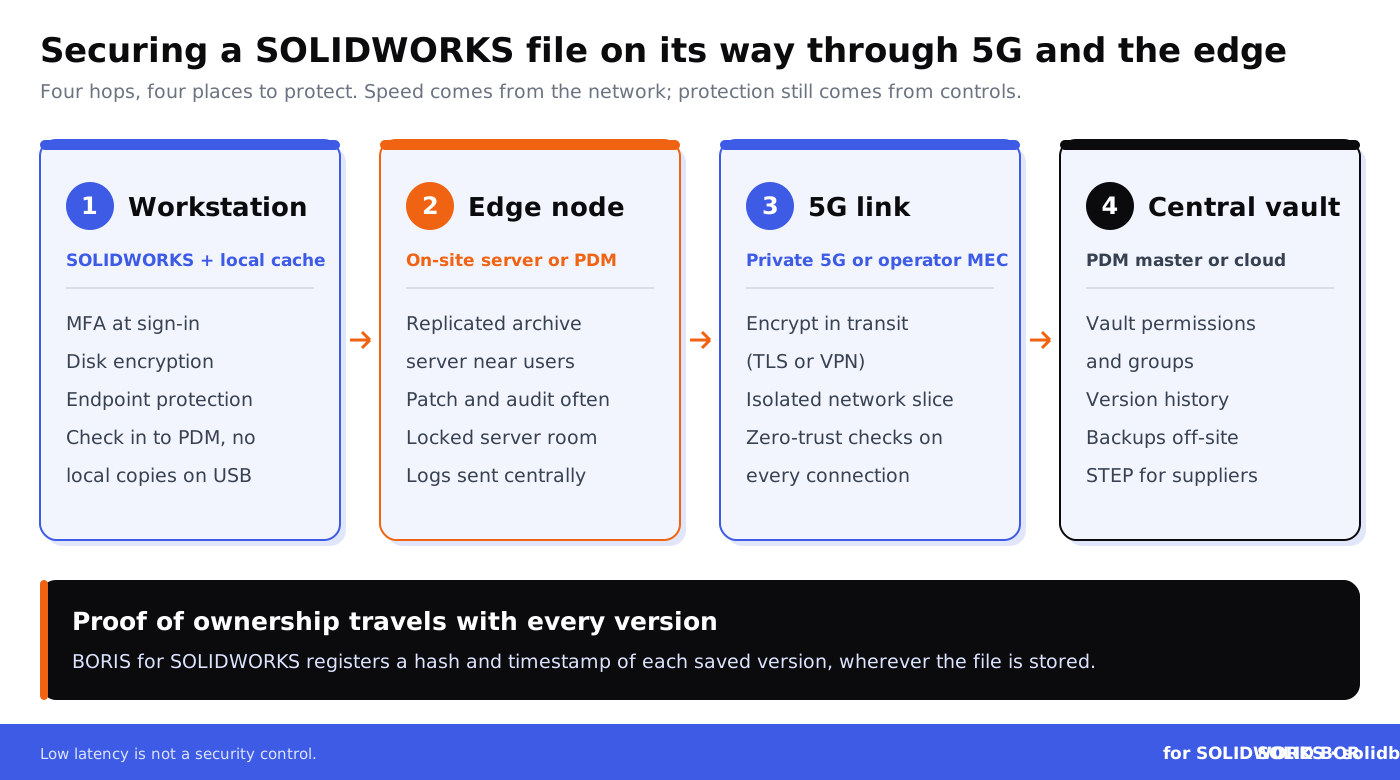
Each new edge node is also one more machine to protect, so treat it like any other CAD workstation; our guide to endpoint protection for CAD workstations covers the basics. By teaming edge systems with specific API security methodologies, engineers utilizing next-gen tools can adopt stronger CAD IP tactics that outperform outdated approaches.
Real-World Use Cases: CAD + 5G + Edge Integration
For European SMEs working in industries like manufacturing, automotive, and robotics, combining 5G networks with CAD-integrated edge computing can change how teams securely collaborate. Here are example scenarios that show how it can work:
- Remote Product Iteration: A German auto parts supplier can pair on-site edge storage with a private 5G network for design updates, keeping sensitive engineering iterations off the public internet.
- Industry-Grade CAD File Enclosures: Dutch electronics firms working in SolidWorks can use BORIS for SOLIDWORKS by CADChain to register each revision (a file hash plus a timestamp) on a blockchain, while PDM permissions on the edge nodes control who can open the files.
- Simultaneous Collaboration: SMEs building architectural models can share files over a hybrid 5G CAD setup with zero-trust access checks, which reduces the risk of unauthorized access even during live modification processes.
The right setup depends on where your files are processed. This comparison shows what each option adds and what it asks of your team:
Mistakes to Avoid When Implementing 5G and Edge Computing
- Overlooking “Zero Trust” Frameworks: Assuming that 5G by itself ensures security is a critical oversight. Zero-trust systems reduce data misuse by always verifying user identities and devices before granting file access.
- Ignoring Edge Node Audits: Without routine verification of your edge storage points, the risk of malware persistence rises.
- Underestimating Scalability Demand: Edge-optimized CAD systems require proactive capacity reviews to prevent bottlenecks; limit-notification settings are vital.
Practical Steps to Strengthen CAD Security Using 5G and Edge Solutions
- Identify all CAD sharing vulnerabilities by testing wireless (over-the-air) file transfers.
- Migrate critical CAD systems to edge-enabled devices and ensure their compatibility with major CAD software like SolidWorks.
- Use blockchain registration (e.g., BORIS for SOLIDWORKS by CADChain) to create tamper-evident records of each design version, and keep access logs in SOLIDWORKS PDM.
- Train engineering teams to recognize red flags in unauthorized edge queries or alerts.
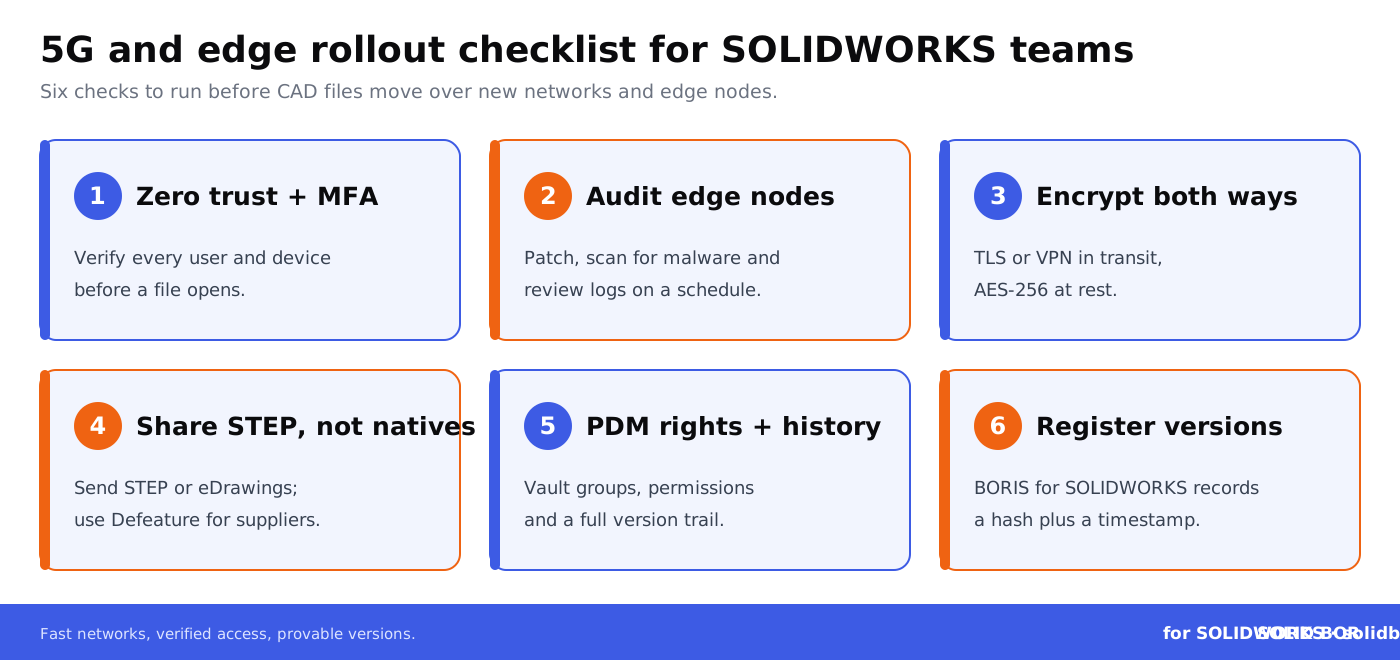
Prove ownership of every SOLIDWORKS version, wherever it is stored!
BORIS for SOLIDWORKS registers a hash and timestamp of your design files on a blockchain, giving you tamper-evident proof of which version existed when, on any network.
👉 Explore BORIS for SOLIDWORKS
Closing Thoughts
The combination of 5G and edge computing gives engineers and SMEs powerful new tools to protect CAD files in 2026. Yet, technological adaptation requires proactive strategizing, something founders like Violetta and Dirk-Jan Bonenkamp put into practice in CADChain’s developments.
Consider expanding this discussion by learning about effective methods to secure distributed CAD collaborations, ensuring your designs thrive in a fully-integrated team effort as enterprises evolve.
People Also Ask:
Why is edge computing a security concern in 5G networks?
Edge computing brings data processing closer to the end users in 5G networks, which reduces delays and enhances performance. At the same time, it expands the number of devices and nodes involved in the network, increasing potential entry points for cyberattacks.
How do 5G and edge computing work together?
5G provides faster data transfer speeds, while edge computing minimizes the distance data travels before processing. Together, they allow real-time processing and lower delays, making them ideal for applications requiring immediate feedback.
Is a CDN edge computing?
While CDNs and edge computing both aim to improve data delivery by moving data closer to users, CDNs focus on caching static data, whereas edge computing processes and analyzes data locally.
What is the difference between 5G and an edge network?
5G provides fast, low-latency wireless communication to transport data. Edge networks, on the other hand, focus on processing and analyzing data close to its source, ensuring results are available quickly.
How does edge computing enhance 5G network performance?
Edge computing enhances 5G networks by offloading data processing from centralized systems to local nodes, enabling faster computation, reduced congestion, and better resource allocation.
What industries benefit the most from 5G and edge computing?
Industries like healthcare, manufacturing, autonomous vehicles, and gaming gain significant advantages due to real-time data processing and faster communication enabled by the combination of 5G and edge computing.
Does edge computing improve security in 5G networks?
Edge computing can both improve and challenge security in 5G. Keeping sensitive data locally reduces exposure risks, yet the decentralized nature introduces potential vulnerabilities across a broader attack surface.
What role does edge computing play in autonomous vehicles?
Edge computing processes data from sensors and cameras in real time, enabling autonomous vehicles to make immediate decisions without relying on distant cloud servers, which supports safety and efficiency.
How does edge computing impact energy usage in 5G networks?
Edge computing can reduce energy consumption by processing data locally, minimizing the need for long-distance data transfer to centralized data centers.
Are there challenges in integrating 5G and edge computing?
Integration challenges often include ensuring compatibility between various edge devices and 5G infrastructure, addressing security concerns, and managing the costs associated with deployment and maintenance.
FAQ: Enhancing CAD Security with 5G and Edge Computing
How does edge computing reduce data breach risks for CAD files?
Edge computing localizes data storage and processing near the source, minimizing vulnerabilities during long-distance transfers. This approach helps keep designs within secure perimeters, reducing exposure to external threats like interception or unauthorized access.
How can 5G help SolidWorks users collaborate effectively during projects?
5G’s reduced latency aids SolidWorks users by enabling faster file updates and collaborative design reviews. Engineers can share CAD models over encrypted connections, make version edits in real time, and boost cross-team performance without delays.
What role does blockchain play in protecting CAD intellectual property?
Blockchain offers a tamper-evident record of each registered CAD file version, so later changes can be detected and the history can be traced. Solutions like BORIS for SOLIDWORKS by CADChain register a file hash and timestamp as proof of ownership; access control itself stays in PDM and your identity tools. Read more about how blockchain hashes fingerprint CAD files.
Can edge computing improve CAD security for aerospace applications?
Yes, aerospace firms benefit from the data sovereignty edge computing affords. Enterprise Digital Rights Management (EDRM) solutions combined with edge nodes help protect sensitive CAD files against compliance breaches. Explore proven aerospace CAD security strategies.
How can SMEs adopt real-time CAD IP protection without extra hardware?
SMEs can pair edge-enabled devices with API security methods and employ cloud-integrated systems to protect CAD IP cost-effectively. Such strategies enhance data processing without requiring advanced infrastructure upgrades.
What mistake should clients avoid when sharing CAD files remotely?
Avoid trusting an open network or assuming compliance certificates replace secure configurations. Ensure zero-trust policies verify user identities before granting access through high-bandwidth connectivity like 5G, and send neutral formats such as STEP instead of native files where possible; see how to share CAD files without exposing IP.
Is edge computing scalable for CAD protection in growing sectors?
Yes, scalable edge solutions grow with CAD demands over time. Regular audits and capacity reviews prevent node overload while enhancing security measures for expanding data streams and file operations.
How can CAD workflows be prepared for quantum threats?
Future-proof CAD workflows by planning a move to post-quantum cryptography, such as the NIST-standardised ML-KEM algorithm (FIPS 203), as your encryption vendors support it. Access key optimization tips for safeguarding designs against emerging quantum risks.
What industry practices safeguard shared files in hybrid environments?
Use AES-256 encryption for files and adopt permission-based collaboration protocols. Secure backup solutions and periodic inspection of edge endpoints keep hybrid CAD environments resilient to attacks or data leaks.
How does outsourcing CAD drafting enhance security and efficiency?
Outsourcing CAD drafting tasks to specialists can support compliance, reduce costs, and enhance workflow efficiency. Experienced teams handle secure file sharing and integration for complex telecom or 5G projects. Check outsourcing benefits for CAD drafting.
What first steps strengthen CAD IP using 5G edge systems?
Start by migrating critical CAD systems to edge-enabled devices, and use blockchain registration for tamper-evident version records. Train your team on identifying unauthorized edge alerts to reduce internal risks efficiently.