
TL;DR: Metaverse CAD IP Protection Is a Priority
The metaverse amplifies risks for CAD IP by enabling instant design sharing and easier piracy. Blockchain provides a defense by recording who owned which version and when, and by creating audit trails. SMEs should adopt tools like BORIS for SOLIDWORKS early, so they can prove ownership of their designs before files circulate in virtual spaces.
💡 Curious about future trends to safeguard CAD IP? Check out Emerging CAD IP Protection Technologies for insights that matter.
Metaverse Implications for CAD IP Protection
What happens when the mass digitalization of engineering and design workflows meets a persistent, immersive virtual environment? The collision of CAD (computer-aided design) intellectual property and the metaverse raises challenging questions about ownership, security, and data control. With the added complexity of NFTs and blockchain-based proofs of ownership, traditional IP laws face unprecedented demands. For SolidWorks users designing proprietary industrial components, this transition isn’t just philosophical; it’s business-critical.
“The metaverse is set to become the Wild West for CAD data unless we actively secure intellectual property before entering this interconnected reality.”
Violetta Bonenkamp, CEO, CADChain
The need for global adaptation of intellectual property frameworks to meet metaverse realities can no longer be ignored. CAD files, easily replicated and shared digitally, are particularly vulnerable, and the consequences of leaked designs go far beyond financial losses: they include liability risks and loss of competitive advantage.
Secure Your CAD Files for the Metaverse!
Discover how blockchain-based systems can protect your intellectual property in this new digital dimension with BORIS for SOLIDWORKS.
👉 Explore CAD Security Solutions
Why the Metaverse Accelerates Risks for CAD IP
The immersive and interconnected metaverse doesn’t just simulate reality; it amplifies the complexities of digital collaboration. Here’s why CAD intellectual property is more at risk than ever before:
- Instantaneous Data Sharing: In virtual environments, CAD designs and engineering files can be accessed, modified, or stolen faster than traditional audits or controls can detect.
- Global Interconnections: Teams from disparate geographies collaborate effortlessly, complicating jurisdictional enforcement of intellectual property laws.
- Replicability: Simple processes like screen scraping or geometry extraction in the metaverse enable piracy at an industrial scale.
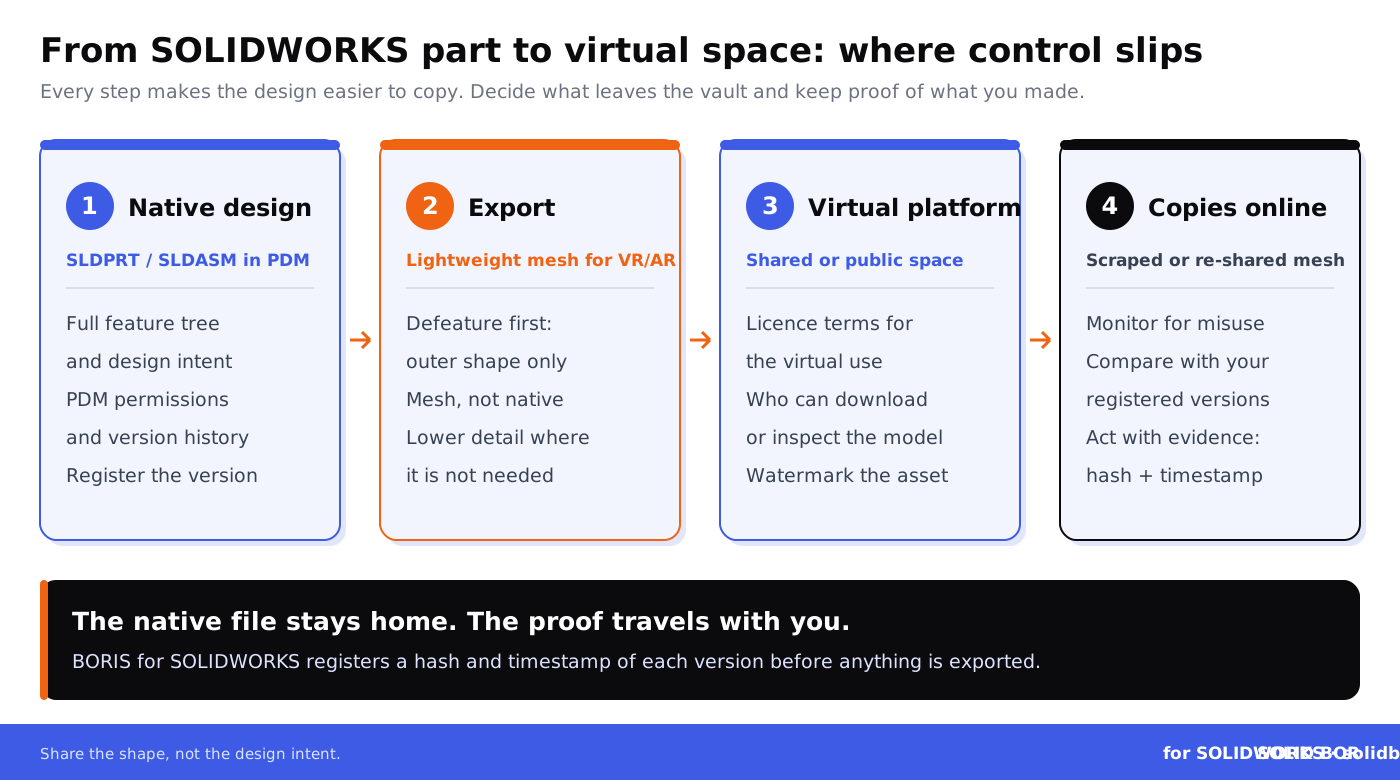
In practice, the native SOLIDWORKS part or assembly rarely needs to leave the vault. What goes into a virtual showroom or VR review is usually a lightweight mesh; running Defeature first keeps internal features and design intent out of it. Our guide on how to share CAD files without exposing IP covers the same idea for supplier exchanges.
Can Blockchain Solve Metaverse CAD IP Problems?
Blockchain, often viewed as the technical backbone of the metaverse, offers potential solutions. By creating tamper-evident, timestamped records of CAD file ownership and transfer, blockchain makes it easier to prove what you created and when, even after a design has been replicated or stolen. For SolidWorks users, tools like NFTs for CAD design ownership can help demonstrate authenticity and provenance, although a token does not by itself create or transfer IP rights.
But the implementation isn’t always straightforward. Issues such as blockchain interoperability arise when trying to ensure consistent digital rights management across multiple platforms that utilize distinct blockchain protocols. Blockchain interoperability for CAD systems thus becomes a pivotal area of development to make blockchain an actionable part of CAD IP protection.
Each protection method covers a different part of the problem. This comparison shows what each one does, and does not do, once a design is shown in a virtual space:
Want Proof of Ownership Without Disruption?
BORIS for SOLIDWORKS works inside your existing SOLIDWORKS workflow and registers a hash and timestamp of each design version on a blockchain.
👉 Explore BORIS for SOLIDWORKS
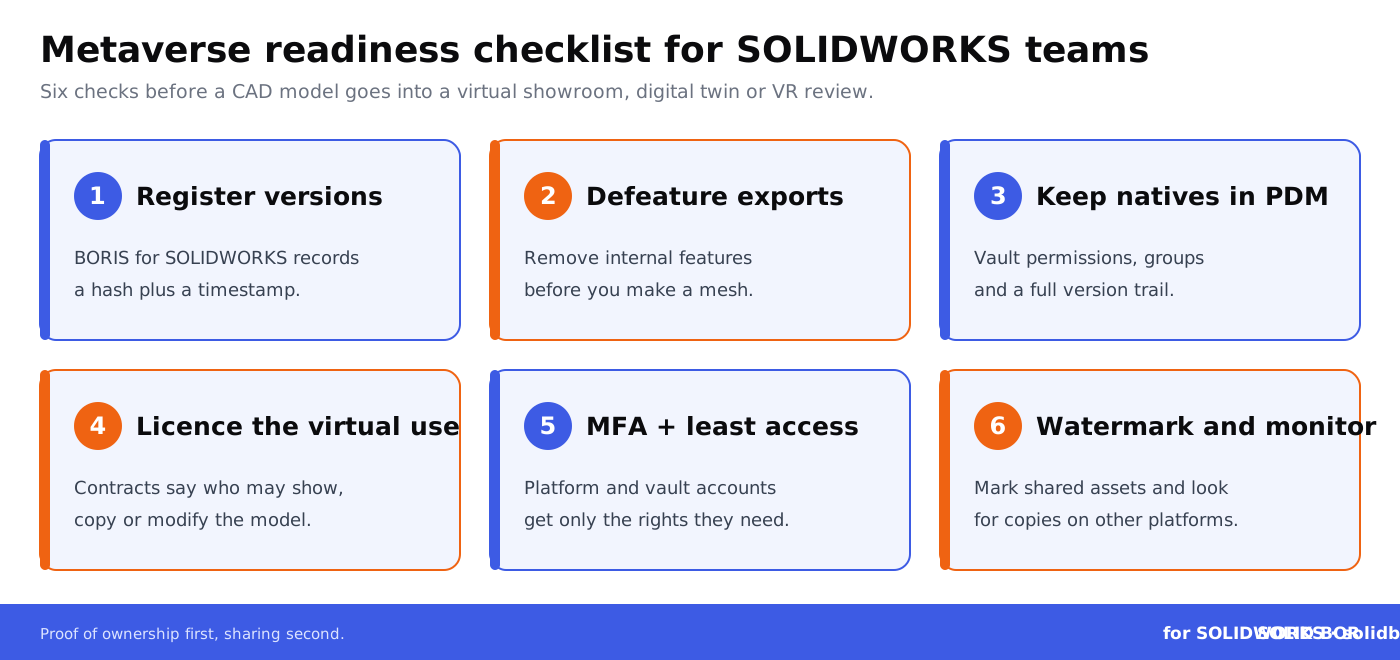
How Small and Medium Enterprises Can Prepare for the Metaverse
Small and medium-sized enterprises (SMEs), particularly in Europe, face unique challenges in adapting to CAD file security challenges in the metaverse. Cost-effective yet scalable solutions are mandatory for staying competitive.
- Adopt Blockchain for File Registration: Tools like BORIS for SOLIDWORKS register a hash and timestamp of each design version from its inception, giving you stronger evidence of ownership if a dispute arises.
- Incorporate IRM into Workflows: Information Rights Management solutions help prevent unauthorized access or editing of CAD files, centralizing file control.
- Integrate DAO-like Mechanisms: Decentralized Autonomous Organizations for IP management can allocate rights dynamically and transparently through code; they are built on the same logic as smart contracts for IP protection.
“Preparation for the metaverse requires a layered approach: legal, technical, and human. Blockchain is just one piece of the puzzle, not a standalone cure.”
Dirk-Jan Bonenkamp, CLO, CADChain
What’s Next? Beyond the Metaverse for CAD IP
As the metaverse matures, its implications for CAD IP will give way to innovations addressing larger issues: interoperability between engineering systems and unified legal frameworks across global markets. For SolidWorks users, integrating blockchain within traditional workflows is an immediate win, but the horizon holds opportunities for real standardization and global IP law alignment.
Are You Ready for the Future of CAD IP Protection?
Dive into the guide for emerging trends in 2026 and beyond to stay ahead of IP challenges.
👉 Discover Emerging Trends Now
People Also Ask:
How does the metaverse impact intellectual property protection?
The metaverse presents new challenges for intellectual property (IP) protection due to its digital nature, making it easier for designs, trademarks, and copyrighted works to be replicated without consent. Companies need to adopt strategies to track misuse, such as utilizing blockchain for transparency and enforcement.
Can CAD designs be protected in the metaverse?
Yes, CAD files and digital designs can be protected in the metaverse using copyright laws and trade secret protections. Additionally, measures such as secure file encryption and watermarking help prevent unauthorized sharing.
What are the risks to IP when designs are shared in the metaverse?
When designs are shared in the metaverse, risks include unauthorized replication, piracy, and loss of exclusivity. Without proper IP protections and tracking mechanisms, original creators could lose control of their intellectual assets.
Is blockchain useful for IP protection in the metaverse?
Blockchain is useful because it creates a tamper-evident record of ownership and transaction history, making it easier to track and prove the authenticity of digital assets within the metaverse.
How can trademarks be enforced in virtual environments?
Enforcing trademarks in the metaverse requires monitoring platforms for unauthorized use and taking legal action where necessary. Building partnerships with virtual platforms to recognize and enforce trademark rights is also effective.
What legal protections cover virtual goods and digital twins?
Virtual goods and digital twins can be protected under copyright and design laws. Patents may also apply if they involve novel technological functions. Registration of IP rights adds an additional layer of enforceability.
How can businesses prevent misuse of IP in online metaverse spaces?
Businesses can prevent misuse by employing digital rights management (DRM), monitoring platforms for violations, and issuing cease-and-desist notices. Collaborating with metaverse administrators can also help in flagging and removing infringing references.
What are the implications of IP theft in the metaverse?
Theft of IP in the metaverse can lead to financial losses, devaluation of brand reputation, and challenges in proving ownership of assets. This emphasizes the need for comprehensive legal strategies and technological measures.
Why is creative licensing vital for metaverse content?
Creative licensing establishes clear terms for the use of content within the metaverse, ensuring creators are credited and compensated while protecting their rights from unauthorized exploitation.
What trends are shaping IP protection strategies in the metaverse?
Emerging trends include the use of AI for early detection of infringements, blockchain for tracking ownership, and stricter collaboration between governments and virtual platforms to address IP challenges on a global scale.
FAQ: Metaverse Implications for CAD IP Protection
Why is IP protection more challenging in the metaverse?
The metaverse amplifies risks due to easier replicability of designs, decentralized platforms, and lack of uniform legal frameworks for digital goods. To address this, companies should integrate blockchain-based tools and smart contracts, improving traceability and control over intellectual property.
What are the key risks for CAD designs in the metaverse?
Major risks include data replication, unauthorized modifications, and industrial-scale piracy using geometry extraction tools. To mitigate these, consider solutions like BORIS for SOLIDWORKS by CADChain, which registers a hash and timestamp of each design version on a blockchain as proof of ownership. Learn more about securing CAD files at blockchain for CAD protection.
How does blockchain improve CAD IP protection?
Blockchain provides tamper-evident records of CAD file ownership and transfer history. By linking each version to a unique fingerprint (hash), it provides verifiable proof of authorship and makes later changes detectable, even when files are modified or shared globally. Access control itself still comes from PDM permissions and your identity tools; see how blockchain hashes fingerprint CAD files.
Can NFTs help protect CAD designs in virtual environments?
Yes, NFTs allow creators to tokenize CAD designs, providing a public record of who holds the token and enabling monetization through royalties where platforms support them. NFTs also bolster trust through authenticity verification, but the IP rights themselves depend on copyright, design law and the licence attached. Explore more about CAD NFTs at NFTs for CAD Protection.
What role does interoperability play in CAD IP security?
Interoperability between platforms is key for consistent IP protection. Blockchain protocols should work across metaverse ecosystems, helping users maintain control over their CAD designs across distinct virtual environments without compromising security.
How can SMEs align their CAD security strategies with metaverse expansion?
SMEs should prioritize cost-effective solutions like blockchain-based file registration and information rights management. These tools offer scalable IP protection without disrupting workflows, supporting compliance and competitive advantage as the metaverse evolves. Start with SOLIDWORKS PDM permissions and version history.
Can legal tech simplify metaverse-related IP disputes?
Yes, legal tech such as smart contracts and timestamped blockchain records simplifies proving file ownership in disputes. These records can reduce the cost of gathering evidence and strengthen IP claims in digital contexts; read more about blockchain records as legal evidence.
How does the metaverse affect global IP enforcement for CAD files?
The metaverse complicates IP enforcement by blurring geographical boundaries. Blockchain records help bridge jurisdictional gaps by offering the same timestamped proof of creation and ownership everywhere, although courts still assess that evidence under their own national laws.
What are the best practices for CAD IP management in the metaverse?
Combine blockchain registration, smart contracts, and file encryption to secure CAD assets. Regularly update workflows to integrate emerging legal and technical frameworks. Proactively educating teams on IP risks also helps reduce vulnerabilities.
What future developments could shape CAD IP protection?
Future developments include enhanced blockchain interoperability, unified international IP standards, and advanced AI-powered tools for detecting unauthorized usage. These innovations will further safeguard CAD designs as virtual collaboration intensifies globally.