
TL;DR: Quantum Computing Threats to CAD Encryption
Quantum computing could make the public-key encryption used around CAD platforms like SolidWorks obsolete. Shor's algorithm can break RSA and ECC, which protect key exchanges, signatures and logins, exposing proprietary designs to theft and tampering. Protect intellectual property with post-quantum cryptography, AES-256 for stored files, blockchain-backed registration of each design version and clear licence terms for file sharing.
💡 Stay ahead of quantum challenges, explore the future-readiness of CAD security technologies to guard your designs effectively.
Quantum Computing Threats to CAD Encryption: What You Need to Know
As quantum computing advances, the ability of traditional encryption methods to secure CAD files comes under serious threat. By leveraging algorithms like Shor's, a large enough quantum computer could break widely used asymmetric encryption systems, such as RSA and ECC. This poses a significant risk to engineers and designers relying on CAD solutions like SolidWorks to safeguard intellectual property.
Nobody knows the exact date of Q-Day, but NIST plans to deprecate RSA and ECC from 2030 and disallow them from 2035, so designers and manufacturers should start planning quantum-resistant strategies now.
In the context of SolidWorks users, CAD designs often represent trade secrets and proprietary knowledge. Losing control over these assets can cost an SME far more than the files themselves, especially when it operates on tight margins. Because design data stays valuable for years, the shift to new encryption that can withstand quantum attacks needs attention now, not on the day a quantum computer arrives.
Need dated proof of ownership for your SOLIDWORKS designs?
BORIS for SOLIDWORKS registers a hash and timestamp of each design version on a blockchain, right inside SOLIDWORKS. Pair it with up-to-date encryption and PDM permissions to protect your files against today's and tomorrow's risks.
👉 Explore BORIS for SOLIDWORKS
How Quantum Computing Threatens CAD Encryption
Quantum computers excel at solving certain problems that classical computers find computationally infeasible. Using Shor's algorithm, they can factor large integers and compute discrete logarithms quickly, breaking encryption systems like RSA and elliptic curve cryptography, which underpin digital signatures, key exchanges and authentication processes in CAD workflows.
For CAD systems, the implications are clear: asymmetric cryptography used to verify access controls and ownership certificates could become obsolete. This is particularly worrisome for SolidWorks users sharing proprietary designs with external collaborators, manufacturers or subcontractors. Attackers can also copy encrypted files and traffic today and decrypt them later, a tactic known as "harvest now, decrypt later". Without robust protective measures, designers risk unauthorized manipulation or theft of their intellectual property.
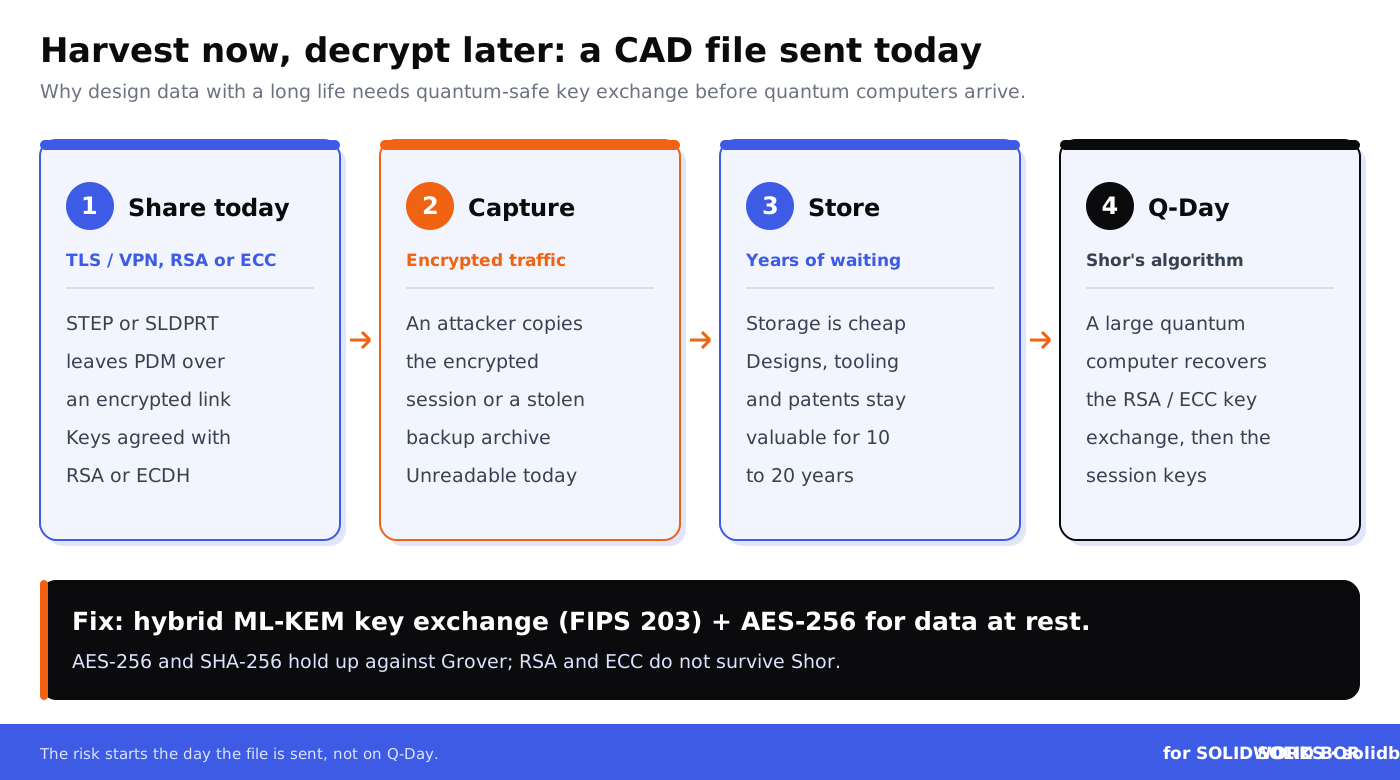
Symmetric encryption is in a much better position. Grover's algorithm only halves the effective strength of a key, so AES-256 encryption for CAD files and SHA-256 hashes remain strong. The weak points are the public-key parts around them. This table shows where each algorithm stands:
Top Quantum-Resistant Solutions for CAD Encryption
- Post-quantum cryptography: New encryption algorithms designed to withstand quantum attacks provide an effective alternative. NIST published its first post-quantum standards in August 2024: ML-KEM (FIPS 203) and ML-DSA (FIPS 204), which are lattice-based, and SLH-DSA (FIPS 205), which is hash-based.
- Blockchain-backed protection: Integrating blockchain technology creates tamper-evident records of authorship and ownership for CAD files, adding an extra layer of evidence. Learn how blockchain interoperability in CAD systems keeps proprietary designs secure.
- Quantum key distribution: This advanced methodology uses quantum mechanics to exchange encryption keys, so any attempt to intercept them can be detected. It needs dedicated fibre or satellite links, so most companies will rely on post-quantum cryptography instead.
- Enhanced DRM/IRM technologies: Digital Rights Management (DRM) and Information Rights Management (IRM) strategies, implemented with encryption that adapts to quantum computing threats, can reinforce file security across platforms like SolidWorks.
The Role of Blockchain in Protecting CAD with SolidWorks
Blockchain technology is well suited to provide tamper-evident records for CAD files. For SolidWorks users, BORIS for SOLIDWORKS registers a hash (digital fingerprint) and a timestamp of each design version from inside SOLIDWORKS. The native files stay in your vault, and access to them is still controlled by SOLIDWORKS PDM permissions.
Smart contracts can record licensing and usage terms for CAD files shared externally, but they do not replace encryption: the files themselves still need strong encryption in storage and transit. Blockchains also rely on ECC signatures today and will need to migrate to post-quantum signatures. A SHA-256 hash and timestamp recorded before Q-Day still show that a design existed at that time, which is why registration and post-quantum encryption work best together. Keep personal data off-chain to stay in line with GDPR.
Violetta Bonenkamp: Quantum Threats from a Legal and Engineering Perspective
Violetta Bonenkamp, CEO of CADChain, emphasizes that preparing CAD workflows for quantum resilience is a necessity, not an option. According to Violetta, early adoption of blockchain-integrated solutions like BORIS for SOLIDWORKS helps SMEs navigate quantum challenges without overhauling their entire process.
Her co-founder, Dirk-Jan Bonenkamp, a legal expert, further asserts that blockchain records will likely become court-admissible evidence for IP ownership disputes, which is a crucial advantage for protecting SolidWorks designs. Read more about blockchain records as legal evidence.
Is your API ready for the quantum era?
Enhance API security and enable seamless integration with advanced CAD encryption tools.
👉 Secure Your API
Common Mistakes in CAD Security Against Quantum Threats
- Relying solely on traditional encryption: Current asymmetric encryption algorithms are vulnerable to quantum breakthroughs. Transitioning to post-quantum cryptographic solutions should be prioritized.
- Failing to register designs with blockchain: Without a dated, tamper-evident record of each version, proving the authenticity and ownership of CAD files in court becomes harder.
- Ignoring collaborative risks: Sharing native files across distributed teams without clear licence terms and controlled sharing could lead to unauthorized reproduction or IP theft. Send STEP or eDrawings files where you can; see how to share CAD files without exposing IP.
- Neglecting API reliability: APIs enabling CAD file transfers must be fortified against quantum-era vulnerabilities. Learn more about AI-enhanced CAD security measures.
Preparing CAD Workflows for Quantum Resilience
- Assess vulnerabilities: Audit your existing CAD security measures to identify weaknesses exposed by quantum computing. List where RSA and ECC are used: PDM server certificates, VPN, single sign-on and code signing.
- Adopt post-quantum cryptography: Transition encryption methods used in CAD file sharing to resilient solutions defined by NIST and similar organizations, starting with hybrid key exchange where your vendors support it.
- Use blockchain-backed registration: Register each released design version with BORIS for SOLIDWORKS, which records a hash and timestamp on a blockchain as tamper-evident proof that the design existed.
- Integrate smart contracts: Record usage permissions and licence terms in smart contracts that refer to the registered versions, so they are clear and automated where payments happen on-chain. Enforcement outside the blockchain still relies on contracts and courts.
- Update training protocols: Train engineers to handle quantum-secure encryption and blockchain-relevant workflows on platforms like SolidWorks.
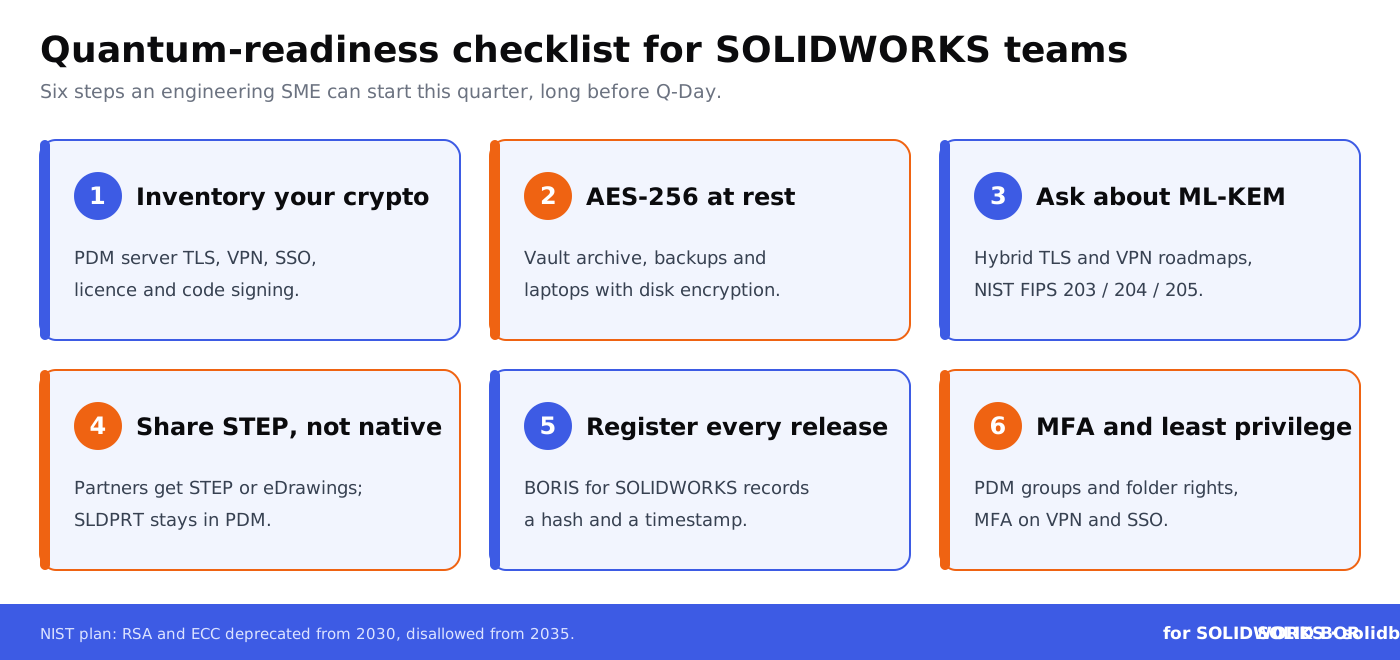
Quantum-safe planning is no longer futuristic: it is becoming a baseline expectation for intellectual property management in 2026.
For a step-by-step plan, read our guide to the top 7 steps to optimize CAD security against quantum threats, and see the difference between CAD file protection and data encryption.
Looking ahead: The future of CAD security technologies!
Discover emerging trends and innovations shaping IP protection between 2026 and 2030.
👉 Explore Future Trends
People Also Ask:
Could a quantum computer break Bitcoin encryption?
Yes, a quantum computer with sufficient power could theoretically break the cryptography that protects Bitcoin using algorithms like Shor’s algorithm. Bitcoin relies on ECC (Elliptic Curve Cryptography) for its signatures, which would be vulnerable to such a device. Current estimates suggest that practical quantum computers capable of breaking ECC may not emerge before 2030 or later.
How quantum computing threatens encryption?
Quantum computing threatens encryption by using algorithms that can efficiently solve mathematical problems considered infeasible for classical computers, like factoring large numbers or solving discrete logarithms. This capability could break widely-used cryptographic protocols, including RSA and ECC, compromising secure communication and data protection systems globally.
How long would it take a quantum computer to crack 256-bit encryption?
It depends on the type. For AES-256, Grover’s algorithm only halves the effective key length to about 128 bits, which would still take an impractically long time, so AES-256 is considered quantum-safe. 256-bit elliptic curve keys are different: a fault-tolerant quantum computer with thousands of logical qubits, which means millions of physical qubits, could break them with Shor’s algorithm in hours or days. Current quantum computers lack this capability and may require many years of development to reach that level.
What did Elon Musk say about quantum computing?
Elon Musk has reacted publicly to quantum computing news, for example to Google’s Willow chip announcement in December 2024. The warnings about encryption come mainly from cryptographers and standards bodies: NIST, for example, plans to phase out RSA and ECC between 2030 and 2035 and recommends quantum-resistant cryptographic methods to protect sensitive information from potential breaches.
What are post-quantum cryptography solutions?
Post-quantum cryptography solutions are algorithms designed to resist attacks from quantum computers. These include lattice-based cryptography, hash-based cryptography, code-based cryptography and multivariate polynomial cryptography. NIST has standardised ML-KEM, ML-DSA and SLH-DSA, and selected the code-based HQC as a backup in 2025. These methods aim to provide security even if quantum computing becomes widely accessible and capable of breaking conventional algorithms.
Why is quantum computing a risk to CAD encryption?
CAD encryption relies on standard cryptographic algorithms that could be vulnerable to quantum computers. If those algorithms, such as RSA or ECC, are compromised by a quantum computer, the security of designs, intellectual property or sensitive industrial data safeguarded by CAD encryption could be at risk, prompting the need for quantum-resistant protocols.
What is Shor's algorithm and how does it impact encryption?
Shor’s algorithm is a quantum algorithm for integer factorization and discrete logarithms, the problems behind cryptographic protocols like RSA and ECC. Its efficiency in solving these mathematical problems means it could break those encryption keys, rendering current systems obsolete if quantum computing becomes capable of running the algorithm at scale.
How is the cybersecurity sector adapting to quantum computing threats?
The cybersecurity sector is developing quantum-resistant encryption standards, participating in global research initiatives and preparing for mass migration to post-quantum systems. Governments and organizations are investing in education and encryption updates to minimize vulnerabilities before quantum computers become capable of breaking current protocols.
What does 'quantum supremacy' mean, and why does it matter for encryption?
Quantum supremacy refers to a quantum computer solving a task that classical computers cannot solve in a practical time. Google claimed it in 2019 with a specially chosen sampling task, which did not threaten encryption. Breaking RSA or ECC needs a much larger, error-corrected quantum computer, so supremacy is a milestone on the way rather than the moment conventional cryptography fails.
What steps can businesses take to prepare for quantum computing risks?
Businesses can prepare by conducting risk assessments for quantum vulnerabilities, adopting post-quantum cryptography, participating in government or industry standardization efforts and ensuring their IT infrastructures are flexible enough for future cryptographic migrations. These proactive measures help mitigate risks associated with the advent of quantum computing.
FAQ on Quantum Computing Threats to CAD Encryption
What is quantum-resistant encryption, and how can it protect CAD files?
Quantum-resistant encryption refers to cryptographic algorithms designed to withstand quantum computing attacks. These include lattice-based and hash-based cryptography. Implementing such encryption helps keep SolidWorks CAD files secure from both current and future vulnerabilities. Read more on quantum-resistant CAD protection.
When will quantum computing begin to affect CAD encryption reliability?
Nobody knows exactly. The day a quantum computer can break RSA and ECC is called 'Q-Day', and expert estimates range from the early 2030s to much later. NIST plans to deprecate RSA and ECC from 2030 and disallow them from 2035, and 'harvest now, decrypt later' attacks make the risk real today, which highlights the urgency of adopting post-quantum cryptography in CAD workflows. Preparing early can prevent disruptions to intellectual property security.
Why is blockchain relevant for securing CAD files in SolidWorks?
Blockchain offers tamper-evident ownership records. In SolidWorks, BORIS for SOLIDWORKS registers a hash and timestamp of each design version on a blockchain to document design ownership, while access permissions stay in your PDM system. Learn more on blockchain’s role in CAD security here.
Can symmetric encryption like AES withstand quantum computing threats?
AES can be quantum-resistant if key lengths are extended. For example, AES-256 offers sufficient strength against quantum attacks using Grover’s algorithm. However, upgrading encryption protocols in CAD systems remains essential to staying ahead of evolving threats.
What are the risks of continuing to use current encryption in CAD workflows?
Relying on current encryption exposes SolidWorks designs to 'store-now, decrypt-later' attacks. Hackers may steal encrypted files today and decrypt them once quantum computers become efficient. Transitioning to quantum-resistant cryptography mitigates this long-term risk.
What role does information rights management (IRM) play in CAD security?
IRM enforces access controls on CAD files, restricting viewing, editing and sharing actions. Upgrading IRM systems to integrate post-quantum encryption helps files remain secure across collaborators. More insights are available in the DRM vs. IRM guide.
How does quantum key distribution (QKD) improve CAD encryption?
Quantum Key Distribution (QKD) enables encryption keys to be shared using single photons. Any attempt to intercept the key disturbs them and can be detected, making CAD file exchanges much safer from quantum attack vectors. QKD needs dedicated hardware and links, so it is mostly used by governments, banks and telecom operators.
How should SMEs prepare CAD security for quantum threats?
SMEs can take steps like auditing encryption protocols, adopting quantum-resistant standards and registering design versions with BORIS for SOLIDWORKS. Enhanced employee training and blockchain-backed registration also fortify intellectual property. Explore proven steps in CAD security optimization here.
Are CAD files used in collaborative workflows more vulnerable to quantum threats?
Yes, collaborative workflows inherently involve file sharing, increasing exposure to attack vectors. Clear licence terms, for example in smart contracts, and end-to-end encryption in CAD workflows minimize risks of unauthorized access or alterations.
What long-term benefits can enterprises expect from implementing quantum-safe CAD encryption?
Enterprises adopting quantum-safe encryption gain competitive advantages like reduced IP theft risks, compliance with emerging regulations and improved customer trust. Quantum-safe encryption helps keep design assets protected for decades, mitigating vulnerabilities and supporting operational continuity.
Which industries face the greatest risks from quantum computing to CAD designs?
Industries relying heavily on patented designs, such as aerospace, automotive and healthcare, face high risks. These sectors must adopt quantum-resistant solutions swiftly to protect sensitive intellectual property and maintain their competitive edge.