
TL;DR: Secure Your Robotics CAD IP Now
Robotics CAD IP Management is essential to prevent theft, unauthorized access, and regulatory mishaps for manufacturing and engineering firms. Protect your intellectual property by combining access control and encryption (DRM), controlled exports and written licence terms with blockchain registration: BORIS for SOLIDWORKS records a hash and timestamp of each released version as dated proof of ownership. Training your team on European GDPR rules for personal data in CAD workflows is vital for operational safety.
💡 Curious about specific strategies? Explore industry-specific CAD security solutions to safeguard designs and enhance legal defensibility.
Robotics CAD IP Management has become a crucial aspect for engineering firms and manufacturing companies to safeguard their intellectual property and competitive edge. With the European market increasingly demanding compliance and innovation in robotics design, effective strategies to protect CAD intellectual property are no longer optional; they are essential.
According to Violetta Bonenkamp, CEO and Co-Founder of CADChain, and Dirk-Jan Bonenkamp, CLO at CADChain, "Managing CAD-based intellectual property is not just about protecting files, it's about securing your company’s future." But how can robotics-focused organizations apply this wisdom to prevent theft, misappropriation, or accidental leaks of their CAD files? Let’s examine.
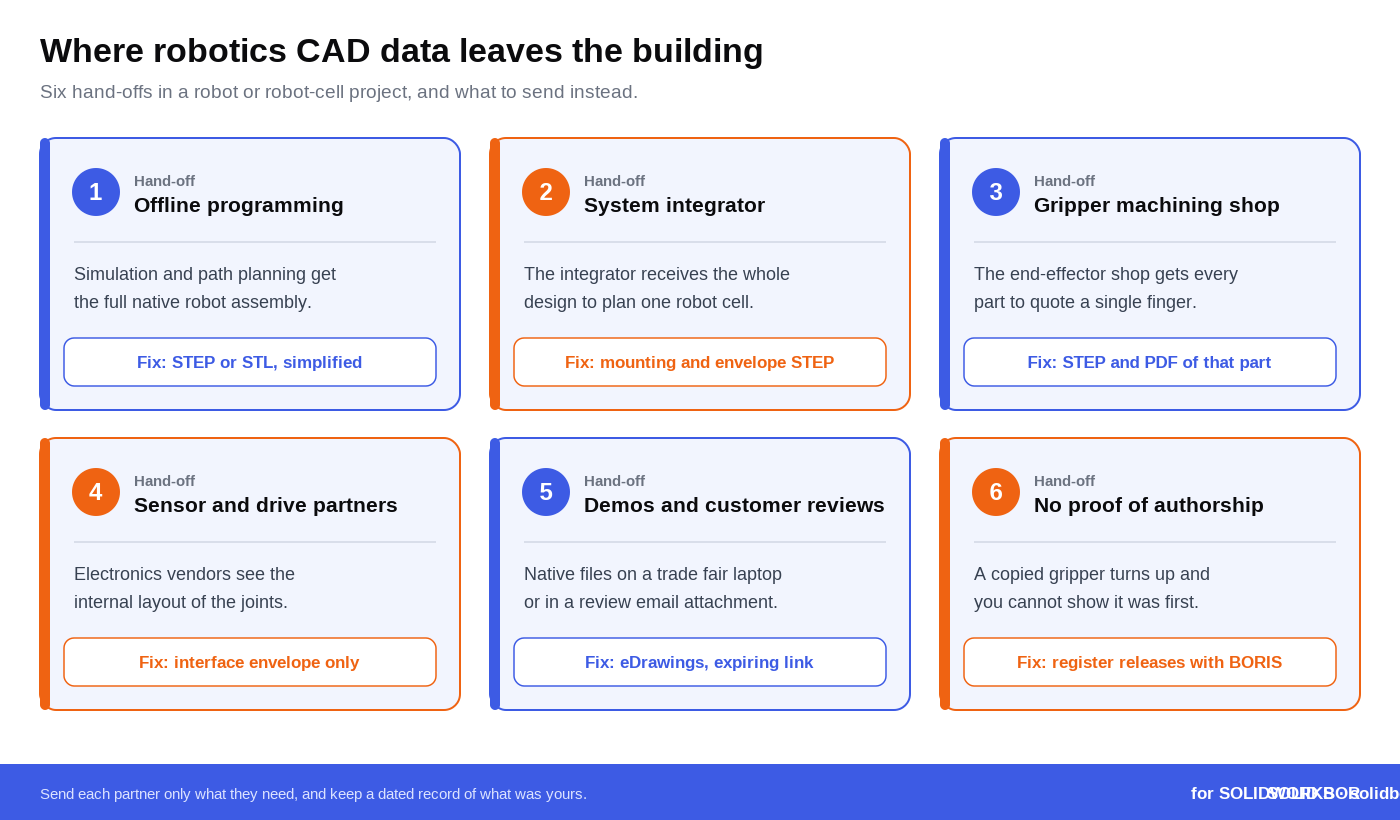
Robotics designs change hands more often than most: offline programming and simulation, system integrators, gripper and end-effector shops, sensor and drive vendors, and customer reviews all ask for CAD data. Each hand-off is a chance for files to leak or be copied; see how IP theft plays out in the CAD industry.
Why Robotics CAD IP Management Matters
The robotics sector heavily relies on CAD designs for creating precise prototypes and groundbreaking innovations. Without robust IP management, companies may experience unauthorized file access, reverse engineering, or data misuse. European SMEs in particular face high risk due to lack of specialized legal teams to safeguard CAD files.
Effective IP management minimizes such vulnerabilities and supports compliance with EU rules: the Trade Secrets Directive expects “reasonable steps” to keep design know-how secret, and GDPR applies wherever CAD workflows hold personal data such as user accounts and author metadata. Using targeted solutions like CAD security strategies suited for the defense industry enhances legal defensibility and closes loopholes often exploited in distributed manufacturing workflows.
What Are the Core Elements of Robotics CAD IP Management?
To protect your robotics CAD files effectively, you must focus on these pillars:
- Implement DRM tools tailored for CAD environments: access control and file encryption for storage and sharing.
- Use blockchain-based registration for IP ownership: a hash and timestamp of each released version.
- Adopt the right legal framework during file sharing.
- Set up mechanisms to track file modifications.
- Train your team to navigate GDPR compliance issues.
BORIS for SOLIDWORKS handles the registration step inside SOLIDWORKS, while SOLIDWORKS PDM permissions and version history cover access and change tracking. For design-side strategies in manufacturing, see industrial design CAD protection.
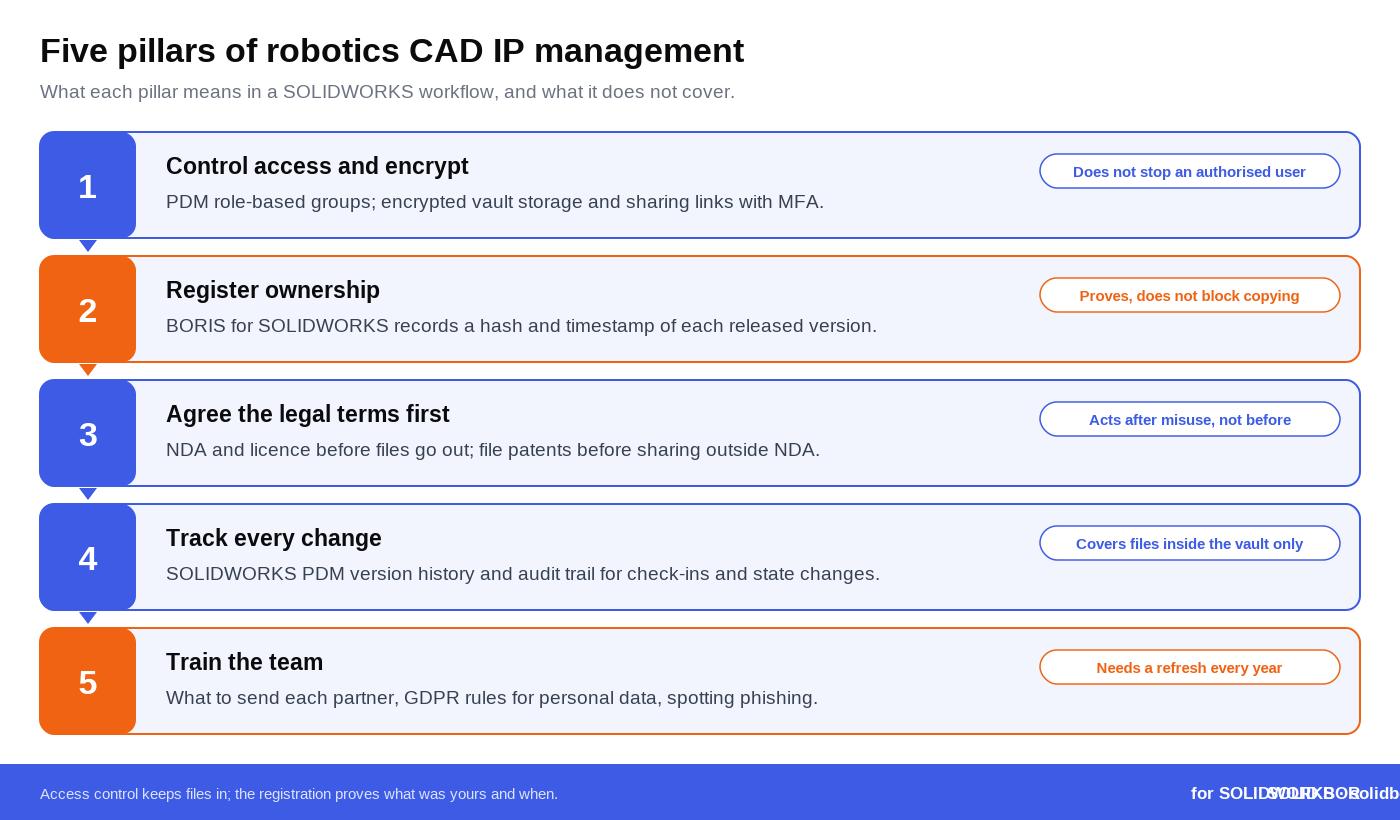
No single layer does everything. This comparison shows what each protection layer covers in a SOLIDWORKS workflow, and where it stops:
How Blockchain Strengthens CAD IP Management
Blockchain has changed IP management by offering tamper-evident ownership records, and smart contracts can record licence terms and automate royalty payments. These features are valuable for robotics companies dealing with CAD files. Violetta Bonenkamp explains, "Blockchain acts as a tamper-proof ledger, giving companies unparalleled transparency in file history and ownership disputes."
This technology’s value is amplified when integrated with tools like SolidWorks, enabling CAD file versioning, quick registrations, and export functionalities. For instance, BORIS for SOLIDWORKS from CADChain registers a hash and timestamp of each released file version, a dated record that courts can weigh as evidence, while SOLIDWORKS PDM keeps the history of who changed or released each file. Only the hash goes on-chain, never the design itself.
Want to protect your CAD designs?
Explore blockchain-based tools to safeguard your intellectual property across design stages.
👉 Blockchain for CAD Protection
Common Mistakes Robotics Companies Make
Despite advancements in IP management, many robotics-focused firms continue to make critical errors:
- Ignoring preemptive registration: Without a dated record of each released design, proving you had it first gets much harder. For patents, Europe follows first-to-file, so file before you show a design outside an NDA.
- Over-relying on NDAs: These often leave gaps when files are shared with extended teams or contractors; see why NDAs don’t fully protect CAD files.
- Failing to track file versions: Without automated tracking, resolving disputes becomes costlier and complex. See how SOLIDWORKS file versioning and tracking work.
Dirk-Jan Bonenkamp stresses that SMEs must actively address these gaps by leveraging modern IP management stacks like manufacturing-focused CAD security solutions to ensure comprehensive protection.
Steps to Enhanced Robotics CAD IP Management Within Europe
Startups and SMEs looking to enhance IP security can follow these actionable steps tailored for European markets:
- Conduct an internal audit of existing CAD workflows to identify vulnerable points.
- Map where your CAD workflows hold personal data (PDM user accounts, author metadata, shared review links) across your European sites and close the GDPR gaps; see GDPR compliance for CAD data management.
- Choose BORIS for SOLIDWORKS for blockchain registration of released versions, and use SOLIDWORKS PDM history and audit trails for monitoring.
- Diversify your protection layers using IRM/DRM combinations that suit design environments, and send partners STEP or eDrawings instead of native files.
- Engage external advisors specializing in IP law for CAD-intensive businesses.
Final Thoughts
European robotics companies stand at a pivotal juncture. With rising IP theft risks and increasingly globalized workflows, prioritizing CAD IP management systems equipped with blockchain is not just beneficial; it’s your competitive edge.
For insights into the future of CAD and IP Protection, check out emerging trends in CAD IP for 2026-2030. Stay ahead by adapting strategies that are shaping global industries.
Register Your SOLIDWORKS Designs
BORIS for SOLIDWORKS registers each released version with a hash and timestamp on the blockchain, straight from SolidWorks.
👉 Get started with BORIS for SOLIDWORKS
People Also Ask:
What is Robotics CAD IP management?
Robotics CAD IP management refers to the process of organizing and protecting intellectual property (IP) associated with Computer-Aided Design (CAD) models and related digital assets used in robotics. It involves secure storage, tracking versions, and ensuring compliance with IP laws to prevent unauthorized use or duplication.
Why is CAD important in robotics?
CAD is vital for robotics because it allows designers and engineers to create, simulate, and analyze robotic models and their components before manufacturing. This reduces development costs, increases precision, and improves the overall efficiency of the robotics design process.
How can IP rights protect robotics CAD models?
Intellectual property rights such as patents, copyrights, and trade secrets can safeguard robotics CAD models by preventing unauthorized reproduction or alteration. These protections can also provide legal recourse against infringement, helping innovators maintain a competitive edge.
What challenges are involved in managing CAD data in robotics?
Challenges include ensuring data security, maintaining version control, enabling collaboration across teams, and integrating various software formats. Additionally, handling large file sizes and ensuring compliance with global IP regulations can complicate the process.
Are there tools available for CAD IP management?
Yes, tools such as Product Lifecycle Management (PLM) systems and CAD-specific management platforms like Aras and Onshape provide capabilities for data organization, secure sharing, and IP protection. These tools help streamline workflows and ensure data compliance.
How is CAD integrated with robotics software?
CAD integration with robotics software typically involves importing CAD models into programming platforms to simulate movements, define robotic paths, and test hardware interactions. Software like RoboDK and Robotmaster supports seamless CAD-to-robot integration for more accurate outcomes.
What are the best practices for protecting CAD designs?
Best practices include encrypting files, using access controls, implementing IP tracking systems, and regularly auditing file usage. Additionally, legal protections such as patents and contracts with clear IP clauses can ensure safe handling of CAD data.
What is the role of AI in CAD IP management?
AI enhances CAD IP management by automating data organization, identifying potential IP violations, and optimizing design workflows. AI tools can also assist in predictive analytics to identify risks and maintain compliance with intellectual property standards.
How does using CAD streamline robotic design processes?
CAD streamlines robotic design by enabling rapid prototyping, virtual testing, and precise modeling of components. This reduces errors, shortens time to market, and ensures that designs meet functional requirements before production begins.
Can CAD models in robotics be standardized across teams?
Yes, standardizing CAD models across teams ensures consistency in design, simplifies collaboration, and reduces errors caused by misaligned formats. Using standardized templates and adhering to universally accepted file formats can facilitate this process.
FAQ on Robotics CAD IP Management
How does CAD IP theft impact robotics companies financially?
CAD IP theft can lead to significant financial losses for robotics companies, including loss of competitive advantage, legal fees, and revenue from misappropriated products. Blockchain registration of released designs gives dated proof of ownership, and PDM history shows who handled each file. Learn more about CAD security in Understanding CAD File Vulnerabilities.
What is the role of GDPR in CAD IP management for robotics?
GDPR protects personal data, not designs: it applies to the names, accounts and metadata that CAD and PDM workflows hold in the European market, and it requires secure handling of that data. Failure to comply can result in steep fines and reputational damage. Design know-how itself is protected through IP rights and the reasonable secrecy steps the EU Trade Secrets Directive expects.
How can SMEs balance collaboration and CAD IP protection?
SMEs can balance collaboration and security by deploying DRM tools, secure cloud environments, and blockchain registration for proof of ownership. These solutions protect shared CAD files without hindering team accessibility. For tailored strategies, explore trade secret protection tips for CAD files.
What are the long-term benefits of using blockchain for CAD IP security?
Blockchain keeps tamper-evident, dated records of ownership, which helps dispute resolution and reduces vulnerabilities in CAD IP management. Design authorization and export logs stay with your PDM system, while the registration gives robotics companies lasting evidence and trust in distributed workflows.
What risks do NDAs fail to address in CAD file protection?
NDAs often fail to prevent unintentional distribution or misuse of CAD files. Unauthorized access by extended teams or third-party contractors remains a loophole. Coupling legal agreements with encryption and version tracking tools significantly strengthens CAD file protection.
How can companies track changes in CAD files effectively?
Version tracking in SOLIDWORKS PDM lets companies monitor file edits, access and version histories. Blockchain registration adds a hash of each released version: if a file is later changed, its hash no longer matches, so tampering shows when the file is checked.
Why is IP certification critical in distributed manufacturing?
In distributed manufacturing, registering ownership gives clear, dated evidence and helps settle disputes across vendors and contractors. Registered CAD designs reassure stakeholders and streamline licensing; registration does not stop copying, so it works alongside access control and written licence terms in a global supply chain.
What specific threats does reverse engineering pose to CAD IP?
Reverse engineering enables competitors to replicate proprietary robotics designs, undermining innovation and market share. Measures like digital watermarking, encryption, access controls and sending simplified STEP exports instead of native files can deter such risks and provide legal accountability.
Can small companies afford CAD IP security strategies?
Yes, small firms can adopt scalable and cost-effective CAD security strategies, such as open-source encryption tools or entry-level blockchain platforms, to safeguard their IP without exceeding budgets. Starting small and gradually upgrading ensures affordability and compliance.
How does multi-factor authentication improve CAD file security?
Multi-factor authentication adds an extra layer of security when accessing CAD files, making unauthorized access with stolen passwords much harder. It is particularly effective for remote teams, and sign-in alerts flag unexpected login attempts, enhancing overall IP resilience.