
TL;DR: Future of CAD IP Protection: 2026-2030 Trends
Emerging challenges like AI threats, metaverse risks, and evolving regulations will redefine CAD intellectual property protection by 2030. Blockchain and AI help secure designs, enable traceability and automate parts of IP compliance. Stay ahead with tools like BORIS for SOLIDWORKS and consider NFT-based ownership records for CAD data.
💡 Curious about the next big trends? Check out Future-Readiness of CAD Security Technologies to prepare for 2030 innovations.
Future of CAD IP Protection: 2026-2030 Trends and What SMEs Should Know
Do you know what challenges your CAD files will face by 2030? From AI-driven threats to evolving IP legislation, the next few years are poised to dramatically reshape intellectual property protection for engineers and designers. The Future of CAD IP Protection: 2026-2030 Trends isn't just about keeping your designs secure; it's about staying ahead in a global race driven by competition, compliance, and collaboration. Experts like Violetta Bonenkamp, co-founder of CADChain, emphasize that failing to adapt could mean irreparable damage to your innovation pipeline.
By the end of this guide, you’ll understand emerging IP trends, how CAD-specific blockchain technologies are evolving, and actionable strategies for SolidWorks users to bolster their intellectual property defenses. Let’s dive in.
"Patent filings and IP activity have skyrocketed in AI-related industries, signaling that the competition is no longer just about great designs, it’s about legally protecting them faster than ever."
Violetta Bonenkamp, Co-founder, CADChain
How Will CAD IP Protection Change by 2030?
The future of CAD IP protection will rely heavily on digital solutions that go beyond traditional methods like non-disclosure agreements (NDAs). Here are some key changes expected to take center stage by 2030:
- Integration of AI tools in CAD environments to identify potential licensing or regulatory risks during file creation.
- A shift toward NFT-based CAD design ownership, where designs are tokenized for verifiable provenance.
- Stricter traceability requirements for file exchanges across international supply chains, driven by customer audits, export control rules and, where personal data is involved, GDPR.
- Rise of metaverse-related IP risks, as engineers collaborate in immersive virtual environments.
- Implementation of Decentralized Autonomous Organizations (DAOs) to manage CAD data licensing and governance transparently.
This is especially important for European SMEs, which are increasingly integrating digital twins and Industry 4.0 workflows. Staying ahead of these trends requires more than tools: it demands understanding and strategy.
AI, Blockchain, and CAD: What’s Driving the IP Revolution?
Three technologies are setting the stage for the 2026-2030 evolution of CAD intellectual property management: AI, blockchain, and legal-tech innovation. Here’s why:
AI: Spotting Risks Before Problems Arise
AI can now flag vulnerabilities in licensing contracts or assess the likelihood of a file being misused after being shared with third parties. AI-assisted tools are also emerging for version comparison and for spotting look-alike designs across global platforms. BORIS for SOLIDWORKS is not an AI tool, but the hashes and timestamps it registers give these tools a reliable reference for which version is the original.
Blockchain: Certifying Ownership
Blockchain technology is gaining ground for CAD data auditing. BORIS for SOLIDWORKS registers a hash and timestamp of each design version on a blockchain, which shows that a specific file existed at a given time and who registered it. Courts weigh such records as evidence alongside contracts, PDM history and witness statements, so they strengthen your position in a dispute rather than making it irrefutable. Read more about blockchain records as legal evidence and digital fingerprints and hash functions.
Legal-Tech Innovation: Automating Compliance
As compliance demands evolve, smart contracts linked to CAD creation processes can record licence terms and automate payments, while the licence agreement and the law still decide what is allowed. According to Dirk-Jan Bonenkamp, CADChain’s Chief Legal Officer, smart contracts embedded in tools like SolidWorks will eliminate delays in licensing negotiations, particularly in sectors requiring cross-border collaboration.
Curious about how blockchain and CAD can evolve together? Here’s a complete guide on blockchain for CAD IP protection.
CAD IP Protection Trends 2026-2030 Compared
How Can SolidWorks Users Stay Ahead?
SolidWorks users, whether designers or manufacturing companies, face rising pressure to modernize their IP protection workflows. Here are key steps you can take to stay ahead:
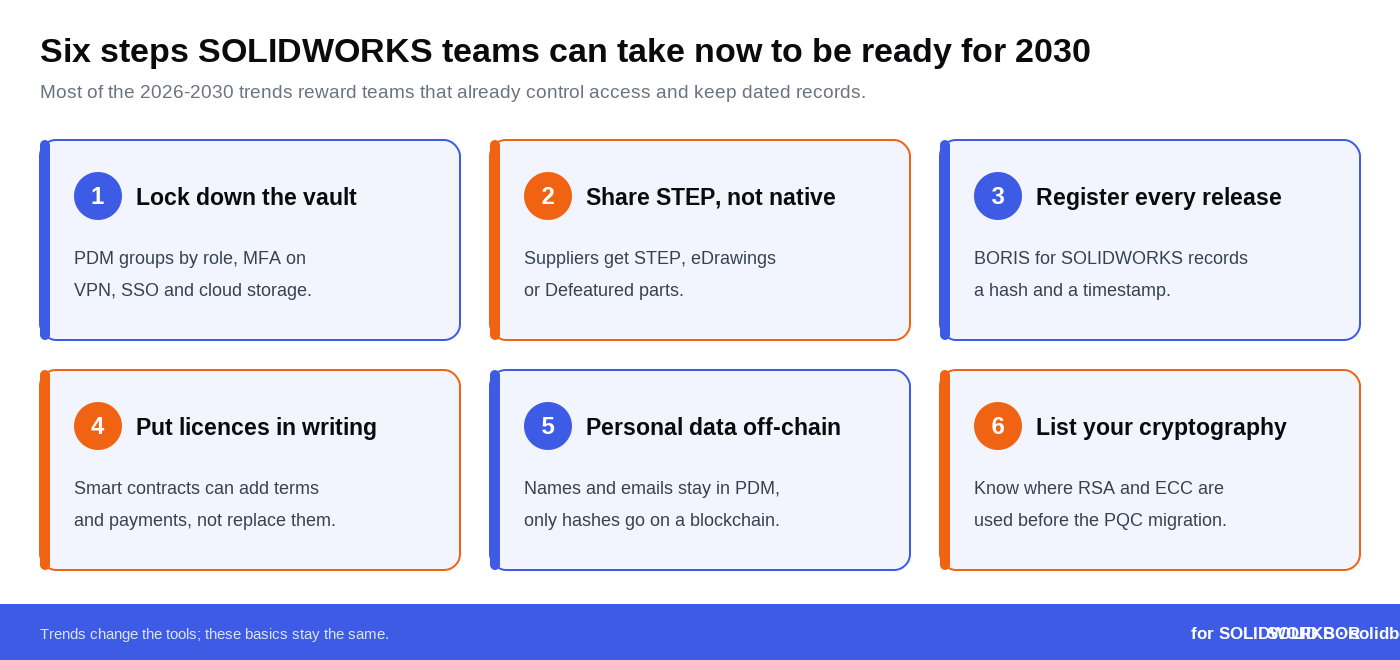
- Install Plugins: Add blockchain-based plugins like BORIS for SOLIDWORKS, which register a hash and timestamp of each design version from inside SOLIDWORKS. Keep access control in SOLIDWORKS PDM permissions and groups and share STEP or eDrawings files instead of native models.
- Identify Licensing Streams: Evaluate how your CAD designs could integrate into new markets, particularly metaverse-related projects.
- Regularly Audit Digital Workflows: Track every edit, share, and interaction with your CAD designs to ensure compliance across supply chains. See the regulatory requirements for CAD audit trails.
- Embed Smart Contracts: Automate parts of licensing, such as payments and usage terms, in your CAD workflows to minimize manual errors and legal disputes, with a written licence agreement as the legal basis.
- Invest in Education: Train your team to recognize weak points in IP workflows and effectively deploy solutions like BORIS for SOLIDWORKS.
Testing these initiatives early offers a competitive advantage, especially when collaborating with global partners, where local and international regulations intersect.
Mistakes That Put Your IP at Risk
Many organizations unintentionally expose their intellectual property to risk. Here are the most common mistakes that SolidWorks users must avoid:
- Insufficient Access Control: Sharing unprotected CAD files via email or basic cloud services makes them vulnerable to theft or misuse. See how to share CAD files without exposing IP.
- Failure to Trace File Edits: Without PDM history and registered versions, it is hard to prove when a file was modified or by whom.
- Over-reliance on Contracts: NDAs alone are often inadequate to prevent misuse. Combine them with technical protections like access control, encryption and neutral formats such as STEP; smart contracts can add a shared record of licence terms.
- No Backup Plan: Failing to keep backups and tamper-evident records of your designs can weaken your legal standing in disputes.
By combining PDM permissions, secure sharing and BORIS for SOLIDWORKS registration in a next-gen IP strategy, these mistakes can be avoided effectively.
Stay Protected While Collaborating Globally!
Learn how decentralized solutions give you the competitive edge your partnerships require.
👉 Explore regulatory advancements now
Why the Future Requires Collaborative Solutions
The next frontier in CAD IP protection won’t rely just on individual tools or isolated efforts. It will require interoperable solutions such as DAOs and smart contracts that drive industry-wide collaboration. For instance, blockchain-backed CAD ownership records not only document who owns which files but also accelerate innovation through confidence in shared designs, benefitting SMEs across Europe.
While you’re working to secure your CAD workflows, consider preparing for next-gen solutions by exploring the future-readiness of CAD security technologies. The more informed your strategy, the stronger your position by 2030.
Want dated proof of ownership for your SOLIDWORKS designs?
BORIS for SOLIDWORKS registers a hash and timestamp of each design version on a blockchain, right inside SOLIDWORKS. Combine it with PDM permissions and secure sharing to be ready for the changes coming up to 2030.
👉 Explore BORIS for SOLIDWORKS
People Also Ask:
What trends are shaping CAD IP protection from 2026 to 2030?
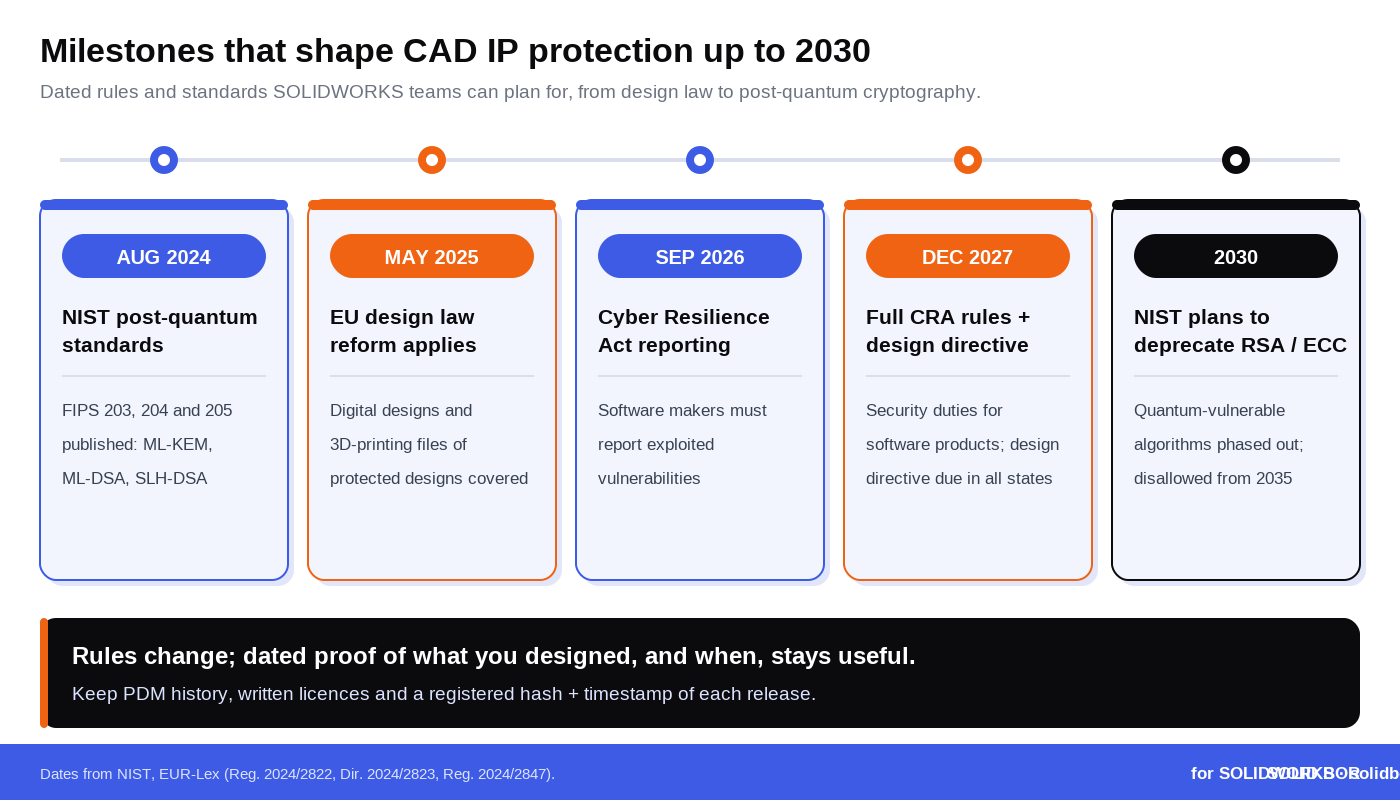
Emerging trends include stronger protection for digital and engineering works, the growing use of blockchain to authenticate asset ownership, and AI-based tools enhancing content monitoring. In the EU, the design law reform that applies from May 2025 explicitly covers digital designs and gives design holders the right to stop others from creating, downloading or sharing files, such as 3D-printing files, that let someone make a protected product.
How can CAD designers safeguard their intellectual property in 2026?
Designers should leverage watermarking techniques, secure file-sharing platforms, and blockchain for timestamped records of ownership. Using contractual agreements like NDAs and licenses when collaborating with third parties also remains a key defense against potential misuse.
Why is blockchain important for CAD IP protection?
Blockchain offers tamper-evident timestamping of CAD files, showing who registered a file and when, which helps deter unauthorized duplications. As of 2026, its use is expanding in industries where design is central, such as architecture and engineering, allowing creators to keep dated evidence of intellectual ownership that can be used across borders.
Are cross-border laws evolving to protect CAD IP?
Cross-border laws are progressively aligning, with trade agreements incorporating newer protections for digital assets and intellectual property. This creates a stronger framework for pursuing legal action against IP infringement in international markets.
What role does AI play in monitoring CAD IP theft?
AI systems are being employed to scan public domains, marketplaces, and file-sharing platforms for unauthorized copies or uses of CAD files. Such systems help significantly reduce manual monitoring efforts while enhancing accuracy and reach.
What are the biggest threats to CAD IP in 2026?
The major threats include unauthorized duplication through insecure sharing, reverse engineering of designs, and growing incidences of deepfake files undermining original work. Cybersecurity gaps within an organization also pose risks for CAD file breaches.
Which industries are prioritizing CAD IP protection the most?
Automotive, aerospace, and medical device sectors lead in prioritizing CAD IP safeguards due to the high costs of design and the critical nature of these files for innovation and safety compliance.
How have government policies assisted IP protection advancements?
Governments mainly support businesses with funding and advice for protecting IP, for example the EUIPO’s SME Fund, which has offered vouchers for trade mark, design and patent fees. Laws such as the EU Trade Secrets Directive and the US Defend Trade Secrets Act, both from 2016, have also strengthened remedies against trade secret theft.
Can digital watermarks be effective for CAD file protection?
Yes, digital watermarks help track the origin of CAD files and can support ownership claims during disputes. These markers are embedded within files without compromising their usability, although some can be lost when a model is converted or re-modelled.
What advancements have been made in file-sharing security for CAD?
Advances include end-to-end encryption, real-time usage tracking, and access restrictions based on geographic or user credentials. These measures help ensure files are accessed only by authorized individuals or entities.
FAQ on Future of CAD IP Protection: Trends and Strategies
How does AI specifically enhance CAD IP protection?
AI tools improve CAD IP protection by identifying vulnerabilities, tracking design versions, and flagging unauthorized sharing. Integrated plugins can analyze file risks in near real time, supporting compliance and helping prevent misuse. Access itself stays controlled by permissions, for example in SOLIDWORKS PDM; read more about AI and machine learning in CAD security.
Are NFTs reliable for CAD design ownership?
NFTs can provide digital certificates of authenticity and a traceable record of ownership transfers for CAD files. This tokenization allows designers to verify provenance, but the token is not an IP right in itself: copyright, design rights and licences still decide who may use a design. Discover more applications on benefits of NFTs for CAD files.
What innovations are making CAD file traceability easier?
Blockchain-based platforms and smart contracts make file traceability and licensing more transparent. PDM history logs check-ins, check-outs and state changes, while blockchain registration adds tamper-evident records of each registered version. BORIS for SOLIDWORKS registers a hash and timestamp of each version, which can be used as evidence of file history and ownership.
How do GDPR rules impact CAD file exchanges?
GDPR applies when CAD workflows involve personal data, such as names and emails in file metadata, PDM user logs or access records. It requires appropriate security for that data during collaboration and sets conditions for transfers outside the EEA; it does not regulate design data as such. With blockchain platforms, keep personal data off-chain and store only hashes. See GDPR compliance and blockchain.
What role do decentralized organizations play in CAD IP governance?
Decentralized Autonomous Organizations (DAOs) provide transparent governance structures for licensing, auditing, and innovation sharing. By leveraging blockchain, DAOs make rules and votes traceable and can speed up global collaboration, while enforcing CAD IP rights still runs through contracts and courts. Learn more about DAOs for IP management.
Is quantum computing a threat to CAD IP protection?
Quantum computing poses risks to encryption methods securing CAD files. Using quantum-safe algorithms can mitigate future threats. Advanced cybersecurity measures, regularly updated for quantum trends, are essential for robust CAD security strategies. Read more about quantum computing threats to CAD encryption.
What are the risks of CAD IP in metaverse collaborations?
Metaverse spaces introduce risks like unauthorized file modifications or IP leakage during virtual collaboration. Ensuring traceability and certified file ownership through blockchain reduces these concerns. Visit metaverse-related IP implications for further insights.
Can SMEs afford advanced CAD protection tools?
Yes, tailored solutions like CADChain’s BORIS for SOLIDWORKS provide scalable and cost-efficient tools for SMEs to protect their intellectual property. Such platforms offer features like blockchain registration of design versions without requiring an expensive infrastructure overhaul.
What are the consequences of failing to modernize CAD IP workflows?
Failure to modernize leads to risks like IP theft, compliance violations, and reduced competitive advantage. By implementing technologies like blockchain and AI, businesses can secure designs, satisfy legal requirements, and improve partnerships.
How can SolidWorks plug-ins assist with CAD security?
SolidWorks plug-ins like BORIS for SOLIDWORKS support CAD security by registering a hash and timestamp of each design version, which documents ownership. Combined with PDM history for edits and written licences for licensing, these tools help users show compliance in multi-party collaborations efficiently.
Do local IP laws affect global CAD workflows?
Yes, IP regulations vary regionally, influencing file sharing and licensing terms in cross-border collaborations. CAD users must navigate local laws and keep consistent records, such as PDM history and blockchain-backed registration, that can be presented as evidence in different jurisdictions.