
TL;DR: Protect Your CAD Files with Blockchain
Stop risking your intellectual property every time you share a SolidWorks CAD file. Blockchain gives each registered file a tamper-evident timestamp and a dated ownership record; together with PDM permissions and history, this gives you an audit trail for your design workflows. SMEs especially benefit from an affordable way to prove ownership, and because only a file hash goes on-chain, no personal data is stored there.
💡 Want proof it works? Explore Real Blockchain CAD Success Stories and see how manufacturing firms secure their designs.
The concept of Risk Reduction Metrics from Blockchain CAD Protection has become a critical topic for engineers, designers, and SMEs in 2026. Imagine a scenario where your SolidWorks CAD files are tampered with or leaked, leading to intellectual property disputes that disrupt innovation cycles. How do you prevent these risks from becoming costly disasters?
Blockchain offers a solution by creating tamper-evident, dated records that help protect intellectual property (IP) and prove ownership. For startups and manufacturing companies dealing with global supply chains, this technology moves IP management from reactive to proactive. Let's explore how CADChain co-founders Violetta Bonenkamp and Dirk-Jan Bonenkamp use blockchain to reduce risks in SolidWorks workflows.
How Blockchain Drives Risk Reduction for SolidWorks Users
Traditional CAD file protection methods rely on copyrights and NDAs, but these methods fail to offer proof of ownership or tamper-resistance as files are shared across ecosystems. Blockchain works directly inside SolidWorks through tools like BORIS for SOLIDWORKS, which registers a timestamp and a unique digital fingerprint (hash) of each design on a decentralized ledger. The file itself stays with you; access control and encryption remain the job of PDM and your sharing tools.
“Blockchain serves as the backbone for CAD file security and IP ownership disputes, even when files are accessed in collaborative environments.”
Dirk-Jan Bonenkamp, CLO, CADChain
Key Metrics to Monitor for Risk Reduction
To ensure effective risk management in your SolidWorks environment, focus on the following blockchain-driven metrics:
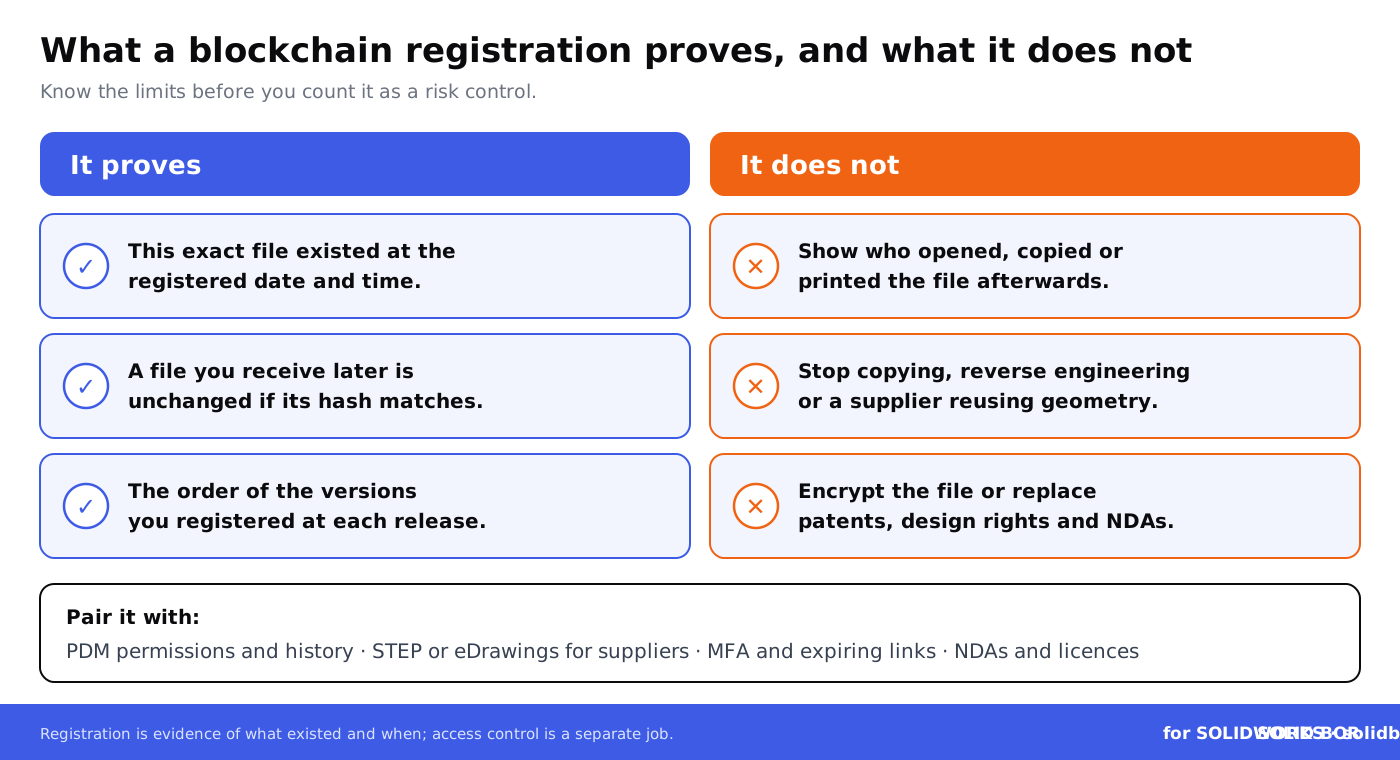
- Tamper-evident timestamps: Each registered version gets a timestamp on the blockchain; any later edit produces a different hash, so unauthorized changes are detectable.
- Activity logs: SOLIDWORKS PDM history shows who checked out, modified and released each file; the blockchain record itself does not track access.
- Cryptographic verification: Unique fingerprints (hashes) let you check that a file matches the registered version; they do not stop duplication or reverse engineering.
- Ownership audit trails: Dated, tamper-evident records that support authorship claims; courts weigh them as evidence in IP disputes.
These metrics give manufacturing companies and SMEs visibility into their CAD data lifecycle, reducing uncertainties around file-sharing and IP infringement. For more on how IP theft hits manufacturing firms and where blockchain records help, check out this resource.
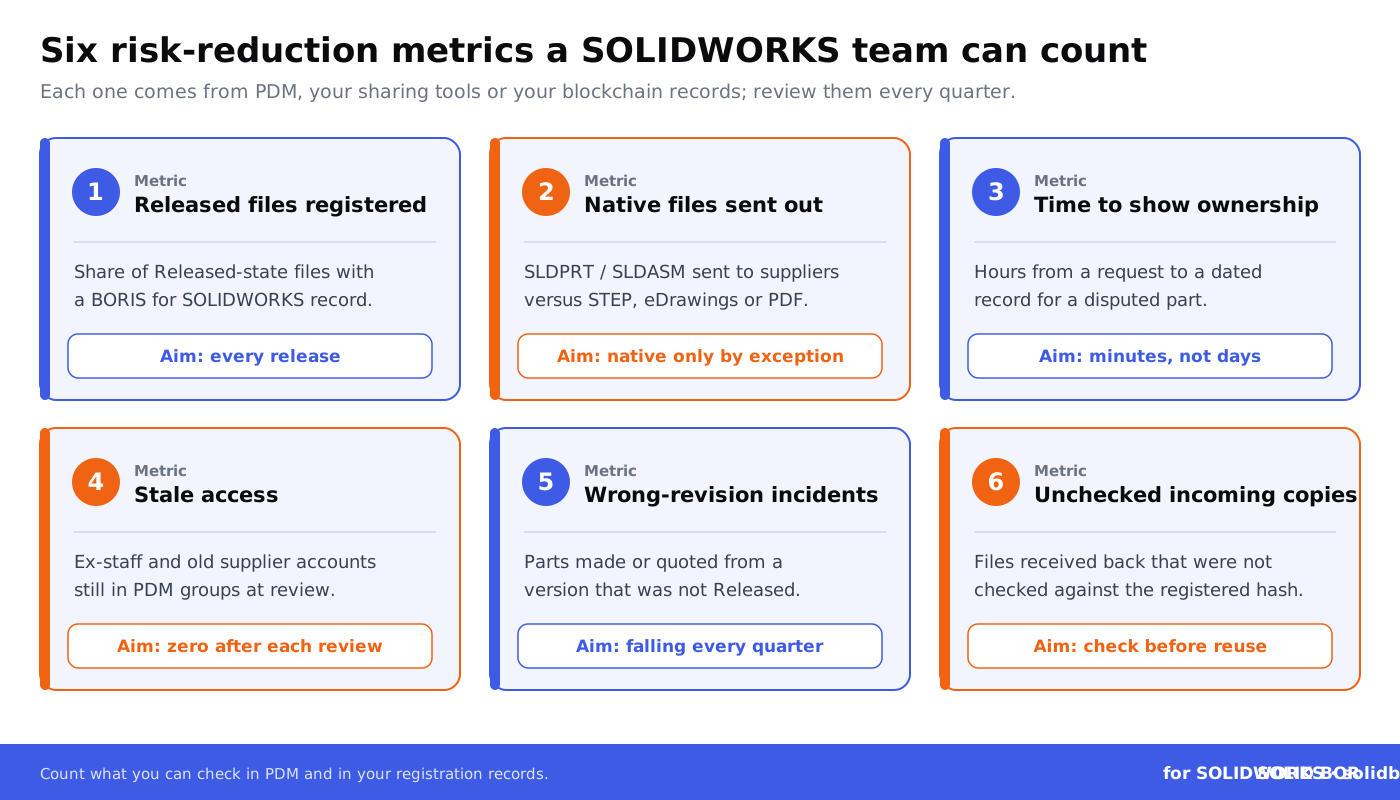
The table below compares how each metric looks with and without registered, dated records in your SOLIDWORKS workflow.
Common Mistakes in CAD Data Sharing and How to Avoid Them
The CAD industry often neglects proactive measures for IP protection, exposing companies to legal and financial risks. Here are the most common mistakes engineers should avoid:
- Overlooked file encryption: Not encrypting CAD files before sharing creates vulnerabilities.
- Undefined ownership rights: Sharing files under open agreements can lead to IP misuse.
- Failure to integrate security tools: Manually tracking file activities increases the risk of errors.
- Ignoring audit trails: Lack of systematic record-keeping weakens your legal standing in disputes.
Avoid these pitfalls by integrating blockchain-based tools that securely register your CAD files directly within SolidWorks, and by sharing STEP or eDrawings files instead of native models. For guidance on protecting CAD files in remote teams, explore the strategies outlined here.
How SMEs Benefit From Blockchain CAD Protection
For SMEs operating with limited resources, blockchain offers affordable yet powerful IP protection. Violetta Bonenkamp highlights these crucial benefits:
- SMEs gain access to verifiable ownership proofs, which strengthens their position in disputes with larger competitors.
- The technology integrates with existing CAD workflows without requiring major operational changes.
- Only a file hash is registered, so no personal data goes on-chain; GDPR still applies to personal data held elsewhere in your workflow (see GDPR compliance and blockchain).
“Blockchain sets a digital standard for CAD file ownership in Europe, protecting SMEs from IP theft that previously went unchecked.”
Violetta Bonenkamp, CEO, CADChain
Step-by-Step: Implementing Blockchain Protection in SolidWorks
Follow these actionable steps to implement blockchain CAD protection fully:
- Install BORIS for SOLIDWORKS, the SOLIDWORKS add-in from CADChain; our guide to blockchain for CAD IP protection explains how it works.
- Register your released CAD files on the blockchain using a digital fingerprint of the file and its metadata.
- Set up PDM permissions and history for activity monitoring, and use hash checks to confirm that a file you receive matches the registered version.
- Where licensing terms apply, record them with smart contracts that can automate payments; enforcement still runs through the licence and the courts.
- Train your design team on blockchain protocols to ensure smooth adoption.
Is your startup using blockchain CAD protection?
Boost security and avoid IP disputes by integrating blockchain into your design workflows.
👉 Learn how to implement
What’s Next: Exploring Blockchain CAD Case Studies
The effectiveness of blockchain CAD protection is easiest to see through examples. Dive deeper into case scenarios from SME, startup and supplier work, highlighting lessons learned and what changed in each workflow.
For an automotive angle, read about automotive industry CAD protection requirements: how suppliers share CAD files with OEMs while keeping trust, compliance and proof of ownership.
Turn your releases into dated proof of ownership
BORIS for SOLIDWORKS registers a hash and timestamp of each released CAD file from inside SOLIDWORKS, so you can count your registered releases and show which version you created and when.
👉 Explore BORIS for SOLIDWORKS
People Also Ask:
What are the risk assessment considerations for blockchain technology?
Assessing blockchain technology involves reviewing cybersecurity risks such as user confidentiality, security of private keys protecting digital assets, and endpoint vulnerabilities. Furthermore, a comprehensive evaluation should address the system's architecture to identify potential points of exploitation or failure.
What strategies can mitigate the major risks in blockchain, like 51% attacks or phishing?
Strategies include using well-tested cryptography, such as Elliptic Curve Digital Signature Algorithm (ECDSA) signatures, and keeping private keys in hardware wallets or hardware security modules. Maintaining updated, audited smart contract code and monitoring for phishing attempts related to smart contracts are critical steps in reducing these risks; on smaller networks, waiting for more block confirmations also lowers the impact of a 51% attack.
What are the primary security risks associated with blockchain?
Security risks in blockchain include the potential for 51% attacks, vulnerabilities in smart contracts, and poor key management. Additionally, risks arise from improper use of private keys, insecure bridges between blockchain networks, and limited protection against phishing campaigns.
How does blockchain reduce operational risks?
Blockchain reduces operational risks by creating transparent, tamper-evident records, which enhance trust and accountability. It reduces discrepancies in shared business processes and limits losses caused by data manipulation or record-keeping errors.
How is CAD file security improved with blockchain technology?
Blockchain improves CAD file security by recording file ownership and creating tamper-evident, dated records of each registered version. These records help prove authorship and spot altered copies; preventing unauthorized access still depends on PDM permissions, encryption and sharing neutral formats such as STEP.
What role do metrics play in evaluating blockchain's impact on risk reduction?
Metrics such as error reduction rates, time saved in operational processes, and incident response times help measure blockchain's effectiveness in mitigating risks. Data transparency and the reduction in disputes are pivotal indicators of its success.
What tools can evaluate blockchain-related risks in CAD applications?
Risk assessment tools like smart contract auditing platforms and CAD data tracking systems are essential. Tools that analyze cryptographic protocols and monitor network activities also provide detailed insights into the overall security and integrity of blockchain environments.
How does blockchain improve collaboration in CAD environments?
Blockchain supports collaboration in CAD environments with shared, tamper-evident records of model revisions that every stakeholder can check, while access controls stay in PDM. Such records improve trust among stakeholders while reducing the possibility of conflicts or data disputes.
What is the impact of blockchain on intellectual property rights in design projects?
Blockchain supports intellectual property management by storing dated proof of ownership. It does not prevent duplication of designs, but its traceability helps identify and prove infringements, protecting creators' rights during collaboration.
Can blockchain be seamlessly integrated into legacy CAD systems?
Yes, blockchain can integrate with legacy CAD systems through APIs and middleware solutions. These integration methods ensure compatibility while enabling decentralized features without substantial modifications to existing infrastructure.
FAQ on Risk Reduction Metrics from Blockchain CAD Protection
How does blockchain protect CAD files against tampering?
Blockchain records tamper-evident timestamps and cryptographic fingerprints (hashes) for CAD files: any modified file produces a different hash, so changes are detectable when you check it. Because the record sits on a decentralized ledger, it does not depend on one central server that could be altered. Learn more in our guide on understanding CAD file vulnerabilities.
Can blockchain replace encryption for CAD file security?
Blockchain complements, but does not replace, encryption. Encryption protects file contents, while blockchain records prove ownership and dates, and PDM tracks activity. Together, they create robust IP security, critical when files are shared across global ecosystems.
What are the key benefits of smart contracts in file sharing?
Smart contracts can record licence terms and automate royalty payments in file sharing, reducing manual errors; permission control stays in PDM and your sharing tools. Explore top strategies for implementing blockchain in CAD.
How does blockchain support SMEs in protecting their IP?
Blockchain gives SMEs a cost-effective way to create verifiable ownership proof without putting personal data on-chain. This strengthens their position against IP theft by larger competitors and fits limited SME budgets.
What industries benefit most from blockchain in CAD workflows?
Manufacturing, automotive, and 3D design industries gain the most from blockchain, given their IP-sensitive files and collaboration intensity. Blockchain minimizes disputes by ensuring visibility and traceability across the design lifecycle.
What are common CAD data sharing mistakes blockchain solves?
Undefined ownership rights and a lack of audit trails are addressed with blockchain’s dated, tamper-evident records; overlooked encryption still needs encryption and PDM permissions alongside them.
How does blockchain improve compliance with IP laws?
Blockchain creates tamper-evident audit trails and timestamped ownership proofs that courts can weigh as evidence in IP disputes. They support, but do not replace, patents, registered designs and copyright under international intellectual property laws.
Are blockchain plugins for SolidWorks easy to adopt?
Add-ins like BORIS for SOLIDWORKS work directly inside SolidWorks, requiring minimal training for design teams. Registering a released file takes a few steps, so adoption fits into the normal release routine.
What role does user training play in blockchain adoption?
Training helps teams understand blockchain protocols, boosting adoption efficiency. Educating users on hash checks and PDM activity history strengthens file sharing security and compliance.
Can blockchain help prove prior ownership during disputes?
Yes, blockchain’s cryptographic hashes and timestamps provide dated evidence of when designs existed, helping to settle ownership disputes faster. This is critical in competitive industries.
What’s next for blockchain CAD technology in IP protection?
The future includes enhanced AI-driven monitoring, deeper smart contract automation, and broader adoption in SMEs. Read more in CADChain’s CAD security resources.