
On 28 October 2026, the WIPO working group that shapes the Hague System for international design registrations agreed to start technical consultations on the possible use of 3D and video files to show designs. Today, an international design application can only show a product in 2D images. In the EU, applicants have been able to file a single OBJ or STL file or an MP4 video since 1 July 2026.
For SOLIDWORKS teams, this is about the step after the model is finished. When you protect the look of a product with a registered design, the pictures you file decide what is protected. For decades those pictures were drawings, then photos and renders. The same 3D geometry you build in SOLIDWORKS is slowly becoming something you can file directly.
Nothing changes overnight. The Hague working group made no decision to accept 3D files, and the EU option comes with strict limits. But the direction is clear, and the choices you make about renders, exports and records now will matter when the rules catch up.
TL;DR: 3D design filings are coming, slowly, so prepare your files and your proof now
At its 15th session in Geneva (26 to 28 October 2026), the WIPO Working Group on the Legal Development of the Hague System agreed that its Technical Forum should expand its talks to the technical details of 3D and video files. It also asked for a proposal to let applicants file different designs for different countries in one international application, and it will keep discussing the removal of the rule that all designs in one application must belong to the same product class. The EU Intellectual Property Office already accepts one OBJ or STL file, or one MP4 video, per design. For SOLIDWORKS teams, the practical steps are the same either way: decide which designs are worth registering, prepare clean views and exports, check what each country accepts and keep dated proof of when each design existed.
What did the WIPO working group decide on 28 October 2026?
The Hague System lets a company file one international application with the World Intellectual Property Organization (WIPO) and seek design protection in many countries and regions at once, including the EU, the US, Japan, China and the UK. The rules are set by its member states, and a working group meets roughly once a year to prepare changes. Its 15th session took place in Geneva and online from 26 to 28 October 2026, and the outcomes are recorded in the Summary by the Chair on WIPO's meeting page.
The main points for design owners:
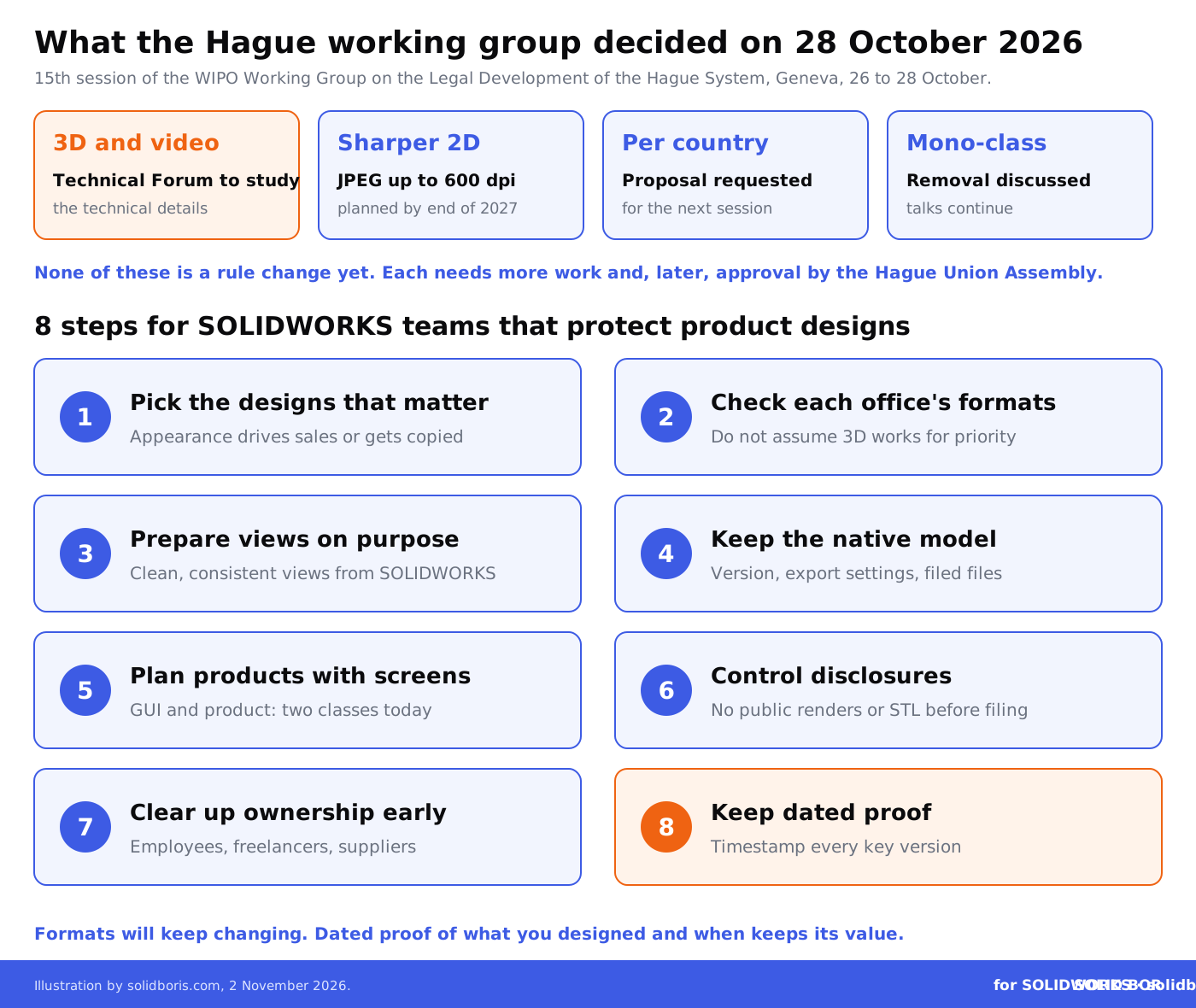
- 3D and video files: talks expand. The working group took note of a report on better 2D images and agreed that the Technical Forum should expand its consultations to include the technical details of the possible introduction of 3D and video files. This is a start of technical work, not a decision to accept them.
- Sharper 2D images first. WIPO plans to raise the maximum resolution of JPEG images from today's 300 dpi to 600 dpi (up to 3,780 x 3,780 pixels and 8 MB), and PNG is still under discussion. It intends to deliver this by the end of 2027. SVG was put off because of security and legal certainty concerns.
- Different designs for different countries. The group asked WIPO's International Bureau to prepare, for the next session, an analysis and a proposal to amend the rules so that applicants could file designs per designated country in one application.
- One class per application, for now. The proposal to drop the mono-class rule, which requires all designs in one international application to be in the same Locarno class, was discussed again, and talks will continue at the next session.
The EU and its member states backed both the wider 3D and video talks and the removal of the mono-class rule, according to their statements published by the Council of the EU. They pointed to a common standard for design representation that the EU's network of IP offices adopted in May 2026.
Why can an international design application only show 2D images today?
Because every designated office has to receive, examine and publish the same pictures. WIPO sends the images to national offices in a standard data format, and many offices can only handle JPEG files at today's resolution. A 2025 WIPO survey of 48 offices found that relatively few accept 3D or video files, or are ready to. A mesh can be viewed from any angle and zoom, which is why offices want to agree on the technical details first.
The 2D report, dated 13 October 2026, shows how careful the offices are. Some asked WIPO to keep converting new formats to standard JPEG so their systems keep working. SVG drew two objections: it is an XML format that can carry scripts and external references, and it has no fixed rendering state, so a vector drawing may look different in different software. For a legal document that defines what is protected, that matters.
Can you already register a design with a 3D file in the EU?
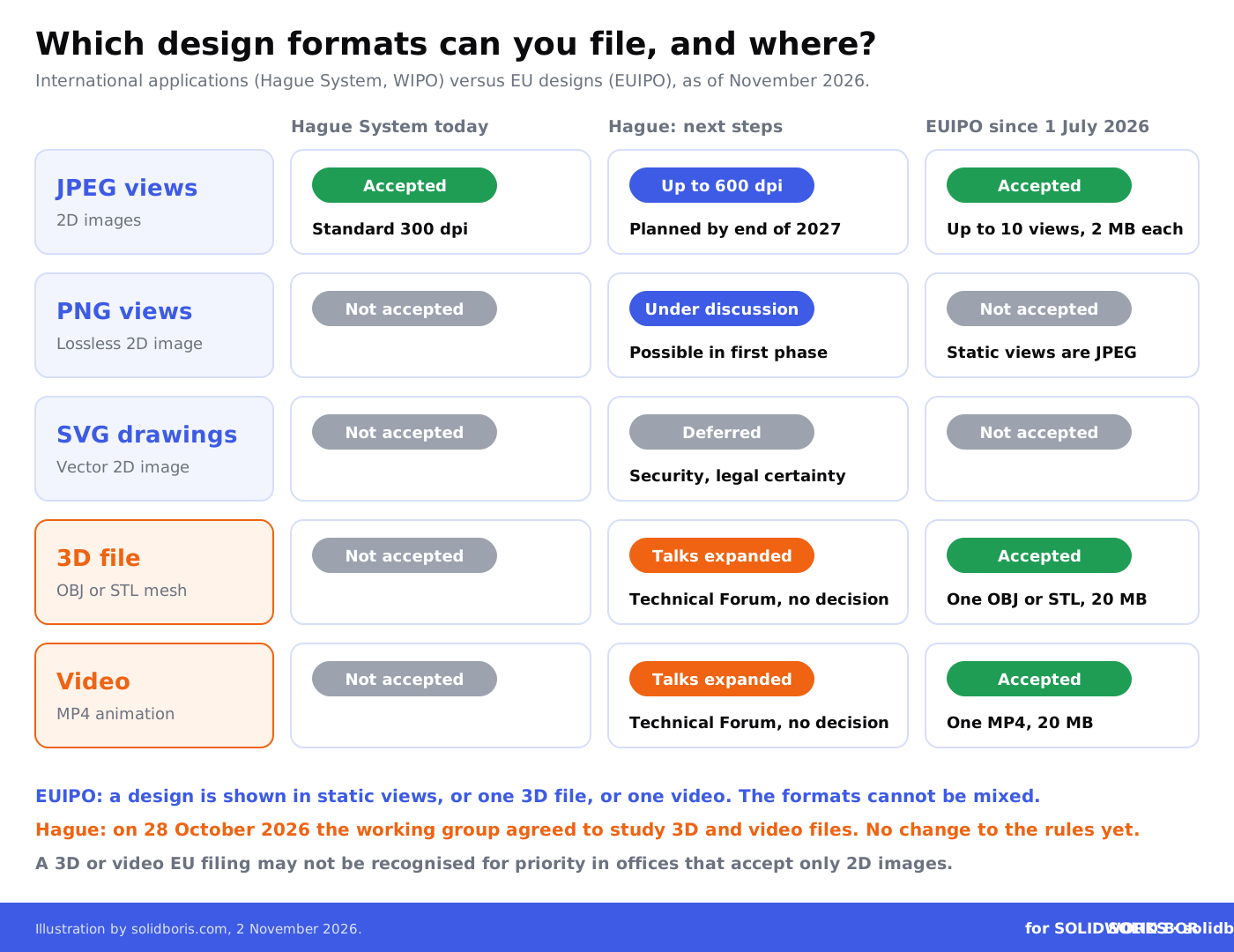
Yes. Since 1 July 2026, the second phase of the EU design reform has let applicants at the EU Intellectual Property Office (EUIPO) show a design in one of three ways:
- Static views. Up to 10 JPEG views per design, each at least 800 x 800 pixels and up to 2 MB.
- A 3D file. One OBJ or STL file per design, up to 20 MB.
- A video. One MP4 file per design, up to 20 MB, meant for designs where the animation itself is part of what you want protected.
You cannot mix them: a design is shown either in static views, or in a 3D file, or in a video. WIPO's own working document notes this rule, set out in an EUIPO decision of 8 June 2026. The law firm Withers & Rogers also warns that a 3D or video filing in the EU may not be recognised when you claim priority in countries outside the EU that only accept 2D images.
For SOLIDWORKS users, an STL export of a part is easy to produce. That does not make it the right choice for every design. A mesh shows shape, but not the line weights, shading and selected views that a design attorney uses to show what matters and what does not. Our guide to neutral CAD formats and their risks explains what each export carries, and our look at AI that rebuilds STL files as editable CAD shows why a mesh is no longer a dead end once it leaves your hands. A filed design is public once it is published, so treat the 3D file you file like any other STL you share.
Keep dated proof of every SOLIDWORKS design, registered or not.
BORIS for SOLIDWORKS registers your CAD files with a blockchain timestamp and a certificate of ownership from inside SOLIDWORKS, so you can show what you designed and when, long before any design application is filed.
👉 Get BORIS for SOLIDWORKS
Why does this matter for SOLIDWORKS teams?
Because many SOLIDWORKS users design products whose look is part of their value: consumer products, housings, furniture, tools, medical device casings, machine guards and spare parts. A registered design protects that appearance, and in many countries it is faster and cheaper to get than a patent. Our guide to industrial design protection for CAD covers the basics, and our comparison of copyright, patents and trademarks for 3D models shows where each right fits.
Three changes discussed in Geneva would affect how SOLIDWORKS teams file abroad:
- Filing straight from 3D. If the Hague System one day accepts 3D files, the geometry you already have could become the core of an international filing, instead of a set of drawings prepared from it. Until then, an EU filing made with an STL file and an international filing made with 2D views will show the same design in different ways, which you need to plan for.
- Products with screens. A machine with a touch panel combines a physical product and a graphical user interface, which usually sit in different Locarno classes. Today they need separate international applications. Dropping the mono-class rule would let you file them together.
- Fewer refusals. Twelve Hague members, including the US and China, keep their own rules on which designs may share one application. Filing designs per country would let you send only suitable designs to each office, instead of dealing with refusals afterwards.
Cost matters too. Under WIPO's fee schedule in force since 1 July 2026, the basic fee is 397 Swiss francs for the first design and 50 Swiss francs for each extra design in the same application, before the fees of each designated country. Two designs in different classes filed separately pay 794 Swiss francs in basic fees, against 447 if they could be filed together.
What does not change for SOLIDWORKS designers?
A better file format does not change the core rules of design law. A design still has to be new and have individual character when you file, and features that are dictated only by function are excluded in the EU. Grace periods for your own earlier disclosure differ by country, so a product shown at a trade fair or on your website can start a clock you did not notice.
Ownership questions do not go away either. Who designed the product, who employed them and whether a freelancer or supplier contributed are questions a filing assumes you have already answered. Our articles on proving authorship of CAD designs and on international treaties that affect CAD IP explain why records still decide disputes, whatever format the registration uses.
Registered designs also sit next to other rights. A recent Canadian case on copied engineering drawings and a SolidWorks 3D model showed how narrow copyright can be for functional parts, and France's draft decree on 3D-printed spare parts shows how often part files may have to leave the company.
What should SOLIDWORKS teams do now?
- Pick the designs that matter. List the products whose appearance drives sales or is copied often, and decide with your IP adviser which ones are worth registering, and where.
- Check each office's format rules. Before you file, confirm which formats each target office accepts. Do not assume an EU 3D filing will work as a priority basis elsewhere.
- Prepare views on purpose. Create clean, consistent views from SOLIDWORKS that show what you want protected, and agree with your attorney how to mark features you do not want to claim.
- Keep the native model with the filing. Store the exact SOLIDWORKS version, the export settings and the files used for each application, so you can show later how the filed images were made.
- Plan products with screens. If your product has a user interface, file the interface and the physical product with the current mono-class rule in mind, and watch for the change.
- Control disclosures before filing. Keep renders, STL files and photos of new designs out of public view until you have filed, or until you know which grace periods apply.
- Clear up ownership early. Make sure employment, freelance and supplier contracts assign design rights to your company before a filing names you as the owner.
- Keep dated proof of every version. Timestamp the native files of key designs as they develop, so you can prove what existed and when, for registered and unregistered designs alike.
What about designs you never register?
Most SOLIDWORKS designs are never registered, and that is normal. In the EU, an unregistered design is protected for three years from its first disclosure in the EU, but only against copying, and you have to prove what your design looked like and when it was disclosed. That proof usually comes from your own files: dated models, drawings, renders and emails.
This is where the file format debate meets everyday practice. Whether an office accepts JPEG, STL or MP4, the strongest evidence of your design history is still the native SOLIDWORKS data with a reliable date attached. Our guide to blockchain timestamping and first-in-time proof explains how that works.
How does this fit the bigger picture for CAD users?
Across our network, a common thread this week is control over files once they leave your hands, and proof of what you hold.
- Drawings on leak sites. CADChain looks at ransomware gangs claiming drawings and design data from Korean manufacturers, and what that means for trade secret protection after a leak.
- Tools with too much access. BORIS Inventor explains a trojanized Claude Code extension on Cursor's marketplace, and why automation workstations that hold design data need tighter controls.
- Saying no to AI training. Blended BORIS covers a proposed shared AI training opt-out in robots.txt, and what it means for artists who publish 3D work online.
Conclusion
The Geneva meeting did not make 3D design filings international. It started the technical work that could lead there, put sharper 2D images on a path to the end of 2027 and kept two useful changes, multi-class and per-country filing, on the table. In the EU, OBJ, STL and MP4 filings are already possible, with limits.
For SOLIDWORKS teams, the message is practical. Decide which designs deserve registration, prepare your files with the target offices in mind, settle ownership before you file and keep dated proof of every version. Formats will keep changing. A clear record of what you designed and when will not lose its value.
Make your SOLIDWORKS designs provably yours.
BORIS for SOLIDWORKS adds blockchain timestamps and certificates of ownership to your CAD files from inside SOLIDWORKS, so you have independent proof of your designs whether you register them, publish them or keep them in-house.
👉 Get BORIS for SOLIDWORKS
FAQ: 3D files, design registration and SOLIDWORKS
Can I file a SOLIDWORKS model directly to register a design?
Not as a native SLDPRT file. In the EU, since 1 July 2026, you can file one OBJ or STL file per design instead of 2D views. International applications under the Hague System still accept only 2D images.
Did WIPO decide to accept 3D files in international design applications?
No. On 28 October 2026 the working group agreed that its Technical Forum should expand its consultations to the technical details of 3D and video files. Any change to the rules would come later.
Can I combine a 3D file with 2D views in an EU design application?
No. Each design is shown either in static views, in one 3D file or in one video. The formats cannot be mixed.
What is the mono-class requirement?
It is the Hague System rule that all designs in one international application must belong to the same class of the Locarno classification. WIPO members are discussing its removal, which would help products that combine physical parts and screen interfaces.
Will an EU 3D design filing work as a priority basis in other countries?
Not always. Offices that accept only 2D images may not recognise a 3D or video filing as showing the same design, so plan your first filing with your target countries in mind.
How does BORIS for SOLIDWORKS help with design protection?
It does not register designs. It gives your SOLIDWORKS files blockchain-timestamped certificates of ownership, so you can prove what you designed and when, which helps with unregistered designs, ownership disputes and the history behind a filing.