
On 29 October 2026, engineering.com published a close look at CADFit, an open-source research tool from MIT that turns a mesh, such as an STL file, back into an editable CAD model built from sketches, extrusions, revolves, fillets and chamfers. It joins commercial tools like Backflip AI and Autodesk Fusion's AutoTimeline in a fast-growing group of AI mesh-to-CAD tools.
For years, many SOLIDWORKS teams have treated an STL file as the safe thing to send. A 3D printing service, a prototype shop, a customer who only wants to see the shape or a marketplace listing gets a mesh, while the native SLDPRT, the feature tree and the design intent stay at home. Turning a mesh back into a usable parametric model took a skilled engineer hours or days, so the mesh felt like a dead end.
That assumption is getting weaker. Nothing here involves SOLIDWORKS software, and CADFit cannot rebuild every shape. But it is a good moment to check what you share as meshes, drawings and photos, what AI can rebuild from them and what still protects your designs.
TL;DR: an STL is no longer a dead end, so share it on purpose
CADFit, led by MIT PhD student Ghadi Nehme, rebuilds meshes as editable CAD programs from sketches, extrusions, revolves, fillets, chamfers, unions and cuts. It is free for non-commercial use, and Nehme and Siemens have filed for a patent on the method. Backflip AI already sells scan, drawing and photo to CAD tools, Autodesk Fusion has AutoTimeline in Tech Preview, and SOLIDWORKS has shown mesh-to-parametric AI as a project in development. Reverse engineering a product someone lawfully holds is generally allowed in the EU and the US, so the protection has to come from what you share, the contract around it and your own dated proof of what you designed and when.
What is CADFit, and what was announced?
CADFit is a research project led by Ghadi Nehme, a PhD student at MIT, with co-authors Eamon Whalen of Siemens Digital Industries Software and Faez Ahmed of MIT. The paper, titled "CADFit: Precise Mesh-to-CAD Program Generation with Hybrid Optimization", was first posted on arXiv on 2 May 2026 and is listed for ICML 2026. On 29 October, engineering.com senior editor Michael Alba described the project in detail after a call with Nehme, in his Engineering Paper column on mesh-to-CAD.
The key facts from that report and the project page:
- Open source, with limits. The code is public and free for non-commercial use. The project page names the licence as Creative Commons Attribution-NonCommercial 4.0 and points companies to the author for commercial licensing.
- Patent filed. According to engineering.com, the initial research was funded by Altair, now part of Siemens, and Nehme and Siemens have filed for a patent on the CADFit method. The project page mentions a provisional patent application.
- Output in code. CADFit takes watertight meshes, including STL exports, and describes its models in CadQuery, an open-source Python library for CAD. There are no plug-ins for common CAD software yet, and Nehme is working on one for Siemens NX.
How does CADFit turn a mesh into a CAD model?
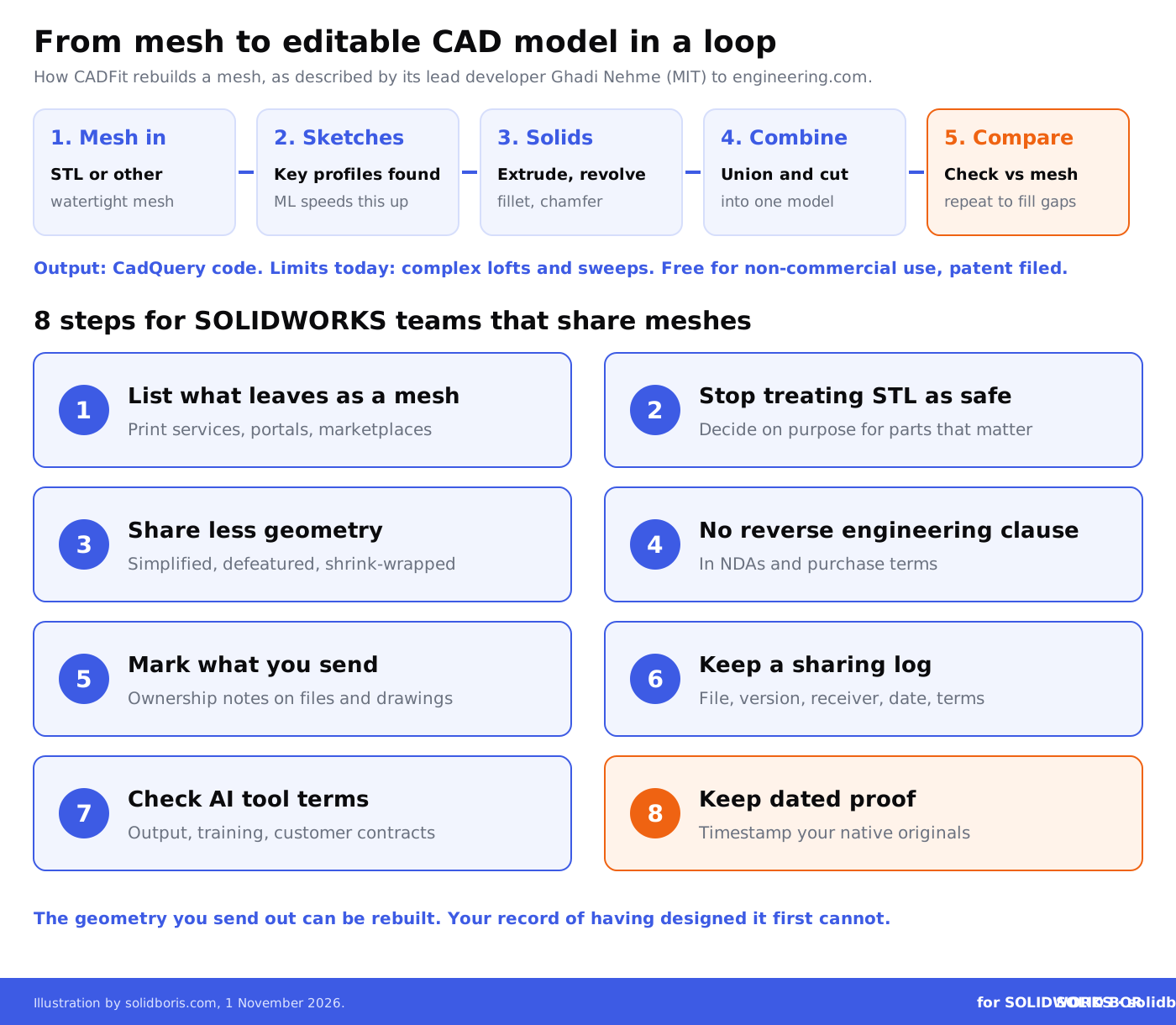
As Nehme explained it to engineering.com, CADFit works in a loop, much like a patient engineer:
- Find the sketches. It starts with the mesh and extracts key sketches, similar to how an engineer would. A small machine learning model helps pick the meaningful ones, which Nehme says makes the process about three times faster, though it is not required.
- Build solids. It turns those sketches into solids with extrusions and revolves.
- Combine them. It joins and subtracts the solids with unions and cuts, and adds fillets and chamfers.
- Compare and repeat. It checks the result against the original mesh, measures the overlap and adds or corrects operations to fill the gaps.
The paper reports better accuracy than earlier mesh-to-CAD methods on research datasets and far fewer invalid models. It also shows a pipeline that starts from images, via an image-to-3D model. The code is on the CADFit project page on GitHub.
There are clear limits. Nehme told engineering.com: "But if a shape is very complex, like loft-based or also sweep-based shapes… the math will struggle." Research datasets are also not a real cast housing with drafts and ribs, so do not assume perfect results on every industrial part.
Is CADFit the only tool that rebuilds CAD from meshes?
No. It is one of several, and some are already commercial products:
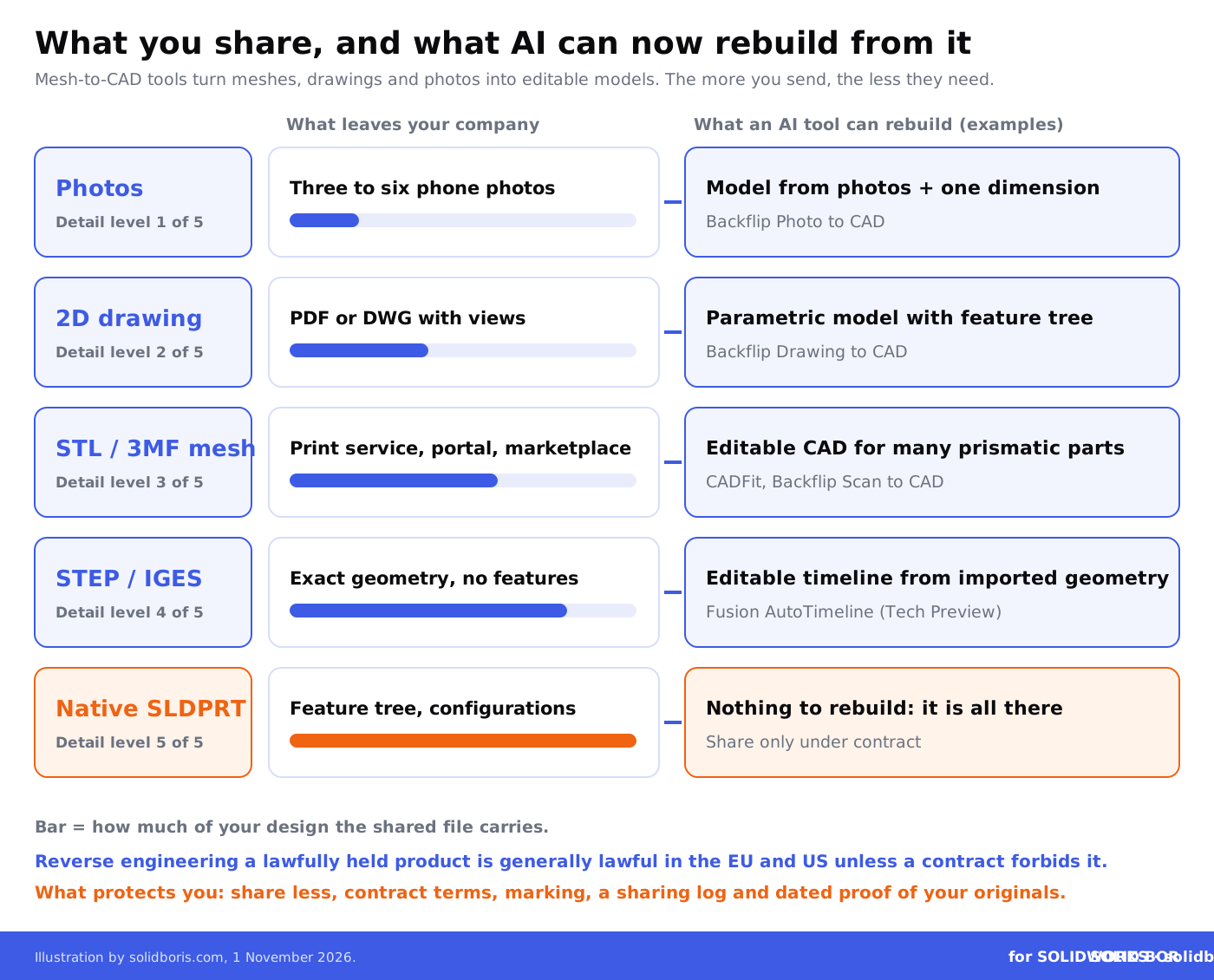
- Backflip AI. Founded by Greg Mark, who also founded Markforged, Backflip launched an AI copilot on 4 August 2026 that turns scans, STL files and other meshes into editable parametric CAD, in a Fusion add-in and a web app. On 17 September it added Drawing to CAD, which builds a model with a feature tree from 2D drawings, and Photo to CAD, which uses three to six phone photos plus one known dimension. The web app exports STEP, and more CAD integrations are in development.
- Autodesk Fusion AutoTimeline. In its October 2026 update, Autodesk added AI-assisted feature reconstruction that rebuilds imported geometry into an editable Fusion timeline, as a Tech Preview for Design Extension users. Our sister site covered it in its look at the Fusion October 2026 update.
- SOLIDWORKS. SOLIDWORKS has long had the ScanTo3D add-in, which builds surfaces and solids from mesh and scan data, but not a feature tree. Dassault Systèmes has shown AI that turns a mesh or scan into an editable parametric model as a project in development, with no release date announced. Our overview of what is new in SOLIDWORKS 2027 for your design data covers the AI features that have shipped.
AI is learning to work with CAD the way engineers do, as an AI agent passing the CSWP exam showed. Rebuilding parts is one of the first jobs where that skill changes who can copy what.
Why does this matter for SOLIDWORKS teams that share STL files?
Because the mesh is often the file that leaves with the least control: an STL sent to a print service, a mesh uploaded to a quoting portal, a model on a marketplace, and the 3D print files that France's draft decree on 3D-printed spare parts would require some manufacturers to hand to repairers.
Turning such a mesh into a model you could change and send to a machine shop used to be a real barrier. Mesh-to-CAD AI lowers it, especially for prismatic and turned parts: the brackets, plates, shafts and fixtures many SOLIDWORKS users design every day.
This adds to the risks we described in our guide to neutral CAD format risks. STEP and IGES already hand over exact geometry. Now even a mesh or a dimensioned drawing can become an editable model at low cost.
Make your SOLIDWORKS designs provably yours before you share them.
BORIS for SOLIDWORKS registers your CAD files with a blockchain timestamp and a certificate of ownership from inside SOLIDWORKS, so you keep dated proof of your original design, whatever someone rebuilds from a mesh later.
👉 Get BORIS for SOLIDWORKS
Is it legal to rebuild a part from someone else's STL file?
Often, yes, and that is the uncomfortable part. Trade secret law in both the EU and the US treats reverse engineering as a lawful way to learn how a product is made:
- EU. Under Article 3 of the Trade Secrets Directive (EU) 2016/943, observing, studying, taking apart or testing a product that was made public or that someone lawfully holds is a lawful way to acquire a trade secret, as long as that person has no legally valid duty to limit it.
- US. The Defend Trade Secrets Act says that improper means do not include reverse engineering or independent derivation.
So once a mesh or a part is lawfully in someone else's hands without a contract that limits its use, trade secret law may not stop them from studying it. A contract can change that: an NDA or supply agreement that forbids reverse engineering and limits use to one project is the kind of legally valid duty the EU rule refers to. Our article on the limits of NDAs for CAD files explains why that clause still needs proof behind it, and our guide to protecting CAD files as trade secrets covers the reasonable measures courts look for.
Copyright and design rights are a separate question, and they are narrower for functional parts than many engineers think. In a recent Canadian ruling on CAD drawings, the court found copyright in the drawings but held that a useful-article exception covered the competitor's valves and its 3D CAD files. Registered designs and patents protect what they cover, whoever rebuilds the part. Our comparison of copyright, patents and trademarks for 3D models shows which right fits which kind of design.
What should SOLIDWORKS teams do now?
- List what leaves as a mesh. Check which STL, 3MF and OBJ files go to print services, quoting portals, marketplaces, customers and repairers, and who decides that.
- Stop treating STL as safe by default. For parts that matter, decide on purpose whether a mesh needs to leave at all, and at what level of detail.
- Share less geometry. Send only the bodies, faces or envelope the job needs. Simplified or defeatured exports and shrink-wrapped assemblies hold back internal features, and our article on neutral format risks lists what else to strip.
- Put reverse engineering in the contract. Use NDAs and purchase terms that limit use to the project and forbid rebuilding, scanning or using AI to recreate the part.
- Mark what you send. Add ownership and confidentiality notes to drawings, file names and packages. Our guide to digital watermarking for CAD designs explains the options.
- Keep a sharing log. Record which file, in which version, went to whom, on which date, under which terms.
- Check the terms of AI tools you use. Before you upload a customer's mesh or drawing to a reconstruction service, read who owns the output, whether data is used for training and whether your contract with the customer allows it.
- Keep dated proof of your originals. Timestamp the native SOLIDWORKS files of key parts before they go out, so you can show what you designed and when if a rebuilt copy appears.
What if your own team wants to use mesh-to-CAD AI?
There are good reasons to, such as digitising legacy drawings or scanned parts. Backflip founder Greg Mark says many factories have 3D CAD for less than 1% of their equipment, and puts the goal simply: "Our mission is to digitize the world." A few questions are worth asking first:
- Whose part is it? Rebuilding your own legacy parts is one thing. Rebuilding a customer's or supplier's part may break a contract, even where trade secret law would allow it.
- What does the licence allow? CADFit is free for non-commercial use only, and its method is under a patent application. Commercial use needs a licence.
- Where does the data go? Backflip says it never uses enterprise data to train its models and that its SOC 2 Type II audit is still in progress. Check the terms of any tool, and our article on generative AI and CAD ownership covers who owns AI-assisted output.
How does this fit the bigger picture for CAD users?
Across our network this week, a common thread is that what looks public or harmless can still carry value, and that records decide who can prove it.
- Public patents, secret reports. CADChain covers the jailing of Samsung's former IP chief on appeal, where the court treated an internal patent analysis as a trade secret even though the patents themselves were public.
- Records an attacker can switch off. BORIS Inventor looks at a VMware ESX zero-day that let operations go unrecorded, and what that means for Vault, licence and file servers running on ESX.
- Real photos over renders. Blended BORIS explains Etsy's new AI policy, which asks most sellers for at least one unedited photo of the actual item.
Conclusion
CADFit is a research tool with clear limits, and none of the mesh-to-CAD tools works perfectly on every part. But together with Backflip, Fusion AutoTimeline and the AI that Dassault Systèmes has in development, it shows where things are going: an STL, a drawing or a few photos are becoming a starting point for an editable model, not a dead end.
For SOLIDWORKS teams, that means sharing meshes on purpose, writing reverse engineering into contracts, keeping a log of what went where and keeping dated proof of the original designs. The geometry you send out can be rebuilt. Your record of having designed it first cannot.
Keep independent proof of your SOLIDWORKS designs.
BORIS for SOLIDWORKS adds blockchain timestamps and certificates of ownership to your CAD files from inside SOLIDWORKS, so you can show what you designed and when, before any mesh, drawing or STEP file leaves your hands.
👉 Get BORIS for SOLIDWORKS
FAQ: AI mesh-to-CAD and SOLIDWORKS files
What is CADFit?
CADFit is an open-source research tool led by MIT PhD student Ghadi Nehme that turns a mesh, such as an STL file, into an editable CAD model described in CadQuery code. It builds the model from sketches, extrusions, revolves, fillets, chamfers, unions and cuts and checks it against the mesh in a loop.
Can CADFit open or create SOLIDWORKS files?
Not directly. It writes CadQuery programs and has its own viewer. There are no plug-ins for common CAD software yet, and the developer is working on one for Siemens NX.
Does SOLIDWORKS have AI mesh-to-CAD?
SOLIDWORKS has the ScanTo3D add-in for building surfaces and solids from mesh and scan data. Dassault Systèmes has shown AI that turns meshes into editable parametric models as a project in development, but no release date has been announced.
Is an STL file still safer to share than a native SOLIDWORKS file?
It still holds back the feature tree and design intent. But AI can now rebuild many simple parts from a mesh, so share STL files on purpose and under clear terms.
Is it legal for someone to rebuild my part from an STL I sent them?
It depends on your contract and your rights. Trade secret law in the EU and the US generally allows reverse engineering of lawfully held products, unless a valid agreement forbids it. Copyright, registered designs and patents may still apply, depending on the part.
Can I use CADFit commercially?
Not under its public licence. The project is licensed for non-commercial use, a patent application covers the method and the project page points companies to the author for commercial licensing.
How does BORIS for SOLIDWORKS help here?
It does not stop anyone from rebuilding a mesh. It gives your original SOLIDWORKS files blockchain-timestamped certificates of ownership, so you can prove what you designed and when if a rebuilt copy of your part appears.