
On 3 November 2026, OpenAI published a research update called "Accelerating engineering for the physical world". It says its own hardware teams now use Codex and ChatGPT to create and revise CAD models, prepare manufacturing drawings, set up simulations and review designs, and that two employees used GPT-6 Astra to design a working test device, from enclosure to circuit board to firmware, in under a week without editing the design themselves.
The same post announces an expanded project with Chip Ganassi Racing that turns 3D scans of existing parts into editable CAD models and 2D manufacturing drawings, a new research collaboration with Mazda's aerodynamics and crash-safety engineers, and an open call for engineers, engineering firms and software vendors to help shape how OpenAI trains its models for mechanical and electrical design.
OpenAI does not name the CAD software it uses, and nothing in the post is about SOLIDWORKS specifically. It still matters to every SOLIDWORKS team, because it describes general-purpose AI agents doing the daily work of a design office: models, drawings, FEA set-up and design reviews. Here is what OpenAI said, what it did not say, and what to do about it.
TL;DR: AI agents are starting to do real CAD work, but they still miss tolerances and assembly details, and they raise new questions about your design data
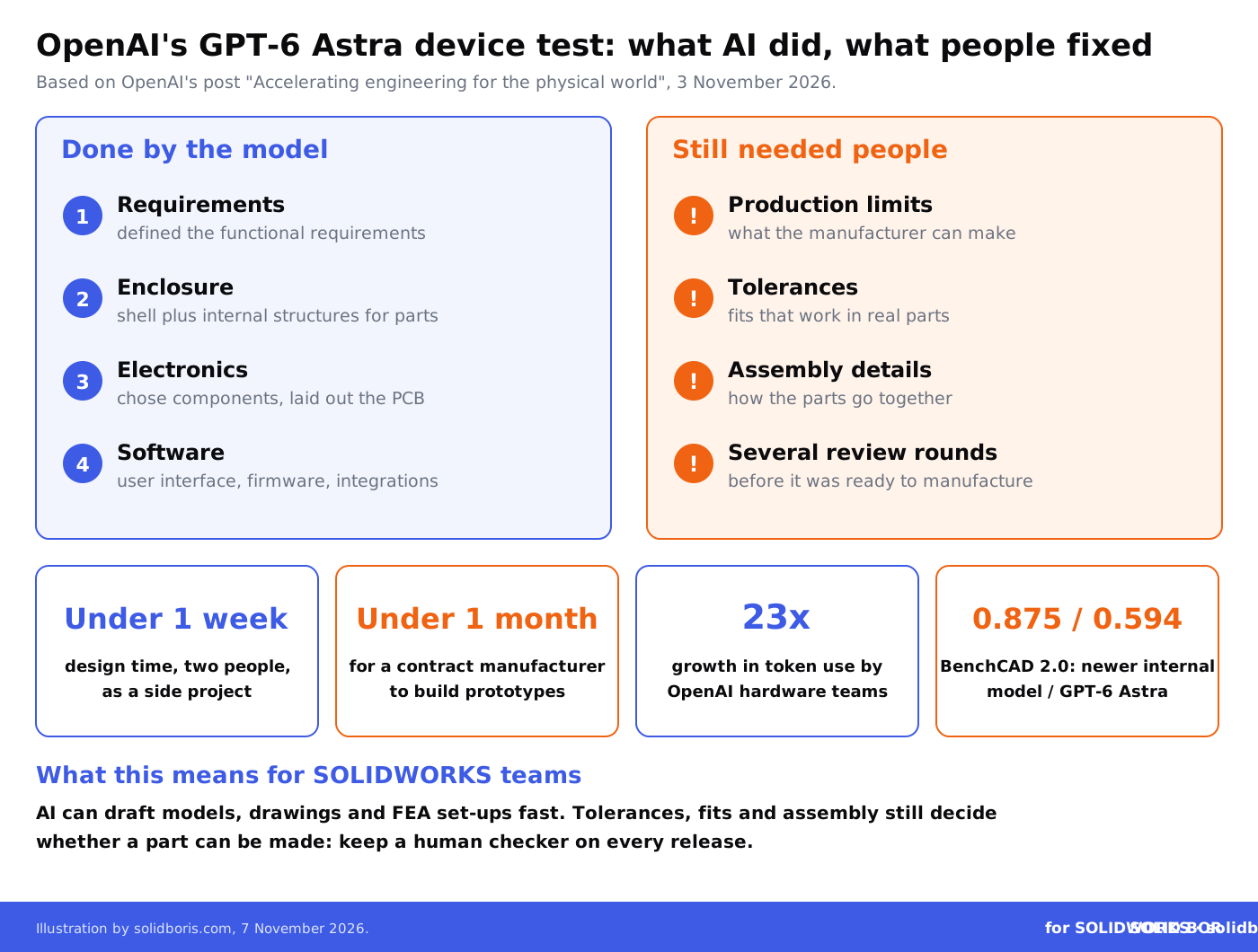
OpenAI says GPT-6 Astra designed a test device without direct human edits in under a week, and a contract manufacturer built prototypes in under a month. It also admits the model did not consistently account for production limits, tolerances or assembly details, so the design still needed several rounds of review. OpenAI's hardware teams have increased their model usage 23-fold since February, and a newer internal model scored 0.875 on the BenchCAD 2.0 test, against 0.594 for GPT-6 Astra. For SOLIDWORKS teams, the lessons are simple: keep a human checker on every AI-made drawing, decide which files may go to outside AI services, treat scan-to-CAD of other people's parts as an IP question, and keep dated proof of your own designs and of who did the work.
What did OpenAI announce on 3 November?
The post, Accelerating engineering for the physical world, is a research update rather than a product launch. It describes how OpenAI models are being taught to help with mechanical design, electrical design and end-to-end system design, from preparing drawings and setting up simulations to coordinating changes between disciplines.
It contains five main pieces of news:
- A device designed by GPT-6 Astra. OpenAI tested whether its model could create a physical device without any direct human edits to the design: requirements, enclosure, internal structures, circuit board and software.
- Codex in OpenAI's own hardware work. Teams use Codex and ChatGPT for CAD models, drawings, simulations and design reviews.
- A benchmark result. A newer internal model scored 0.875 on BenchCAD 2.0, against 0.594 for GPT-6 Astra.
- Two industry projects. An expanded collaboration with Chip Ganassi Racing on scan-to-CAD and drawings, and a new research collaboration with Mazda on aerodynamics and crash safety.
- A call for collaborators. OpenAI invites engineers, engineering firms and software vendors to help shape the training and development of its frontier models around the tools they use.
The post names no product, price, release date or supported CAD systems, and no terms for how collaborators' design data is handled. Treat it as a statement of direction backed by OpenAI's own examples, not an independent evaluation.
What did the GPT-6 Astra device test actually show?
OpenAI asked GPT-6 to define the functional requirements of a small device that people can use to talk to Codex, and then to design it. According to the post, Astra developed the look of the device, designed the enclosure and the internal structures that hold the components, selected the electrical components and laid out the printed circuit board to fit inside the enclosure, and wrote the firmware and software that connect the device to Codex.
Two team members did this as a side project in under a week. A contract manufacturer then built a small batch of prototypes in under a month. That loop covers the mechanical, electrical and software sides of a product at once.
The more useful part for engineers is the admission that follows. Getting the device ready for manufacturing still took several rounds of review and iteration, and OpenAI writes: "Astra did not consistently account for the manufacturer's production limits, tolerances, or details required for assembly." Anyone who has released a SOLIDWORKS drawing to a shop knows that those are exactly the details that decide whether a part can be made, fits and passes inspection.
How are OpenAI's hardware teams using AI in CAD?
Beyond the test device, OpenAI says its hardware and infrastructure teams use Codex and ChatGPT to create and revise CAD models, prepare manufacturing drawings, set up simulations and review designs, across robotics and compute infrastructure. Model usage across those teams, measured in tokens, has grown 23-fold since February.
Grace Lam, a Forward Deployed Engineer at OpenAI, says in the post that Codex has sped up the path from idea to engineered part: "We're iterating faster across CAD, converting 3D designs into production-ready 2D drawings, and setting up simulations and FEA with far less manual work."
Those are the same chores that fill a SOLIDWORKS engineer's week. They are also the tasks where Dassault Systèmes is building its own AI. On its third-quarter call, Dassault said more than 40 AI use cases are now available in the SOLIDWORKS portfolio and that its Virtual Companions are enabled on 12 to 14 percent of the installed base, as we reported in our look at Dassault's Q3 2026 results. We have also covered the agentic LEO companion, SOLIDWORKS AI writing macros and MCP servers that let outside AI agents drive SOLIDWORKS.
What does the BenchCAD 2.0 score tell us?
OpenAI reports that BenchCAD 2.0 tests whether models can reconstruct 3D parts and assemblies and identify connections in circuit boards. A newer internal model achieved an average score of 0.875, compared with 0.594 for GPT-6 Astra at its highest reasoning setting. OpenAI calls this early evidence of faster iteration, while noting that engineering involves much more than design.
Two cautions apply. The newer model is internal and has not been released, and the score comes from a test OpenAI chose to report, not from an independent evaluation. It is a different test from the Parametric CAD Bench v3 study, in which the best AI agent scored 61 percent and editing existing models proved hardest. Both point the same way: rebuilding geometry from a drawing or scan is getting good quickly, while reliable, manufacturable design intent is still the hard part. An earlier milestone, an AI agent passing the CSWP exam, showed the same pattern.
What are Chip Ganassi Racing and Mazda doing with OpenAI?
With Chip Ganassi Racing's research and development team, OpenAI is testing workflows that turn 3D scans of existing parts into editable CAD models and 2D manufacturing drawings. OpenAI says this is particularly useful when the original design files are not available. Ganassi engineers review the models and drawings for accuracy and manufacturability, and one of them describes working with Codex directly in CAD, going from raw scan data to a solid body.
With Mazda, OpenAI's researchers are working with aerodynamics and crash-safety engineers on simulations of airflow and structural behaviour, for example exploring nose shapes that reduce drag while respecting styling and cost. OpenAI says it will share results in the coming months.
Scan-to-CAD is the part SOLIDWORKS teams should think hardest about. Rebuilding a legacy part whose drawings were lost is ordinary engineering. Rebuilding a competitor's or a customer's part from a scan is a different matter, and AI makes it much faster. Our reports on AI that rebuilds STL meshes as editable CAD and on a Canadian court ruling about a SolidWorks model made from copied drawings show how quickly the question of who owns the result turns into a legal one.
What does this mean for SOLIDWORKS teams' design data?
OpenAI's call for collaborators asks engineering firms to help shape the training and development of its models around their tools and problems. That may be attractive, but it means sharing real engineering work with an outside company. Before anyone in your team accepts, or simply starts pasting models and drawings into a general AI service, map what is at stake:
Customer files deserve the strictest rules. Most arrive under an NDA or a supply contract, and NDAs alone do not fully protect CAD files. Uploading them to a third-party AI service may breach those terms even if nothing ever leaks. The same discipline you apply when sharing CAD files with suppliers should apply to AI agents, which are, in effect, a new kind of supplier. If you rely on secrecy, remember that trade secret protection for CAD files depends on showing that you took reasonable steps to keep them secret.
Keep dated proof of what your engineers designed, whatever tools they use.
BORIS for SOLIDWORKS registers your CAD files with a blockchain timestamp and a certificate of ownership from inside SOLIDWORKS. When AI agents, suppliers and scans multiply the copies of a design, you can still show what your team created and when.
👉 Get BORIS for SOLIDWORKS
What should SOLIDWORKS teams do now?
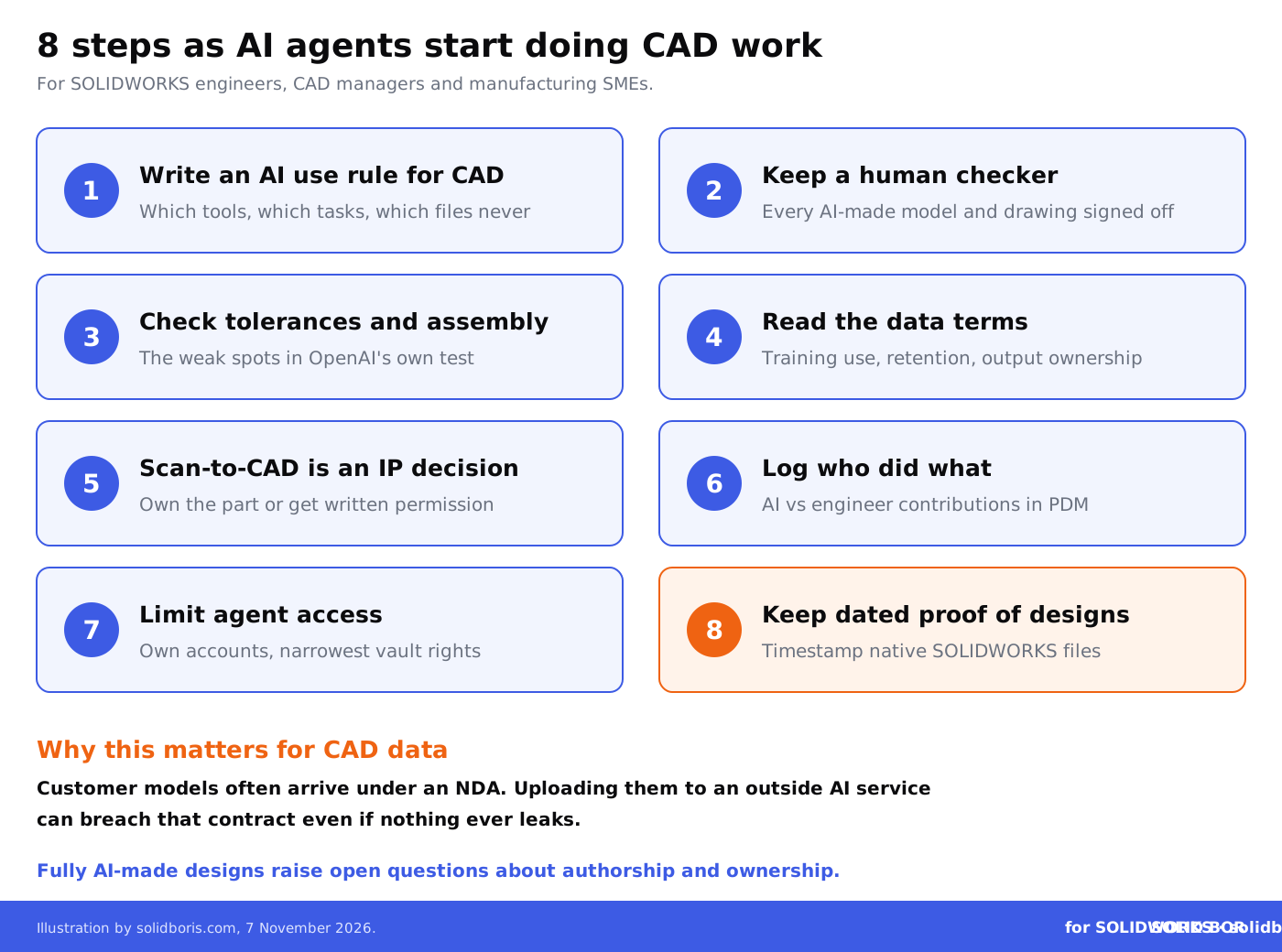
- Write an AI use rule for CAD. State which AI tools engineers may use, for which tasks, and which files may never leave your systems, such as customer models, export-controlled data and unreleased products.
- Keep a human checker on every release. Treat AI-made models, drawings and FEA set-ups like the work of a new hire: checked, signed off and traceable before they reach a supplier or the shop.
- Check tolerances and assembly first. OpenAI's own test shows these are the weak spots. Make fits, tolerances, manufacturing notes and assembly sequences explicit review items.
- Read the data terms before you collaborate. If your company considers OpenAI's invitation or any similar programme, get written terms on training use, retention, confidentiality and who owns outputs.
- Treat scan-to-CAD as an IP decision. Before rebuilding a part from a scan, record who owns it and whether you have permission. Keep that record with the new model.
- Log who did what. Note in PDM or in the file properties which parts of a design came from an AI agent and which from your engineers, so authorship questions have answers later.
- Limit agent access. Give AI agents their own accounts with the narrowest folder and vault rights they need, never a shared engineering login or full PDM access.
- Keep dated proof of key designs. Timestamp native SOLIDWORKS files and released drawings, so you can show what your team had and when, even as AI makes copies easier to produce.
Who owns a design an AI agent created?
OpenAI's test was designed so that no human edited the device design directly. That is a useful experiment, and also a reminder of an open legal question. In the United States and many other countries, copyright has so far required a human author, and works generated entirely by a machine may not be protected at all. Patents need human inventors. Design rights and trade secrets work differently, and contracts often decide who owns what between companies.
For an engineering company, the practical answer is evidence. If you can show which requirements, sketches, decisions and corrections came from your engineers, you are in a much stronger position than if all you have is a final file. Our guides to generative AI and CAD ownership and CAD ownership in employment contracts cover the basics, and our pieces on blockchain timestamping as first-in-time proof and proof of ownership in IP litigation explain what dated records can and cannot prove.
This is general information, not legal advice. If you plan to sell products based on AI-generated designs, ask an IP lawyer about authorship and your contracts.
How does this fit the bigger picture for CAD users?
Across our network this week, the common thread is control over design data as AI tools and partners multiply:
- AI agents and secrets. CADChain reports how Claude Code permission files leaked passwords and keys into public GitHub repositories, a reminder that coding agents working on CAD and PDM tools need the same care with credentials.
- Partners and trade secrets. BORIS Inventor explains a US appeals court ruling that sharing software with a partner under confidentiality did not destroy its trade secret status, which matters whenever you share designs with an outside company.
- AI disclosure for 3D content. Blended BORIS covers the new Nexus Mods AI policy, with mandatory AI disclosure tags and AI training permissions that default to Ask Me.
Conclusion
OpenAI's update is the clearest sign yet that general-purpose AI companies want a place in mechanical design, not just in software. Its own numbers are striking: a device designed in under a week, prototypes in under a month and a 23-fold rise in model use by its hardware teams. Its own caveats are just as important: tolerances, production limits and assembly details still needed people.
For SOLIDWORKS teams, the right response is neither panic nor blind adoption. Set rules for which files AI may see, keep a human checker on everything that gets released, treat scan-to-CAD as an IP decision and keep dated proof of what your engineers create.
Make your SOLIDWORKS designs provably yours in the age of AI agents.
BORIS for SOLIDWORKS adds blockchain timestamps and certificates of ownership to your CAD files from inside SOLIDWORKS, so you keep independent proof of what your team designed and when, whoever or whatever touches the files later.
👉 Get BORIS for SOLIDWORKS
FAQ: OpenAI's engineering update and SOLIDWORKS teams
Does OpenAI's update involve SOLIDWORKS?
Not directly. OpenAI's post of 3 November 2026 does not name the CAD software its teams or partners use. It matters to SOLIDWORKS teams because it describes AI agents doing CAD modelling, drawings, simulation set-up and design reviews.
Did AI really design a device without human help?
OpenAI says GPT-6 Astra designed the device's requirements, enclosure, circuit board and software without direct human edits, and two employees completed it in under a week. It also says the design needed several rounds of review before manufacturing, because the model did not consistently account for production limits, tolerances or assembly details.
What is BenchCAD 2.0?
A test OpenAI cites that checks whether models can reconstruct 3D parts and assemblies and identify connections in circuit boards. OpenAI reports 0.875 for a newer internal model and 0.594 for GPT-6 Astra.
Can we use AI to turn scans of parts into SOLIDWORKS models?
Technically, it is getting easier, and OpenAI is testing exactly this with Chip Ganassi Racing. Legally, it depends on who owns the part and its design. Rebuild your own legacy parts freely, but get written permission before modelling someone else's.
Is it safe to upload customer CAD files to an AI service?
Only if your contract with the customer allows it and the AI provider's terms on training, retention and confidentiality are acceptable. Many NDAs and supply contracts do not allow it. When in doubt, keep customer files inside your own systems.
How does BORIS for SOLIDWORKS help?
It does not check AI output. It gives your SOLIDWORKS files blockchain-timestamped certificates of ownership, so you can prove what your team designed and when, which helps when AI tools, suppliers and scans create more copies of your work.