
AI data brokers are now openly offering design firms money for their old CAD files, and SOLIDWORKS parts and assemblies are on the list. On 9 November 2026, the architecture site Archinect reported that companies are offering "six figures" for CAD archives to train AI models, after a LinkedIn post by USC adjunct professor Simon Ha shared one such offer. A broker comparison site that tracks these buyers names SolidWorks, Inventor and Fusion parts and assemblies, with their features, mates and bills of materials, among the CAD data buyers want.
The offer Ha shared came from Nyne.ai, which describes itself as "the data factory for AI". Its pitch was blunt: "You've got 3 years of CAD files doing nothing. We'll pay you six figures for them." Archinect's story focused on architects, but the same buyers also court engineering firms and manufacturers. One of them has run social media ads aimed at engineering firms, and several list mechanical parts, engineering change orders and CNC programs among the data they take.
For a small manufacturer or design office with ten or twenty years of SOLIDWORKS files on a PDM server, that sounds like found money. But a CAD archive is rarely yours alone. It holds customer drawings, supplier models, work done under NDAs, files from freelancers and, sometimes, export-controlled technical data. Here is what is known about this new market, what is not, and what SOLIDWORKS teams should check before anyone signs anything.
TL;DR: an AI data buyer wants your CAD history, but you can only license what you actually own
Brokers such as Nyne, Troveo, Pewter, Polyshares, Ventra, Mode and micro1 are looking for real design archives to train AI models. Buyer-reported figures start around US$100,000 per company, but no buyer publishes a price list and we found no confirmed closed deal for mechanical CAD. The buyers themselves exclude client-owned, build-to-print, NDA and export-controlled work, which is a large share of what many SOLIDWORKS shops hold. Before you talk to a buyer, sort your archive by ownership, read your customer and supplier contracts, clean the metadata, and decide whether a licence is worth giving up control of your design know-how for good.
What did Archinect report about AI companies buying CAD files?
Archinect's article, written by Niall Patrick Walsh and published on 9 November 2026, starts with Simon Ha's LinkedIn post. Ha, an adjunct professor at the University of Southern California, shared an offer to pay six figures for a firm's CAD files, including revisions and markups, so that AI models can learn how design work gets done. He warned that this raises questions about copyright and about the ownership of what architects call instruments of service, the drawings and models made for a client project.
His most important point applies to every CAD user: "Just because a firm possesses these files doesn't necessarily mean it has the right to sell them for AI training." He added that removing client names does not necessarily solve the problem. Archinect also named other brokers active in the market, including Troveo and AI Data Payout, a site that compares data buyers. A reader comment the next day suggested firms should license only the rights they can actually grant instead of selling outright.
The Archinect report is about architecture, but the brokers it names do not stop there. That is where the story becomes relevant for SOLIDWORKS users.
Why do AI companies want SOLIDWORKS files?
Text and source code were easy for AI labs to collect from the public web. Real engineering design data is not. As AI Data Payout puts it, "A drawing set, a Revit model or a SolidWorks assembly lives on a firm's own server." Public CAD research datasets exist, but they lack the decisions, revisions and context of real product development.
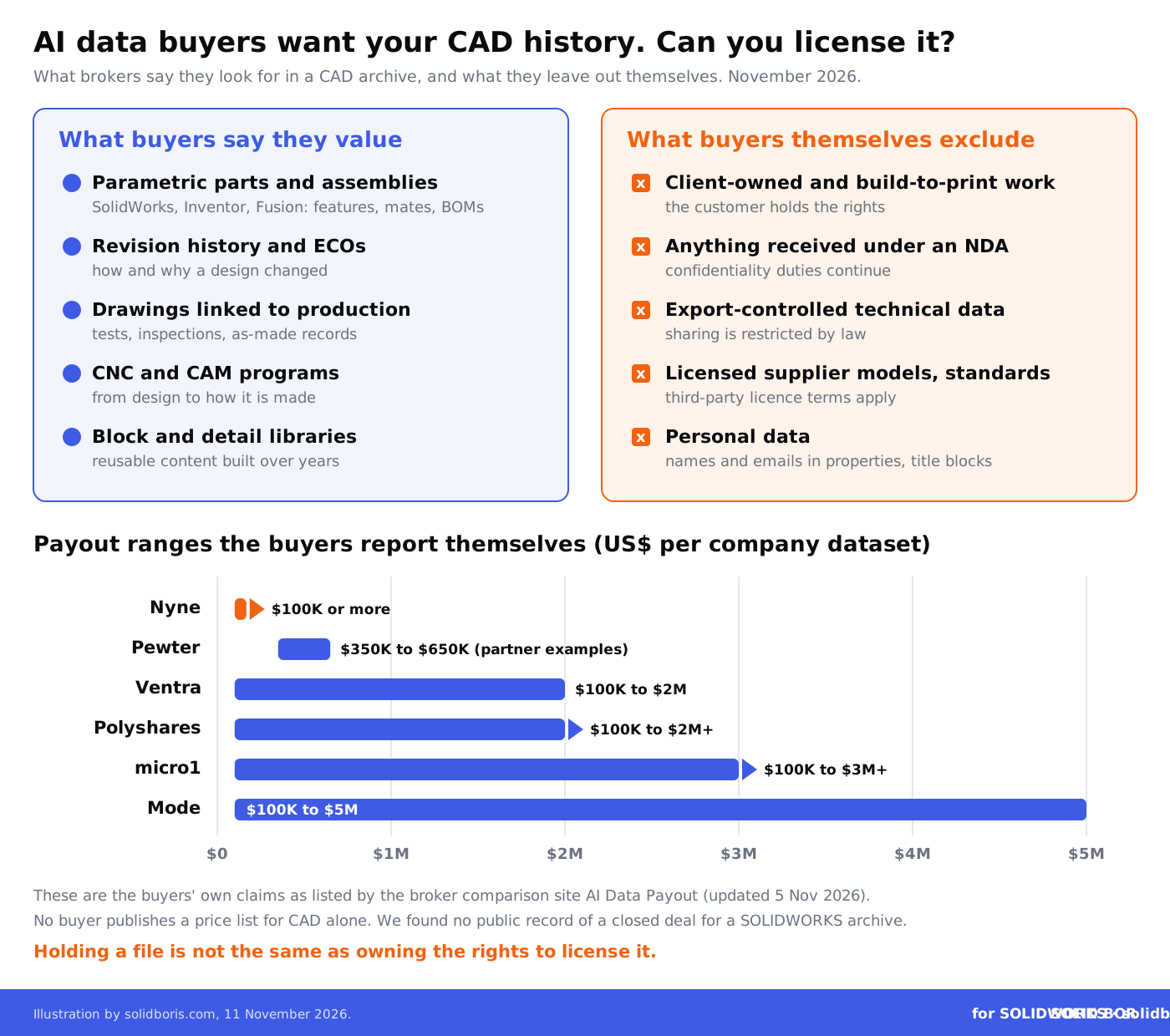
A mature SOLIDWORKS archive has exactly what AI developers are missing. According to the broker listings on AI Data Payout's CAD data page, updated on 5 November 2026, buyers value:
- Parametric parts and assemblies from SolidWorks, Inventor and Fusion, with their features, mates and bills of materials.
- Engineering change orders and revision history, which show how and why a design changed.
- Drawings linked to tests, inspections and production records, so a model can learn what worked.
- CNC and CAM programs, which connect a design to how it is actually made.
- Block and detail libraries, the reusable content a firm has built up over years.
OpenAI said this month that its teams use AI to revise CAD models and prepare manufacturing drawings, and new tests such as the Parametric CAD Bench measure how well AI agents build feature-based models. Training those systems well needs large amounts of real, well-organised engineering data. Your PDM vault is exactly that.
How much are buyers offering for CAD archives?
Less is known here than the headlines suggest. Nyne says payouts start at US$100,000 or more. Other buyers quoted on AI Data Payout give ranges from about US$100,000 into the millions for whole-company datasets, and one buyer's partner examples run from US$350,000 to US$650,000. Troveo, another broker, says typical full-company deals start at six figures but that there is no rate card and a real number needs a scoping call.
All of these figures are the buyers' own claims. No buyer publishes a price for CAD files alone, the buyers do not say which AI labs end up with the data, and we found no public record of a closed deal for a manufacturer's SOLIDWORKS archive. AI Data Payout also says it earns referral fees from the buyers it features, which is worth keeping in mind when reading its rankings. Several buyers set conditions too: some want companies with at least 20 to 50 employees and three or more years in business.
Do you actually own the CAD files in your archive?
For most SOLIDWORKS shops, this is the question that decides everything. Holding a file is not the same as owning the rights to it, and an archive built over years usually mixes several kinds of data. The buyers seem to know this: according to AI Data Payout, one buyer leaves out client-owned, build-to-print and export-controlled work, another excludes data held on behalf of clients, and Troveo's guidance excludes designs clients own, licensed standards, export-controlled technical data and anything received under a confidentiality agreement.
If you are a contract manufacturer or a job shop, much of your archive may be customer data. A build-to-print drawing belongs to the customer who sent it, and the models your team built from it are often covered by the purchase terms or an NDA. As our guide to NDA limits for CAD files explains, those obligations do not always expire when the project ends.
Your own designs are not automatically clean either. Work by freelancers and contractors may still belong to them unless the contract assigned it, a point covered in our articles on CAD ownership in employment contracts and on creator versus owner in CAD projects. Supplier and catalogue models come with their own licence terms, as we noted when TraceParts joined KEYENCE. And courts look closely at what was really copied and from whom, as the Canadian case on SolidWorks models and copied drawings showed.
Which parts of a SOLIDWORKS archive could you license?
Use this table as a first sort of your vault before any conversation with a buyer. It is a starting point, not legal advice: your contracts decide.
Know which designs are yours before anyone asks to buy them.
BORIS for SOLIDWORKS registers your CAD files with a blockchain timestamp and a certificate of ownership from inside SOLIDWORKS, so you have a dated record of what your team created and when.
👉 Get BORIS for SOLIDWORKS
What do you give up when your CAD files train an AI model?
The payment is easy to see; the cost is not. Your archive holds the design rules, tolerances, material choices and assembly methods your team learned through years of work, and once they are in someone else's training data, you cannot take them back.
- Trade secret protection. Know-how is protected as a trade secret only while you take reasonable steps to keep it secret. Handing a full archive to a third party, even under contract, weakens that position if the contract is loose. Our guides to trade secret protection for CAD files and to what you must prove when design data walks out explain why.
- Exclusivity and duration. According to AI Data Payout, one buyer makes its deals exclusive by default, with no end date. That can stop you from licensing the same archive again, or from using it in your own AI projects.
- Resale and sublicensing. Some buyers collect data to resell it. Ask who ends up with a copy and whether you will be told which AI labs receive it.
- Output close to your designs. A model trained on your files may later produce designs that resemble yours, possibly for your competitors. Ask whether the licence covers that.
- Personal data. SOLIDWORKS file properties, PDM data cards and drawing title blocks often carry employee names, emails and customer contacts. In Europe, that is personal data under the GDPR.
This is also why the terms of the AI tools you already use matter. When Dassault revealed SOLIDWORKS 2027, it said its AI was not trained on customer data. Other tools are less careful: our report on the MecAgent add-in's terms showed how an AI add-in can collect open CAD files. Selling an archive is the deliberate version of the same trade.
What should SOLIDWORKS teams do before talking to an AI data buyer?
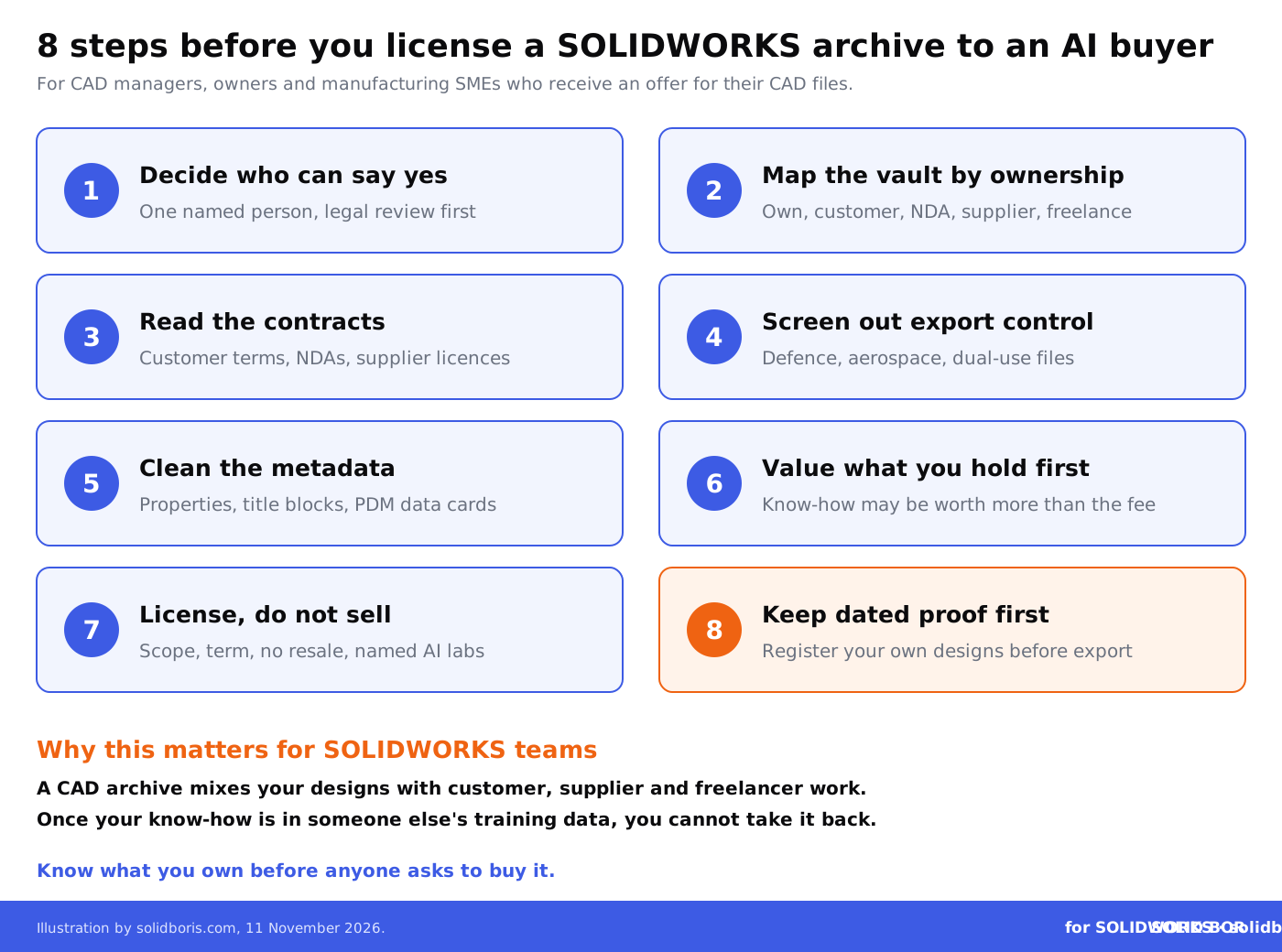
- Decide who can say yes. Nobody should export CAD data to a buyer without approval from management and, ideally, a lawyer. Make sure engineers know that an unsolicited offer goes to one named person.
- Map your archive by ownership. Split the vault into your own designs, customer work, NDA projects, supplier content, freelancer work and export-controlled data. PDM folders, customer properties and project numbers make this faster.
- Read the contracts. Check customer terms, NDAs, supplier licences and employment and contractor agreements for clauses on ownership, confidentiality and use for other purposes.
- Screen out export-controlled data. Defence, aerospace and dual-use files need a separate check. Our article on export controls for CAD files covers what counts.
- Clean the metadata. Remove names, emails, customer names, part numbers and addresses from file properties, custom properties, title blocks and PDM data cards.
- Value what you hold first. A one-off payment may be worth less than the know-how it gives away. Our guide to CAD asset valuation shows how to think about it.
- Negotiate a licence, not a sale. Ask for a defined scope, a fixed term, no exclusivity or a short one, no resale, the names of the receiving AI labs, deletion at the end and a clear rule on outputs. Our CAD licensing best practices list more clauses.
- Keep dated proof of what you created. Before any data leaves, register the designs you own, so you can later show they were yours if similar models appear elsewhere.
How does this fit the bigger picture for engineering data?
Across our network this week, the same question comes up again and again: who controls the data that AI systems learn from?
- AI tools and insiders. CADChain reports on a lawsuit claiming an analyst used AI coding assistants to distil a trading firm's research and code, which the analyst's lawyer calls without merit.
- Business contacts. BORIS Inventor looks at Nvidia's board investigation into reports about a foreign intelligence effort and what it means for engineering teams' contact points.
- Platform rules for AI. Blended BORIS covers ArtStation's new AI declarations and filters, where artists now label generative AI work and can hide it.
Conclusion
AI companies have worked out that real engineering knowledge sits in private CAD archives, and brokers are now knocking on doors with six-figure offers. For some firms, licensing truly owned, cleaned and non-sensitive data may be a fair deal. For many SOLIDWORKS shops, much of the archive belongs partly to customers, suppliers or freelancers, or holds know-how worth more than the payment.
The useful step this month is the same either way: know what you own. Sort the vault by ownership, read your contracts, clean your metadata and keep dated proof of your own designs. Then you can answer any buyer, or any dispute, from a position of strength.
Prove what your team designed, whatever happens to your CAD data.
BORIS for SOLIDWORKS adds blockchain timestamps and certificates of ownership to your CAD files from inside SOLIDWORKS, so you can show which designs are yours and when they were created.
👉 Get BORIS for SOLIDWORKS
FAQ: selling SOLIDWORKS CAD files for AI training
Are AI companies really buying CAD files?
Data brokers say they are. Archinect reported on 9 November 2026 that firms are being offered six figures for CAD archives, and several brokers list CAD files, including SolidWorks parts and assemblies, among the data they collect for AI developers. We found no public record of a closed deal for a manufacturer's SOLIDWORKS archive.
How much can a company get for its CAD archive?
Buyers report ranges starting around US$100,000 per company and going into the millions, but these are their own claims. No buyer publishes a price list, and Troveo says a real number needs a scoping call.
Can I sell CAD files I made for a customer?
Usually not without the customer's written agreement. Build-to-print files and work done under an NDA are typically excluded by the buyers themselves. Your contracts decide, so check them with a lawyer.
Does removing customer names make the data safe to sell?
Not necessarily. As Simon Ha pointed out, removing client names does not settle who owns the files. Anonymising helps with personal data, but it does not create rights you do not have.
Is it legal to share export-controlled CAD files with an AI data buyer?
Export-controlled technical data is restricted by law, and the buyers we looked at exclude it. Keep those files out and get export control advice if you are unsure.
Does SOLIDWORKS train its AI on my files?
When it revealed SOLIDWORKS 2027, Dassault Systemes said its AI was not trained on customer data. Third-party add-ins and AI tools have their own terms, so read them before installing.
How does BORIS for SOLIDWORKS help?
BORIS does not sell or license data. It registers your SOLIDWORKS files with blockchain timestamps and certificates of ownership, so you have dated proof of which designs your team created, useful in licensing talks and in disputes.